




Static stretching causes strength gains
Static stretching programs can cause surprisingly large gains in maximum strength. This has been taken to indicate that they cause increases in muscle fiber cross-sectional area, since an increase in muscle fiber cross-sectional area clearly contributes to an increase in muscle force. But is this a necessary assumption?
.
#1. Static stretching programs often (but not always) cause strength gains
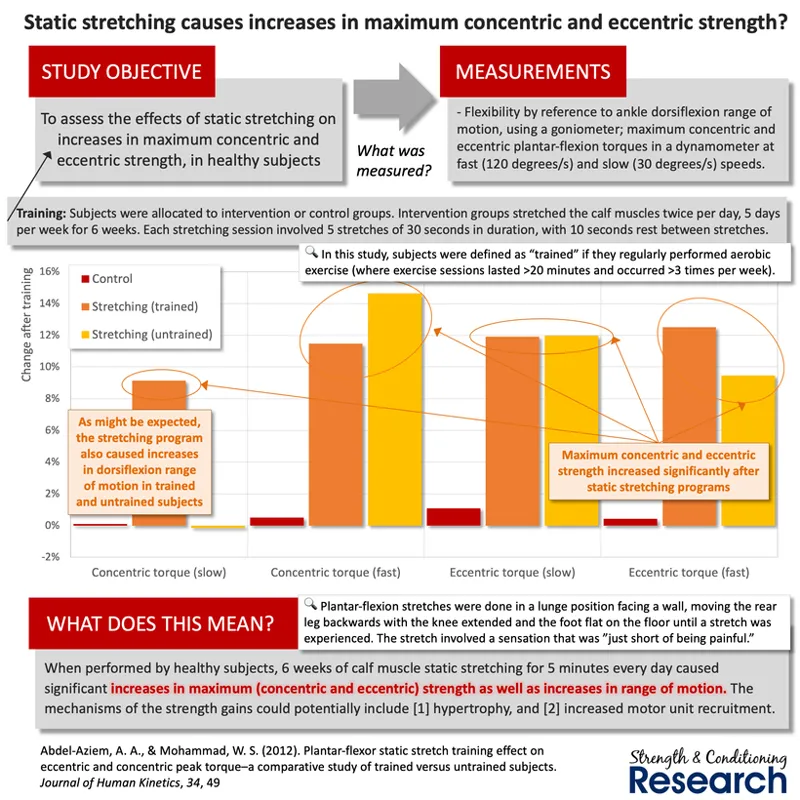
Starting at the beginning, we can confirm that static stretching does cause an increase in both eccentric and concentric strength. Importantly, we also see a tendency for static stretching programs to display some specificity in the strength gains. They increase eccentric strength and fast concentric strength to a greater extent than slow concentric strength.
.
While eccentric-only training obviously also increases eccentric strength more than concentric strength, it similarly displays greater gains in fast concentric strength in comparison with concentric-only training.
.
This is not an isolated finding and several studies have reported the same tendency for eccentric-only training to enhance high-velocity concentric force to a greater extent. This suggests that both static stretching and eccentric-only training cause a similar adaptation that enhances high-velocity concentric force more than concentric-only training. Clearly, this adaptation could well be the addition of more sarcomeres in series.
.
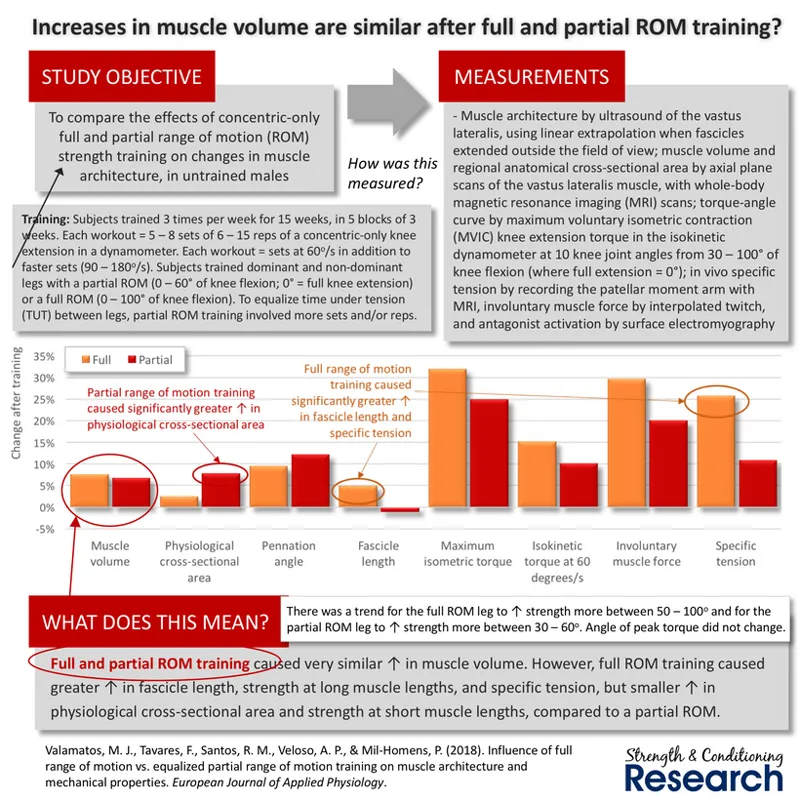
Similarly, static stretching preferentially increases strength at long muscle lengths, in exactly the same way as eccentric-only training due to the change in the angle of peak torque. This change in the angle of peak torque is a well-established indicator of sarcomerogenesis.
.
#2. Static stretching programs often (but not always) increase muscle size
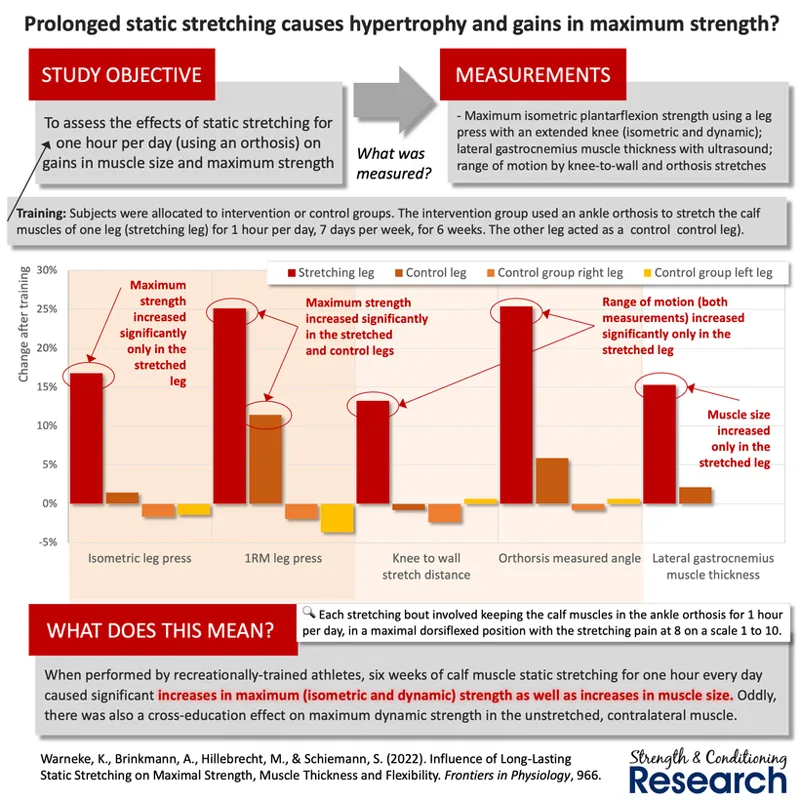
We can also confirm that static stretching does cause an increase in muscle size, albeit this was historically discounted. Most modern studies do in fact report muscle growth occurring,
.
#3. Static stretching programs often (but not always) increase fascicle lengths
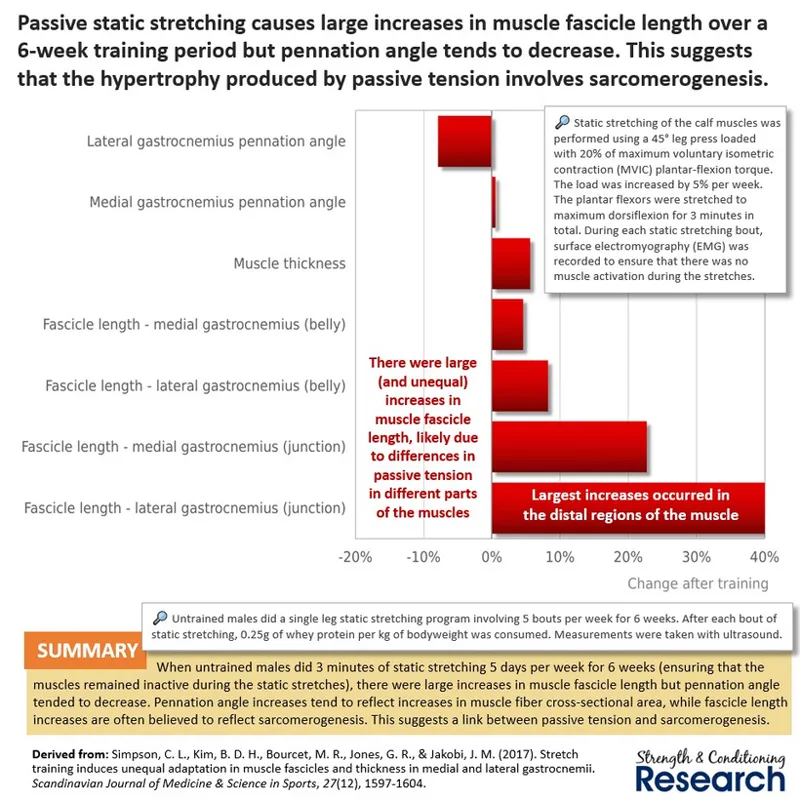
Yet, when studies measure muscle fascicle length changes, the majority (if not the entirety) of the muscle mass increases that are produced by static stretching programs can be attributed to the addition of muscle fascicle length.
.
Although it is often denied that this muscle fascicle length increase reflects an increase in sarcomeres in series in humans, recent research has confirmed that it does.
.
#4. Fascicle length increases contribute to strength gains
Some commentators have argued that an increase in sarcomeres in series cannot contribute to the strength gains observed after static stretching programs. Yet, this fails to understand that sarcomeres do not transmit forces longitudinally but rather laterally and therefore the addition of sarcomeres in series functions exactly the same way as the addition of myofibrils in parallel for increases in maximum strength. Indeed, this is why increases in specific tension seem to be greater after full range of motion training that increases muscle fascicle length (because specific tension is measured relative to cross-sectional area).
.
#5. Static stretching programs cause a cross-education strength gain effect
Even so, we can see that static stretching does not just increase maximum strength by increasing muscle size because there is a cross-over effect from the trained leg to the untrained leg. This indicates that there must be a bilateral increase in a neural adaptation (which cannot be coordination and therefore must be motor unit recruitment levels).
.
Conclusions
Static stretching programs can cause surprisingly large gains in maximum strength. Some commentators have argued that this also demonstrates that static stretch stimulates increases in muscle fiber cross-sectional area. Yet, static stretching could easily cause gains in maximum strength by way of both [1] an increase in sarcomeres in series, and [2] an increase in motor unit recruitment levels. Firstly, static stretching is known to produce large increases in fascicle length in humans and this adaptation can easily explain the gains in muscle size that occur (recent research has confirmed that increases in fascicle length reflect sarcomerogenesis in humans). Adding sarcomeres in series can contribute to strength gains since sarcomeres do not transmit force longitudinally but rather laterally. Thus, the addition of sarcomeres in series increases strength in exactly the same way as an increase in myofibrils in parallel. Assuming that static stretching causes increases in muscle size by sarcomerogenesis then allows us to explain why the strength gains caused by static stretching are greater when measured during eccentric contractions, in high-velocity concentric contractions, and at long muscle lengths (in contrast, increases in muscle fiber cross-sectional area would be expected to increase strength more in slow concentric contractions and at moderate muscle lengths). Secondly, static stretching has recently been found to cause a cross-over effect regarding strength gains whereby even the unstretched muscle increases force producing capacity. This can be most easily explained by an increase in stretch tolerance transferring to an increase in maximum tolerable perception of effort and thereby a corresponding increase in the ability to recruit motor units.
Comments (4)
Hey Chris what would cause the increase in fast concentric opposed to slow if the residual force enhancement effect decreases with the addition of sarcomeres in series?
Reductions in the residual force enhancement effect will primarily reduce the SSC effect during heavy load strength training movements when the tendon remains stiff and the muscle is doing most of the stretch and recoil. During fast movements, the muscle behaves a bit more quasi-isometrically and therefore it is the stretch and recoil of the tendon that contributes to the SSC effect.
The effect on maximum tolerable perception of effort is very interesting. Do you think increasing stretch tolerance in several muscle groups could maximize this effect? Could this be a way to overcome voluntary activation deficits?
Yes, very possibly