





Changes in angle of peak torque
Isometric strength can be measured at a range of angles in our joint angle range of motion. Measuring isometric strength at multiple angles allows us to calculate the joint angle at which we are strongest. This is called the "angle of peak torque" in the torque-angle curve. Various factors can contribute to strength being different at each joint angle, including [1] differences in the level of motor unit recruitment achievable, [2] differences in the internal moment arm length of the muscle, and [3] the length-tension relationship of the muscle fibers. Importantly, strength training can alter the angle of peak torque, but the exact changes depend upon the type of training that is performed.
.
#1. Concentric-only strength training produces joint angle-specific strength gains but does not alter the angle of peak torque
Concentric-only strength training with a full ROM causes strength gains to occur at almost all muscle lengths (except the shortest muscle length), while concentric-only strength training with a partial ROM causes strength gains to occur at only short muscle lengths. Neither full nor partial ROM concentric-only strength training alter the angle of peak torque, however.
.
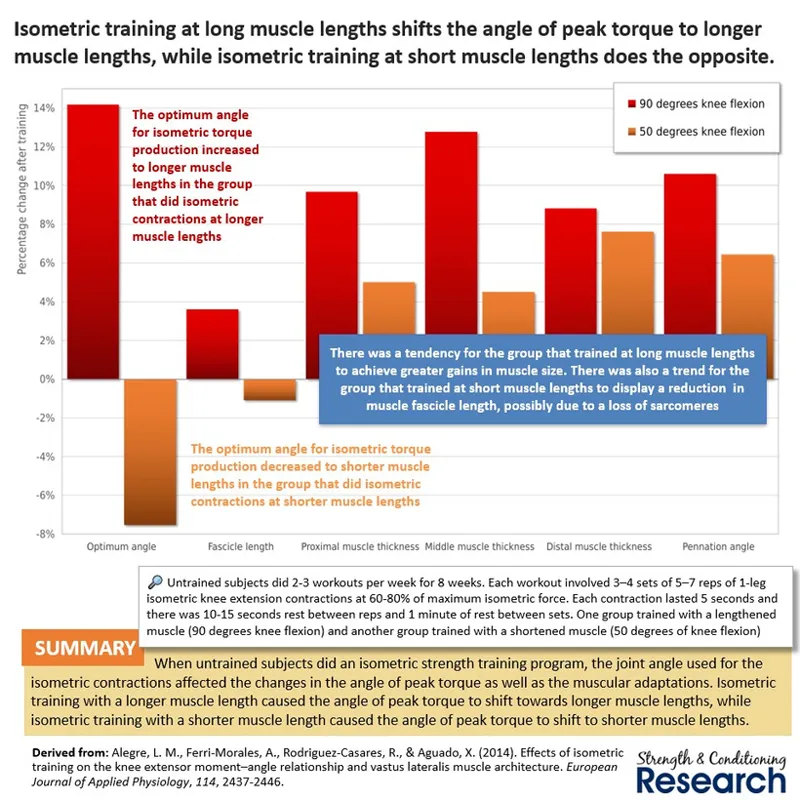
#2. Isometric strength training shifts the torque-angle curve but the exact effects depend on the muscle length used in training
Isometric strength training with a lengthened partial ROM causes the angle of peak torque to shift towards longer muscle lengths. In contrast, dynamic strength training with a shortened partial ROM causes the angle of peak torque to shift towards shorter muscle lengths.
.
#3. Conventional dynamic strength training with a partial ROM shifts the torque-angle curve but the exact effects depend on the muscle lengths used in training
Dynamic strength training with a lengthened partial ROM causes the angle of peak torque to shift towards longer muscle lengths. Conversely, dynamic strength training with a shortened partial ROM causes the angle of peak torque to shift towards shorter muscle lengths.
.
#4. Eccentric strength training shifts the torque-angle curve towards longer lengths
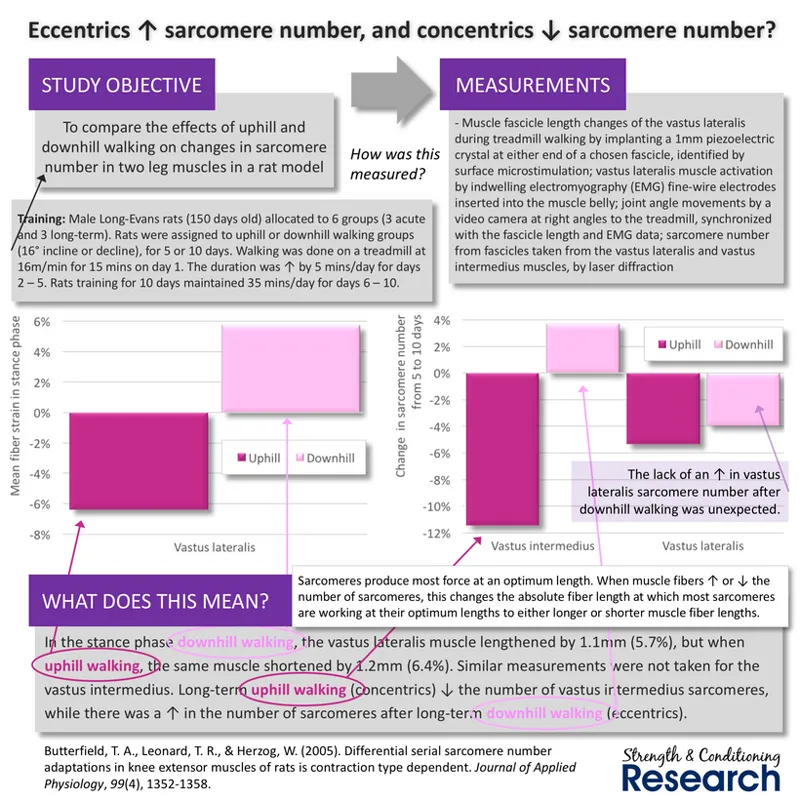
Eccentric-only strength training causes the angle of peak torque to shift towards longer muscle lengths. Logically, this would occur if the length-tension relationship was shifted by the addition of sarcomeres in series. When adding sarcomeres in series, the position of the plateau is moved towards longer muscle fiber lengths because each sarcomere sits at a shorter resting length when the muscle fiber is shortened, and similarly reaches a shorter maximum length when the muscle fiber is fully lengthened.
.
#5. Passive mechanical tension determines sarcomere addition
Importantly, there is data showing that eccentric contractions cause sarcomeres to be added while concentric contractions cause sarcomeres to be lost. This addition or subtraction of sarcomeres due to various types of strength training is likely caused by the presence or absence of passive mechanical tension. The presence or absence of passive mechanical tension can thus likely explain the way in which the angle of peak torque is altered after different types of strength training.
.
The findings regarding eccentric and concentric contractions fit with the much older data showing that passive mechanical tension provided by limb immobilization at long muscle lengths causes the addition of sarcomeres, while the absence of passive mechanical tension at short muscle lengths causes the loss of sarcomeres. Moreover, these changes in sarcomere number have a very clear effect on the length-tension relationships of the immobilized muscle fibers.
.
Moreover, when static stretching increases in maximum strength in humans, the strength gains only occur at long muscle lengths. This would naturally occur if an increase in sarcomeres in series had occurred leading to a shift in the angle of peak torque after training.
.
Conclusions
Isometric strength can be measured at a range of angles over the whole joint angle range of motion. Measuring isometric strength at multiple angles allows us to calculate the joint angle at which we are strongest. This joint angle is called the "angle of peak torque" in the torque-angle curve. Various factors can theoretically contribute to strength being different at each joint angle, including [1] differences in the level of motor unit recruitment achievable, [2] changes in the internal moment arm length of the muscle, and [3] the length-tension relationship of the muscle fibers. Strength training can change the angle of peak torque. The exact changes depend upon the muscle lengths over which training is performed. Isometric training and normal strength training both shift the angle of peak torque towards the joint angle or joint angles used in training. Training at a long muscle length shifts the angle of peak torque to occur at longer muscle lengths, while training with a short muscle length shifts the angle of peak torque to occur at shorter muscle lengths. Eccentric-only training seems always to shift the angle of peak torque to occur at longer muscle lengths. Oddly, concentric-only training does not produce any changes in the angle of peak torque despite also causing some joint angle-specific strength gains. It seems unlikely that changes in internal moment arm are responsible for these alterations. Therefore, it is most probable that [1] joint angle-specific increases in motor unit recruitment, and/or [2] alterations in the length-tension relationship (owing to either the addition or the subtraction of sarcomeres in series) are responsible.
Comments (1)
It makes sense. If athletes do half squats, and as they get stronger and can increase the resistance weight or reps per set, then they can also increase the range of motion (with the same working weight) and squat at least a little deeper even with fewer reps per set, this will be progress. The same thing will happen if they do partial handstand push-ups, and using such ROM progression overload some day athletes can achieve full range of motion handstand push-ups. Also, if beginners cannot perform a single full pull-up and train using eccentric pull-ups, then a plateau occurs quite quickly when the athlete can maintain a static position somewhere at half the amplitude, and then, after practicing for a while, they will have to learn to maintain a static position as close to the bar as possible, as well as add partial pull up to start working out that dead zone. Of course, gradually add weight to the vest until it can hold the top position with its own weight also will work fine. Right? What do you think?