





Exercise order
Exercise order in a strength training workout is a very important training variable that affects hypertrophy. Here is why.
.
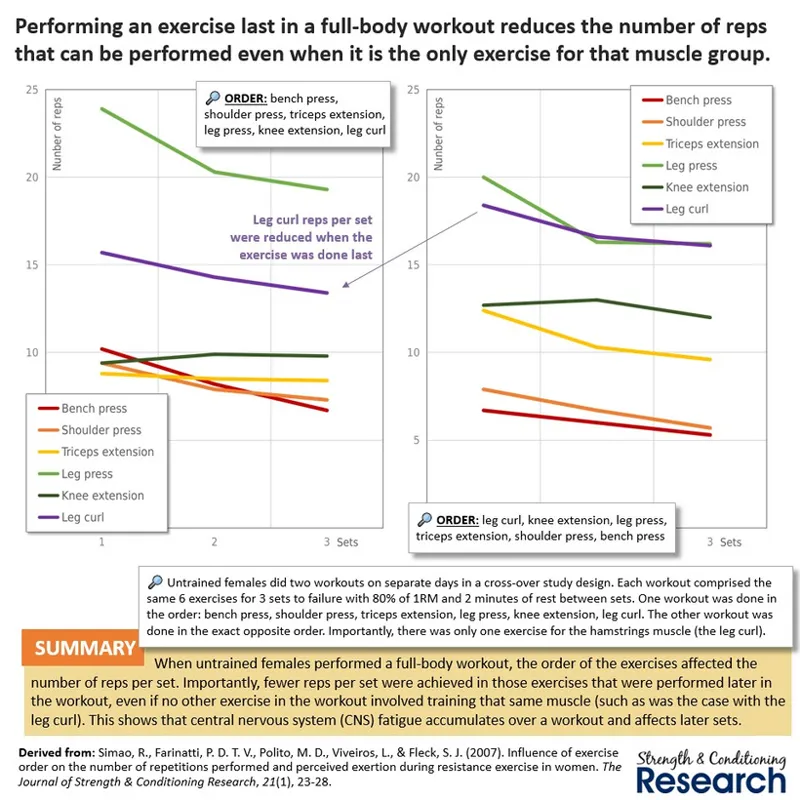
#1. Exercise order affects the number of reps we can perform in successive sets of a strength training workout
It is possible to perform more reps per set when an exercise is performed earlier in a workout compared to when the same exercise is done later in a workout. Importantly, this happens even when the same muscle group is not trained by any exercise earlier in the same workout.
.
#2. The number of reps that we can perform in successive sets of a strength training workout is affected by supraspinal CNS fatigue
The number of reps per set that we can achieve is known to be affected by the level of fatigue that we are experiencing. There are many fatigue mechanisms but only one mechanism has the ability to affect all muscle groups even when only one muscle group has been trained, which is supraspinal CNS fatigue. Supraspinal CNS fatigue is known to accumulate gradually over the course of a strength training workout, increasing from set to set.
.
Also, it is known that this supraspinal CNS fatigue occurs in a muscle during a workout even when that muscle has not exercised previously, as shown by fatigue cross-over effects between limbs.
.
Indeed, many studies have reported cross-over effects of CNS fatigue from one limb to the other.
.
#3. Supraspinal CNS fatigue builds over time during exercise due to the production of inflammatory mediators
Supraspinal CNS fatigue builds over time during exercise as muscles produce inflammatory cytokines that can be detected by the brain. The brain detects these signals by means of two different pathways: [1] afferent signals from the muscle, and [2] at the circumventricular organs of the brain through the bloodstream. When the brain detects these inflammatory signaling mediators, it produces sensations of fatigue.
.
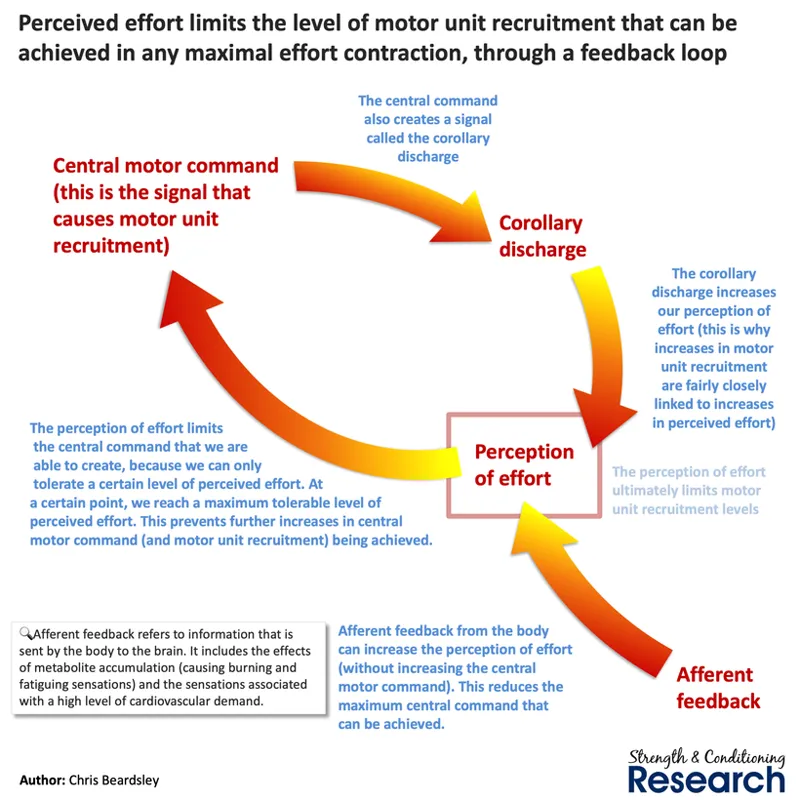
Upon detecting these signals, the brain increases our perception of effort in the sensory part of the brain, which then reduces the available space for the copy signal of the central motor command. This then means that we cannot achieve our customary maximum levels of central motor command or motor unit recruitment at task failure, which then reduces hypertrophy.
.
#4. Hypertrophy is affected by exercise order
Consequently, we can see that when strength training exercises are performed later in a workout, they very often cause reduced hypertrophy in the targeted muscle group.
.
Obviously, the differences in hypertrophy are accompanied by similar differences in the gains in strength of the trained exercises, allowing us to track the effect by progressive overload.
.
Conclusions
Exercise order affects the amount of hypertrophy that is produced by any given exercise. Exercises that are done at the beginning of a workout stimulate much more hypertrophy than exercises that are done at the end of the same workout, even when each exercise targets a totally different muscle group (as is common for full-body workouts). To understand why this happens, we must study fatigue mechanisms. Firstly, it is evident that the number of reps that can be performed per set reduces when an exercise is done later in a workout rather than earlier. This must be the result of supraspinal central nervous system (CNS) fatigue because it is the only fatigue mechanism that can cross over from one part of the body to another. Secondly, we can see that supraspinal CNS fatigue does accumulate over the course of a workout, increasing from set to set. This appears to result from the production of inflammatory cytokines by the contracting muscles, which are then detected by the brain either by afferent signals from the muscles or in the bloodstream. When the brain produces an increase in effort perception after detecting these signals, this reduces the available perception of effort for the central motor command, thereby reducing the maximum central motor command for a given level of perceived effort. Consequently, at maximum tolerable perception of effort, we achieve a lower level of central motor command, produce less motor unit recruitment, activate fewer muscle fibers, and ultimately stimulate less hypertrophy.
Comments (4)
It would be good to study if then training more days with fewer exercises in each session could be more interesting, or if, on the contrary, going more days would also increase CNS fatigue, thus generating the same effect (even if they are days with less volume)
may be personal preference. I know for me the last time I tried to lift two days in a row, even with different muscle groups, I lost two reps on my presses. (I did pull day then a push day to try to go to more frequent shorter workouts instead of less frequent long ones. now I'm back to upper lower alternating MWF).
What would then be a practical way to ensure that supraspinal CNS fatigue does not affect hypertrophy? Have small sessions of workouts throughout the day? Have minimal volumes of each muscle grp for example only 2 sets in each workout?
Since exercise order matters let’s say on a day where you’re working chest and delts would it be better to alternate between contracted exercises or do all of chest then move to delts?