


Plateaus during strength training
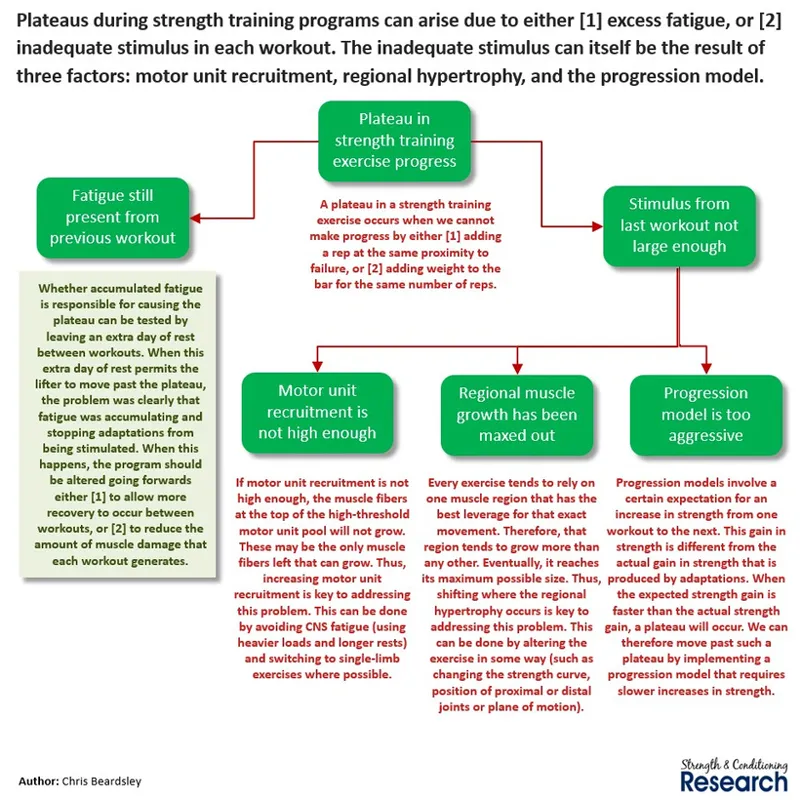
During a strength training program, lifters can reach a plateau on an exercise. A plateau occurs when a lifter is unable to increase either [1] the number of reps per set (with the same weight and proximity to failure), or [2] the weight on the bar (with the same reps and proximity to failure) despite repeated attempts over multiple workouts. Here, we discuss why such plateaus occur in physiological terms and what we must do to move past them.
.
#1. Why do plateaus happen?
Plateaus can happen either [1] because fatigue has accumulated, suppresses strength, and also prevents us from making further adaptations, or [2] because the stimulus that we are currently creating with each of our workouts is inadequate to produce the necessary strength gains in the context of our current progression model. We can further identify that the stimulus may be insufficient because [1] motor unit recruitment is not high enough, [2] regional muscle growth has maxed out, or [3] our current progression model is demanding a strength gain greater than the actual strength gain caused by the workout program.
.
#2. Why do motor unit recruitment levels matter?
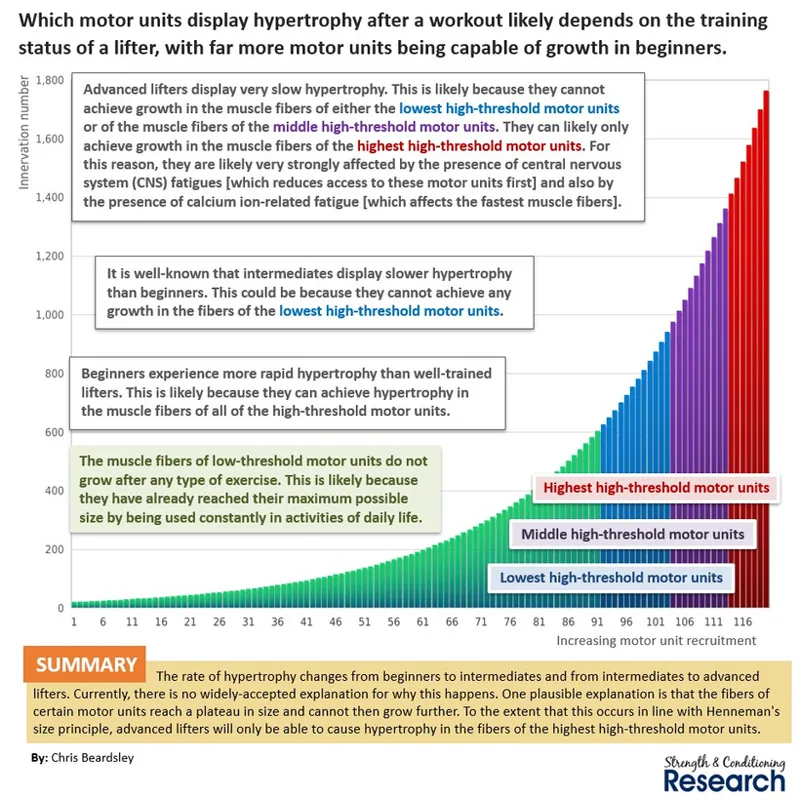
Motor unit recruitment levels determine which muscle fibers we can access. This is important if we have already achieved a large amount of hypertrophy and caused many muscle fibers to reach their own individual plateaus in size. The only remaining muscle fibers capable of growth will be those at the very top of the high-threshold motor unit pool.
.
We can increase motor unit recruitment by a variety of training techniques (read more).
.
#3. Why does regional muscle growth matter?
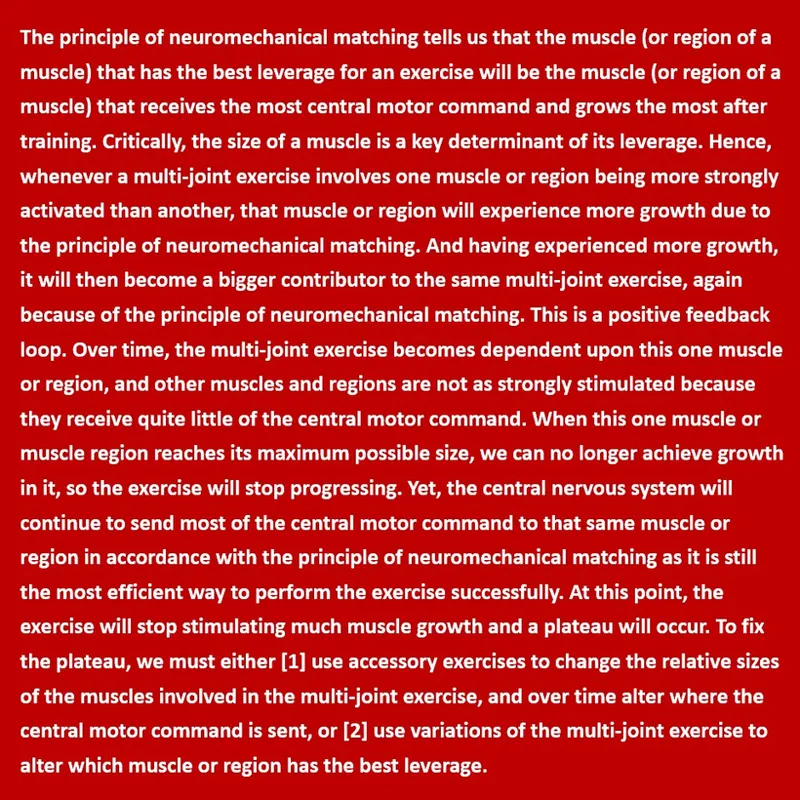
Plateaus can occur because of the way in which the principle of neuromechanical matching works during strength training programs to produce regional muscle growth (read more).
.
#4. Why does progression model matter?
Progression models inherently assume a certain strength gain will occur in order for the programmed number of reps to be increased or for the programmed amount of weight to be increased. For example, when training with a single set to failure, the smallest strength gain that is expected is an increase in one rep for that set or a small amount of weight. We can define this as the demanded strength gain. However, this may not reflect the actual strength gain that is occurring due to the adaptations that are being produced in the body. We can define this as the supplied strength gain. When the demanded strength gain due to the progression model exceeds the supplied strength gain created by the underlying adaptations, a plateau will necessarily occur. Yet, we could move through that plateau by switching to a progression model that allows a slower rate of strength gains to meet its demands.
.
Conclusions
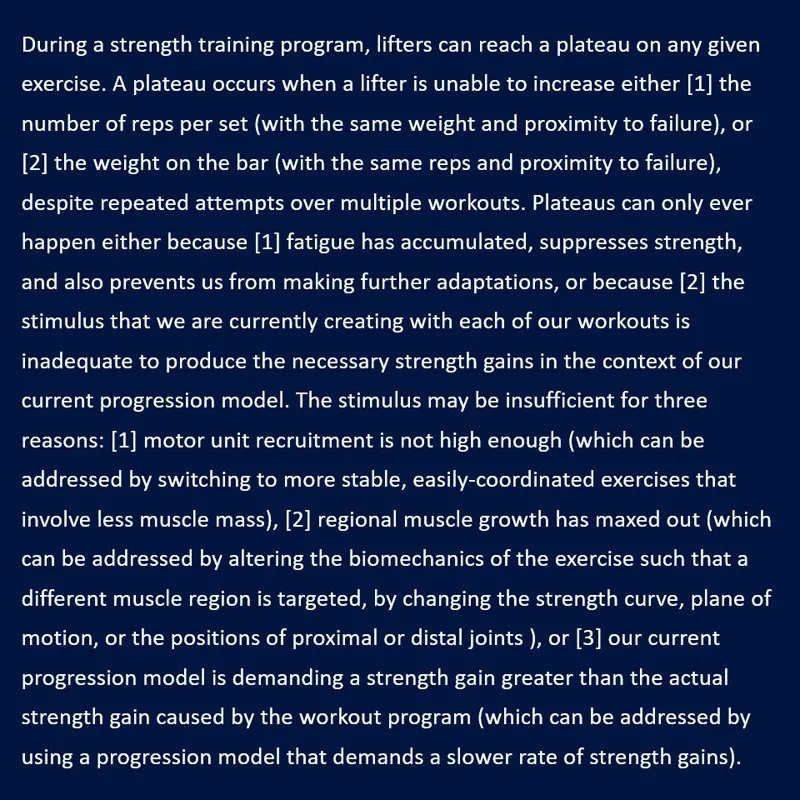
During a strength training program, lifters can reach a plateau on any given exercise. A plateau occurs when a lifter is unable to increase either [1] the number of reps per set (with the same weight and proximity to failure), or [2] the weight on the bar (with the same reps and proximity to failure), despite repeated attempts over multiple workouts. Plateaus can only ever happen either because [1] fatigue has accumulated, suppresses strength, and also prevents us from making further adaptations, or because [2] the stimulus that we are currently creating with each of our workouts is inadequate to produce the necessary strength gains in the context of our current progression model. The stimulus may be insufficient for three reasons: [1] motor unit recruitment is not high enough (which can be addressed by switching to more stable, easily-coordinated exercises that involve less muscle mass), [2] regional muscle growth has maxed out (which can be addressed by altering the biomechanics of the exercise such that a different muscle region is targeted, by changing the strength curve, plane of motion, or the positions of proximal or distal joints ), or [3] our current progression model is demanding a strength gain greater than the actual strength gain caused by the workout program (which can be addressed by using a progression model that demands a slower rate of strength gains).

Comments (1)
would an example of modifying progression models to match actual progression be: adding 1 rep every other x amount of sessions? or does it have to be via micro loading?