




Training status and recovery
Often, the denizens of the fitness industry will state that trained people recover much faster after a workout "because of the repeated bout effect" and this betrays a misunderstanding of the nature of fatigue mechanisms in general and the repeated bout effect in particular.
.
#1. What is the repeated bout effect?
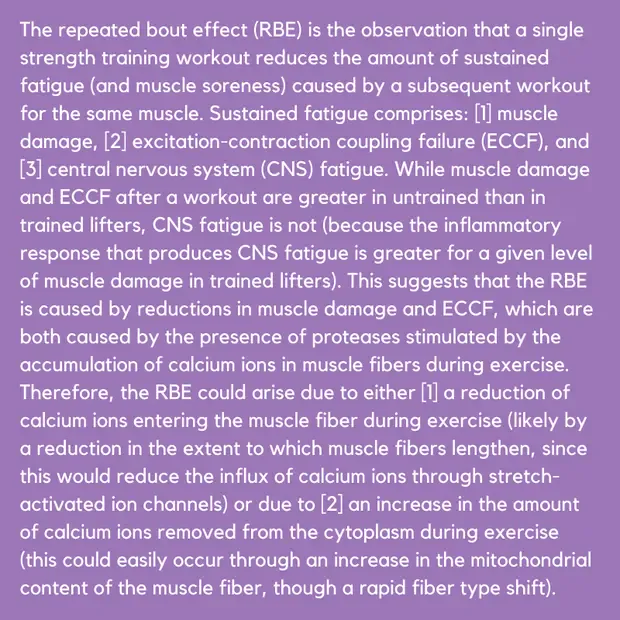
The repeated bout effect is the observation that post-workout fatigue is substantially reduced after a second workout compared to after a first workout. It does not refer to changes in post-workout fatigue that occur from the second workout to the third workout and thereafter. Consequently, it is completely irrelevant for discussing the differences between untrained and trained lifters, as soon as the untrained lifters have completed one single workout (read more).
.
#2. What is the multiple repeated bout effect?
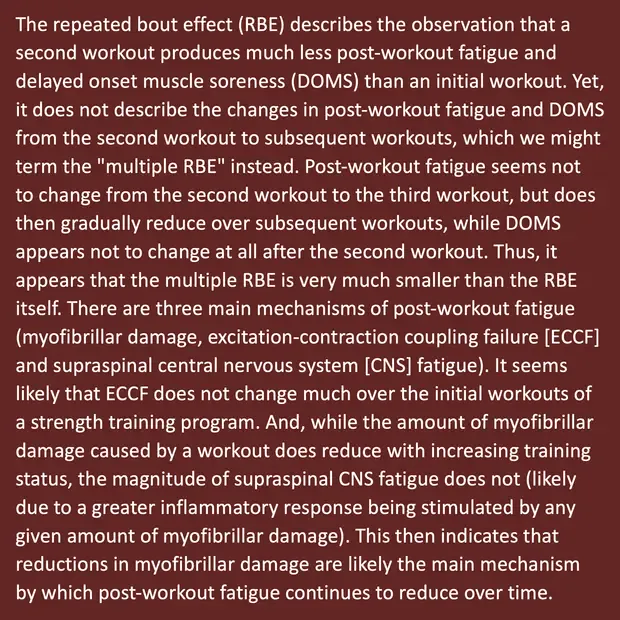
The multiple repeated bout effect is the observation that post-workout fatigue is substantially reduced after a second workout compared to after a first workout. Subsequently, post-workout fatigue displays tiny reductions from workouts two to three, three to four, and so on (read more).
.
Indeed, in comparison with the changes from workout one to workout two, it is important to note that the changes in post-workout fatigue from workouts two onwards are extremely small. In many studies, no changes are even apparent. Therefore, the difference in recoverability between trained and untrained lifters appears to be somewhat overstated.
.
#3. How different is the recovery between trained and untrained lifters?
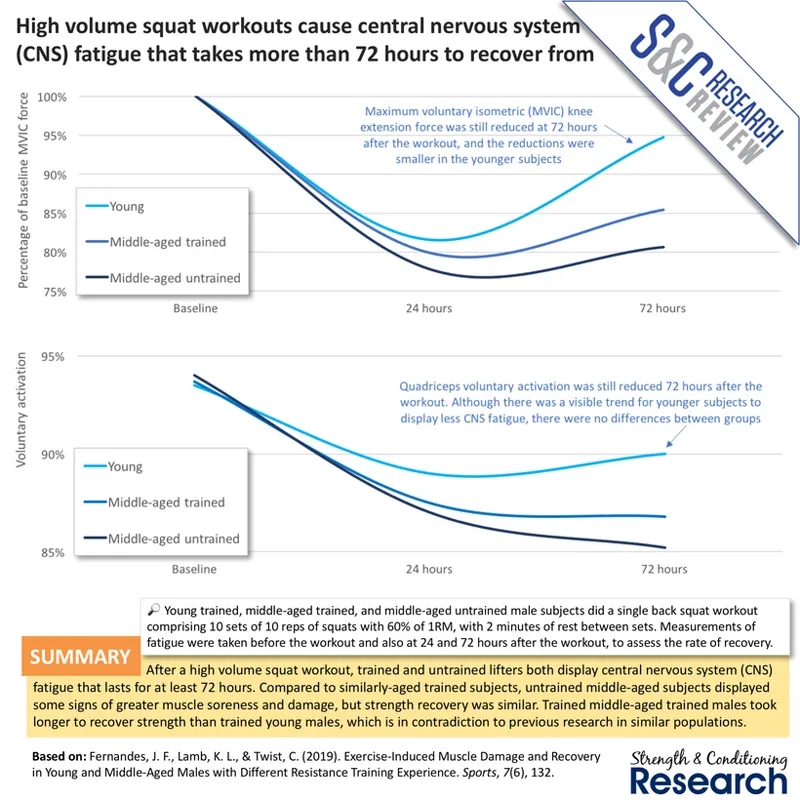
Even though it is widely believed that trained lifters recover more quickly than untrained lifters, the differences are larger between younger and older lifters than between trained and untrained lifters of a similar age. Indeed, in this recent study, there was no difference in either post-workout fatigue overall or post-workout central nervous system (CNS) fatigue between trained and untrained lifters.
.
#4. Why might post-workout fatigue be increased in trained lifters?
Even though the repeated bout effect and multiple repeated bout effect can clearly reduce the amount of post-workout fatigue in trained lifters, there are two key factors that can work in the opposite direction and increase the amount of post-workout fatigue. Firstly, as lifters increase their training status, they display increases in the ability to recruit motor units. This increase in the ability to recruit motor units occurs mostly from untrained to intermediate levels but likely also occurs from intermediate to advanced lifters as well, albeit to a much smaller degree.
.
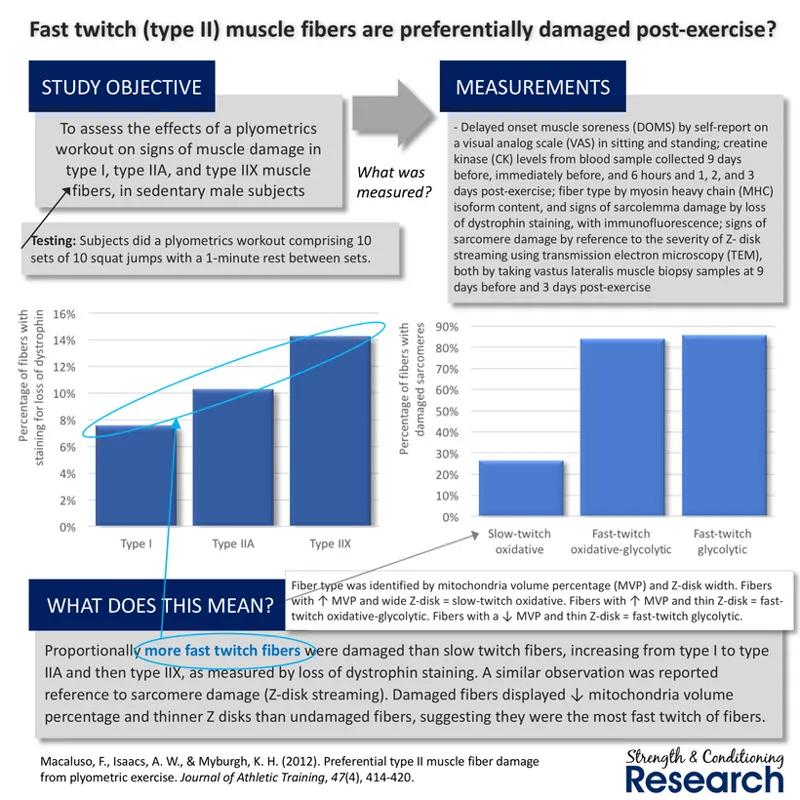
By increasing their ability to recruit motor units, intermediate and advanced lifters are able to switch on more fast twitch muscle fibers. Since fast twitch muscle fibers are much more easily damaged than slow twitch muscle fibers, this then causes much more post-workout fatigue. This is a very well-established phenomenon and it occurs since fast twitch muscle fibers are much less able to defend themselves against calcium ion influx because they have far fewer mitochondria.
.
Secondly, the repeated bout effect does not reduce post-workout inflammation and this suggests that there may be a sensitization effect of repeated strength training workouts that leads to more muscle damage and muscle damage repair in more well-trained individuals.
.
Conclusions
Even though it is widely believed that trained lifters recover more quickly than untrained lifters, the literature and the underlying physiology indicate that the difference is much smaller than we tend to assume. While the repeated bout effect is widely referenced, this only refers to the change from an initial workout to a second workout. Once an untrained lifter has performed this initial workout, they have experienced the same repeated bout effect as a trained individual. The multiple repeated bout effect refers to the changes from workout two onwards. Yet, the multiple repeated bout effect is extremely small in comparison with the repeated bout effect and many studies have failed to find differences in the amounts of post-workout fatigue between workouts two, three, four and so on. In line with this observation, when studies have actually compared post-workout fatigue directly between trained and untrained lifters, there have not always found significant differences between the groups. Physiologically, there are two main reasons why post-workout fatigue might actually be greater in well-trained lifters compared to in less well-trained lifters. Firstly, the ability to recruit motor units increases with training status, which means that more fast twitch muscle fibers can be activated (and fast twitch fibers experience more damage than slow twitch fibers). Secondly, the inflammatory response to a workout increases with training status, which probably means that more secondary muscle damage will occur for the same amount of calcium ion-related fatigue.

