




Metabolic stress and recovery
Some fitness industry influencers have argued that strength training workouts that involve more metabolically-demanding methods (such as light load training to failure or short rest periods or even advanced training methods like drop sets) are less muscle-damaging than workouts that involve less metabolite accumulation in each set. In some cases, they have even proposed that the experience of "metabolic stress" is key to this faster post-workout recovery. However, we can see that training with more metabolic stress is actually far more muscle-damaging.
.
#1. Lighter loads cause more post-workout fatigue than heavier loads
The strength training literature is fairly clear that when performing the same number of sets to failure, using a lighter load creates more post-workout fatigue than when using a heavier load.
.
Indeed, the greater post-workout fatigue after training with lighter loads is a universal finding.
.
Although a major part of the post-workout fatigue effect is comprised of muscle damage, other calcium ion-related fatigue mechanisms such as excitation-contraction coupling failure (ECCF) also contribute. Low frequency fatigue is the standard measurement for assessing ECCF in humans and training with low force isometric contractions produces more ECCF than training with high forces. This is important because it tells us that the mechanism by which light loads causes larger amounts of post-workout than heavier loads is by causing more calcium ion accumulation in each set.
.
Training with lighter loads also causes more post-workout central nervous system (CNS) fatigue than training with heavier loads, most likely due to the link between the inflammatory process that is involved in the muscle damage repair process and supraspinal CNS fatigue mechanisms.
.
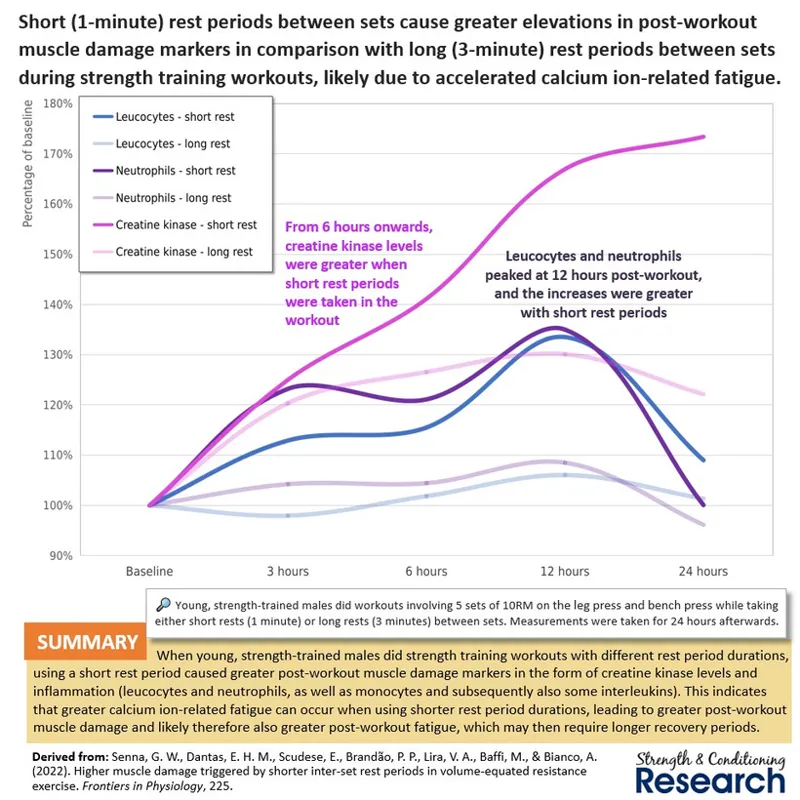
#2. Short rest periods cause more post-workout fatigue than long rest periods
In the same way as lighter loads cause more post-workout fatigue than heavier loads, shorter rest periods also cause more post-workout fatigue than longer rest periods, as measured by various muscle damage markers (including creatine kinase and inflammatory markers).
.
Indeed, the greater post-workout fatigue after training with shorter rests is a universal finding.
.
In animal models, researchers have found that shorter rest periods are more muscle-damaging after training with eccentric contractions. This is important because eccentric contractions do not involve much metabolite accumulation and therefore the primary local muscle fatigue mechanism is calcium ion accumulation. Consequently, this data tells us that the mechanism by which short rest periods causes larger amounts of post-workout than long rest periods is by causing a larger amount of calcium ion accumulation in each set, perhaps by permitting a smaller dispersal of the calcium ions from one set to the next.
.
Conclusions
Some fitness industry commentators have argued that training with metabolically-demanding training methods that produce higher levels of metabolite accumulation and more muscle swelling (such as with lighter loads and shorter rest periods between sets) is less muscle-damaging than training with lower levels of metabolite accumulation and less muscle swelling (such as with heavier loads and longer rest periods between sets). Yet, the literature is extremely clear that training with lighter loads and shorter rest periods between sets cause more post-workout fatigue than training with heavier loads and longer rest periods between sets. Moreover, there are strong indications that this greater post-workout fatigue [1] comprises all of the main post-workout fatigue mechanisms, including muscle damage, excitation-contraction coupling failure, and supraspinal central nervous system (CNS) fatigue, and that [2] greater calcium ion accumulation when training with lighter loads and/or shorter rest periods between sets is ultimately responsible for the greater post-workout fatigue mechanisms. Obviously, light loads cause more calcium ion accumulation to occur because they provide a longer duration of time during which muscle fibers are activated. It seems likely that short rest periods must cause more calcium ion accumulation to occur over the course of a workout because they do not allow calcium ion accumulation to disperse between sets.
Comments (1)
Hi chris hope youbare doing great. Would you say that the same thing apply for conditioning session? For example, a short bout of anaerobic alactic (sprint) would be less demanding on the post workout recovery apspect compared to a low intensity steady state cardio session? Thanks in advance as always