



Distal region hypertrophy
Hypertrophy does not occur similarly in all regions of a muscle. Moreover, it does not occur similarly in all muscles within a group. Owing to variances in both motor unit recruitment (because of the principle of neuromechanical matching and the two-joint muscle principle) and in mechanical tension (because of different length-tension relationships), there can be substantial variances in hypertrophy within muscles and within muscle groups as a result of following a strength training program. One particular region that has received a lot of attention is the distal region of muscles and muscle groups. Muscles can be segmented into proximal (closest to the center of the body) and distal (furthest from the center of the body) regions and the distal region often displays more hypertrophy than the proximal after training with certain exercises or training methods.
.
#1. Preferential distal region hypertrophy after eccentric-only training and stretched-position strength training
It is very common for the distal region of a muscle to grow to a greater extent after eccentric-only training programs. It is widely accepted that this occurs as a result of localised increases in muscle fiber length, most likely because of greater fiber strains in that region of the muscle.
.
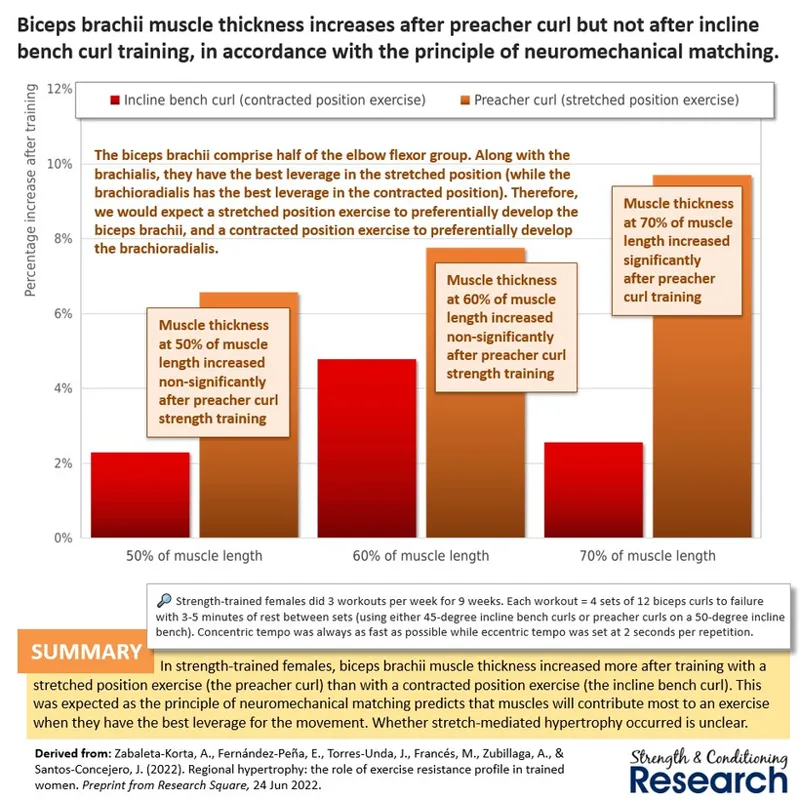
Similarly, it is very common for the distal region of a muscle to grow preferentially after normal strength training with stretched-position exercises. Again, this most likely occurs due to the greater sarcomerogenesis in that region of the muscle.
.
Even so, it is possible for the distal region of a muscle to grow after strength training despite no increases in muscle fascicle length (indicating that the hypertrophy did not occur because of the localised muscle fiber strains being greater and causing more sarcomerogenesis). For example, in this study, there was distal region hypertrophy of the vastus lateralis without any changes in the fascicle lengths of that muscle.
.
#2. Preferential distal region hypertrophy after single-joint exercises for the distal joint of two-joint muscles
Two-joint muscles (such as the rectus femoris, hamstrings, triceps brachii long head, and biceps brachii) seem to prefer using the region closest to the joint for producing a movement. Indeed, the hamstrings generally prefer using the proximal region to generate hip extension and the distal region to produce knee flexion. Therefore, we should expect the hypertrophy to be regional.
.
Similarly, the rectus femoris tends to involve more proximal region activation for generating hip flexion and more distal region activation to generate knee extension.
.
Moreover, recent hypertrophy research has shown that the rectus femoris does indeed display more distal region growth after strength training with knee extension exercises. Note that this is almost certainly not the result of stretch-mediated hypertrophy because the distal region of the vastus lateralis did not grow after squat training in this population of strength-trained subjects.
.
There is also evidence that the same phenomenon occurs in the two-joint biceps brachii muscles, which can display more distal region hypertrophy after training with elbow flexion exercises.
.
While the evidence for preferential proximal region hypertrophy is less clear (since the rectus femoris is rarely trained by hip flexion exercises and the biceps brachii is rarely trained with shoulder flexion exercises), there are indications that the proximal region of the biceps brachii can grow more when different shoulder flexion exercises are implemented into a training program.
.
Conclusions
Hypertrophy does not occur uniformly in all regions of a muscle after strength training with an exercise that requires a contribution from that muscle. There are often variations within the muscle, with some regions growing more than others. Frequently, the distal region of the muscle will grow to a greater extent than the middle and proximal regions. This preferential distal region hypertrophy occurs for two reasons. Firstly, it can occur due to localized increases in muscle fiber length as a result of greater passive mechanical tension being experienced in that area. Preferential distal region hypertrophy often occurs after eccentric-only strength training and normal strength training with stretched-position exercises (yet, it is also clear that distal region hypertrophy can also occur without such localized increases in fascicle length, which means that we cannot use distal region hypertrophy as an indicator that stretch-mediated muscle growth has occurred). Secondly, preferential distal region hypertrophy can occur in two-joint muscles because the distal region has better leverage for producing a movement at the distal joint. Both the rectus femoris and hamstrings display signs of preferential distal region muscle activation when working to cause movement at the knee rather than at the hip. And both the rectus femoris and the biceps brachii display signs of preferential distal region hypertrophy after working to cause movement at their distal joints (while the biceps brachii seems to display more proximal region hypertrophy after it works to cause movement at its proximal joint).
Comments (2)
Classifying the incline bench curl as a "contracted position exercise" is biomechanically inaccurate, as the biceps brachii is actually in a stretched position due to shoulder extension during this movement. am i right ?
Amazing. Score one for the old school. Preacher curls develop the lower bicep, flyes "outer" chest? Shut the front door! One of the more interesting ones was the Squat depth and thighs. Shallow squats used to be know for developing "turnip thighs"....development in the upper regions but not the lower. Great information Chris. Vince Gironda likes this post.