







Force-time integral does not explain training variables
Recently, a new model has been proposed to explain how hypertrophy works. The model is comprised of two parts: a theoretical element and a practical element. Each of these two parts has its own assumptions. On the theoretical side, it is proposed that the force-time integral produced by a muscle during any given workout can predict the amount of hypertrophy that is stimulated (where muscle force is the pulling or tensile force applied by the muscle to the tendon). On the practical side, this muscle force-time integral is assumed to be approximated by a set to failure with any load and with any repetition duration (tempo). Last week, I explained why the model does not work from a physiological perspective. This week, I will examine the claims that the model predicts the effect of individual training variables.
#1. Repetition duration (tempo)
Repetition duration in general does not have a meaningful impact on the hypertrophy stimulus of a strength training set to failure (although some research seems to indicate that when tempo is longer than 10 seconds per repetition, muscle growth may be reduced).
For the muscle force-time integral model to predict this result, we would need to demonstrate that muscle force-time integrals are equal in all sets to failure with any repetition tempo. The problem is that time under tension is much, much greater in sets to failure with slow tempos and volume load is much, much greater in sets to failure with fast tempos. What is more, the whole muscle force differs depending on the tempo, being greater in the fast tempo condition compared to the slow tempo condition (but note that muscle fiber mechanical tension does the exact opposite, because it is dependent upon the force-velocity relationship). Therefore, we cannot be certain that muscle force-time integrals are equal irrespective of tempo until somebody goes and measures it (nobody has measured it yet, so there's no evidence).
#2. Repetition range (load)
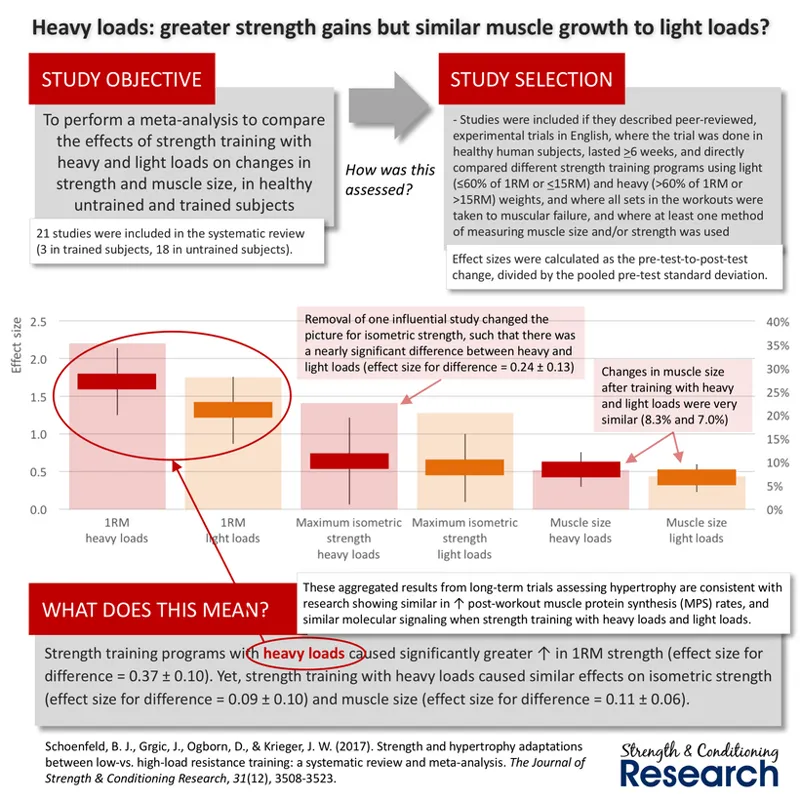
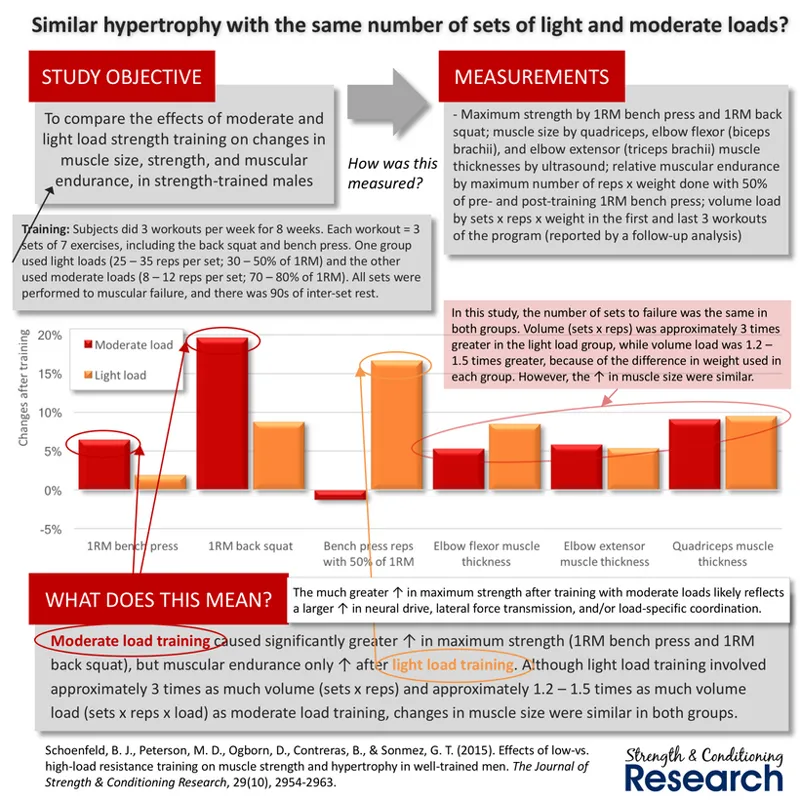
Repetition range (load) during normal strength training sets with moderate or light loads does not have a meaningful impact on the hypertrophy stimulus of a strength training set to failure.
For the muscle force-time integral model to predict this result, we would need to demonstrate that muscle force-time integrals are equal in all sets to failure with any repetition range. The problem is that volume load (sets x reps x weight) is much, much greater in sets to failure with lighter loads. Although the relationship between volume load and muscle force-time integral has never been established, we might reasonably assume that greater volume loads imply a greater muscle force-time integral and therefore that light loads should be more stimulating.
What is more, the volume load that we achieve when training with light loads to failure increases by much more over time than the volume load that we achieve when training with moderate loads (because of increases in muscular endurance). For the muscle force-time integral model to work, the stimulus caused by light load strength training to failure should therefore increase relative to the stimulus caused by moderate load strength training over time (and should therefore be greater in trained people than in untrained people).
Finally, the model itself does not contain boundary conditions but it is well-known that the effects of repetition range are limited to moderate (6-15RM) and light (16-30RM) loads. When testing very light loads, we see that hypertrophy is substantially reduced. If we take the model at face value, such sets with very light loads would be expected to create extremely large muscle force-time integrals and therefore a lot of hypertrophy. However, they do not.
Similarly, the absence of boundary conditions means that the model predicts substantial hypertrophy after low-intensity cardiovascular exercise, which obviously does not happen. Indeed, muscle force-time integrals are probably bigger after marathon running training sessions than after almost any other form of exercise training you can imagine.
#3. Volume (sets to failure per workout)
Volume per workout displays a very strong tendency towards diminishing returns such that the first set accounts for almost half of our total possible gains from that workout. Numerically, we can see that to double the hypertrophy created by the first set, we must do five further sets.
It has been suggested that the muscle force-time integral model can predict the diminishing effects of additional sets in a workout because we naturally fatigue and drop reps from one set to the next. Nevertheless, the numbers do not add up. Assuming that we perform all sets with a 10RM, then the muscle force-time integral model says that the first set contains 10 reps that are all stimulating. The following five sets must then only contain 10 total repetitions (for example: 4, 3, 1, 1, 1). Nobody is going to generate those numbers. If we use the same numbers in the stimulating reps model, the first set of 10RM contains only 5 stimulating reps and then following five sets must only contain 5 stimulating reps: 7(2), 6(1), 6(1), 6(1), 5(0). Far more likely.
.
#4. Proximity to failure (repetitions in reserve)
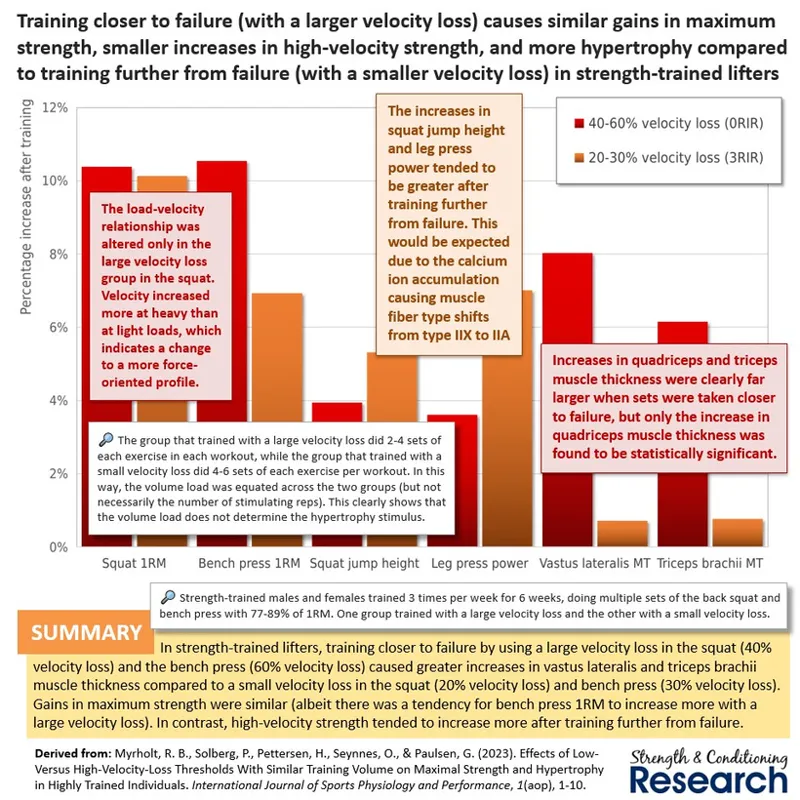
Many studies show that the reps in a set that are performed closer to failure are more stimulating that the reps performed further from failure. For example, velocity-based training studies (with matched volume loads) show that where both groups train with the same load and the same total number of reps, they still achieve very different amounts of muscle growth.
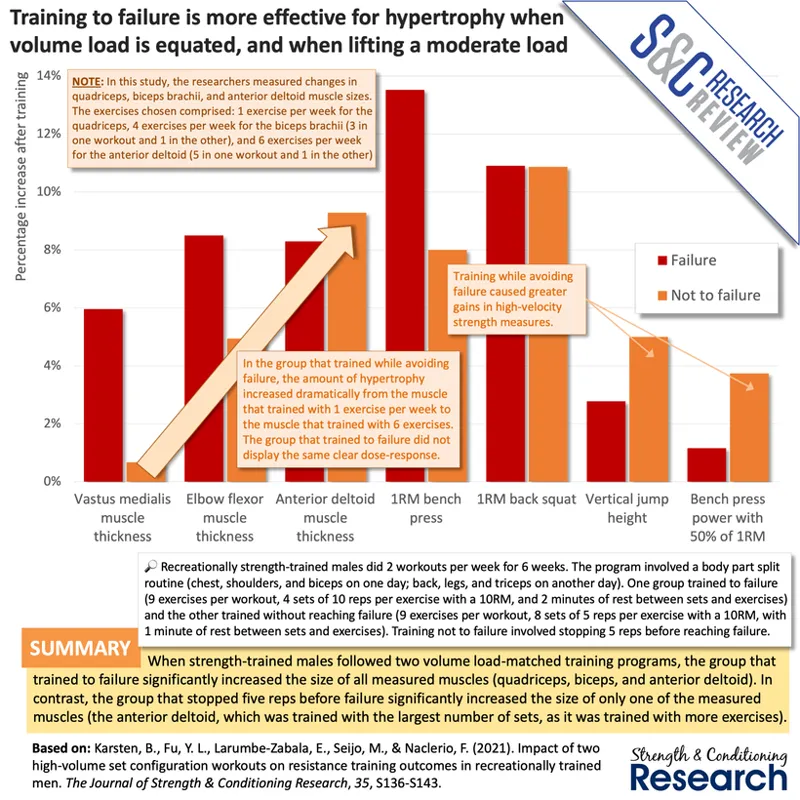
Similarly, cluster training studies (with matched volume loads) also show that where both groups train with the same load and the same total number of reps, they still achieve very different amounts of muscle growth because proximity to failure differs between groups.
Moreover, in isometric contraction studies that have been used to examine the effects of fatigue during strength training, we can see the same impact of proximity to failure. These are interesting studies because they actually equate muscle force-time integrals between groups and show totally different amounts of hypertrophy in the group training with greater fatigue.
The muscle force-time integral model suggests that each rep in a set with a given load is equal in stimulus. Consequently, we can see that this cannot explain the effects of volume-matched cluster training and volume-matched velocity-based training studies cited above. Moreover, it does not explain the different effects of isometric training with identical muscle force-time integrals but differing degrees of fatigue. Also, the muscle force-time integral model predicts that repetitions in reserve should have different effects at each load because it assumes that muscle force-time integrals are equal across repetition ranges. Therefore, leaving 1RM with a 5RM should produce the same results as 5RIR with 25RM but light loads instead require us to train closer to failure than heavier loads, not the other way around.
[E] Rest period duration
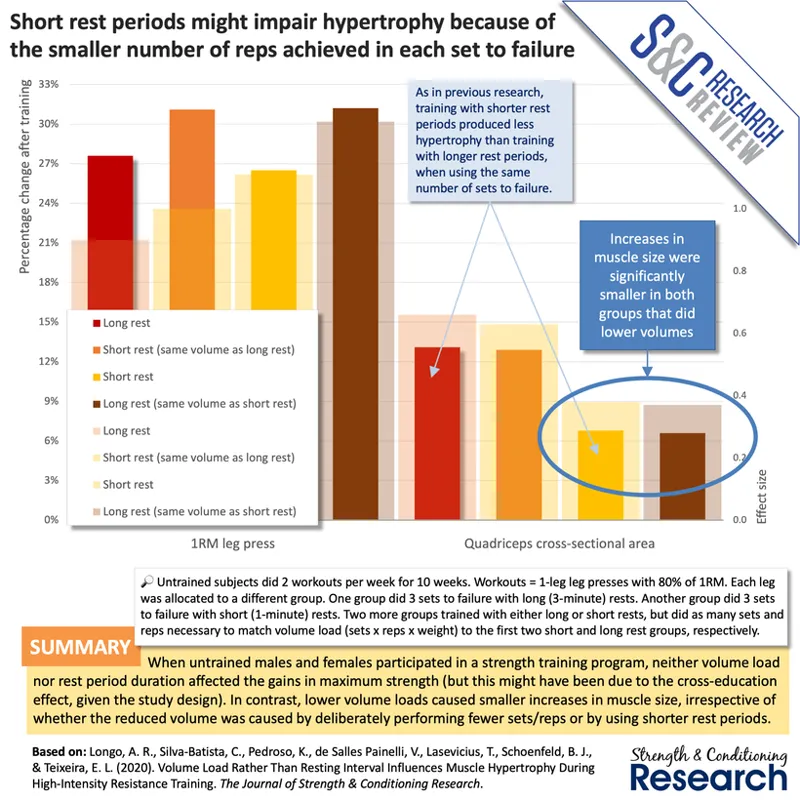
Currently, the long-term training literature indicates that shorter rest periods produce less hypertrophy than longer rest periods. Like the stimulating reps model, the muscle force-time integral model predicts this relatively well by noting that the lost reps at the end of the set are responsible for this negative impact of short rest periods.
[F] Frequency
Currently, the long-term training literature indicates that training frequency does not matter so long as the same number of sets to failure per week are performed (irrespective of whether these sets are done earlier or later in a workout). While I think that this is actually just an artefact of the way in which the studies were performed, that is the result we will be testing against for the purpose of this model since that is the result that the rest of the industry uses.
The muscle force-time integral model does not predict this result because it instead predicts that those sets done earlier in a workout will be more stimulating (because they involve doing more reps per set). Therefore, it predicts that higher training frequencies will be superior to lower training frequencies (which I think is correct but the fitness industry hive mind does not).
.
Conclusions
Recently, a new hypertrophy model has been proposed. It suggests that the muscle force-time integral achieved during a workout can predict the resulting muscle growth. It assumes that a set to failure (with any load or tempo) generates the same muscle force-time integral, but that dropping reps because of fatigue or by leaving reps in reserve reduces the size of the muscle force-time integral. Can this model predict the effects of training variables? In fact, it only predicts the effects of load and tempo if we accept its inherent assumption that all sets to failure with any load or tempo generate the same muscle force-time integral. Since nobody has ever measured muscle force-time integrals during sets to failure with different loads and tempos, we have no idea whether this is true. Since total time under tension is very different between tempos and since volume loads differ between rep ranges, it is likely NOT true. The model does NOT predict the diminishing returns of volume because it would require too many reps to be dropped from set to set to match the large reductions in stimulus over a workout. It does NOT predict the effects of proximity to failure because many volume-matched studies (including velocity-based training and cluster training methods) have shown greater hypertrophy in groups that train closer to failure than groups that train further from failure. It does NOT predict the effects of training frequency (as reported at face value by long-term training studies) because it predicts that sets done later in one workout would be less effective than sets done first in another workout owing to reps being dropped from one set to the next.