








Force-time integral does not predict hypertrophy
Recently, it has been suggested that [1] the force-time integral produced by a muscle during a workout can predict the amount of hypertrophy that is stimulated, and also [2] that the muscle force-time integral can be approximated by a set to failure with any tempo and with any load. Let us examine each of these two claims.
.
#1. CAN MUSCLE FORCE-TIME INTEGRAL PREDICT HYPERTROPHY?
#A. Introduction
Muscle force-time integrals are calculated as the average whole muscle force multiplied by the time for which that force is produced. Hence, we can generate an extremely high muscle force-time integral irrespective of [1] the level of motor unit recruitment, and [2] the movement velocity and therefore the degree of single muscle fiber mechanical tension. Spelling this out: we can achieve high muscle force-time integrals while maintaining low levels of motor unit recruitment by doing a lot of reps with a low level of effort, and we can achieve high muscle force-time integrals with a low level of single muscle fiber mechanical tension by doing a lot of reps with a high effort but a fast movement speed. So, if we can show that either [1] high level of motor unit recruitment or [2] a high degree of single fiber mechanical tension are necessary for hypertrophy to occur, then we can dismiss the muscle force-time integral hypothesis.
.
#B. Motor unit recruitment is essential for hypertrophy
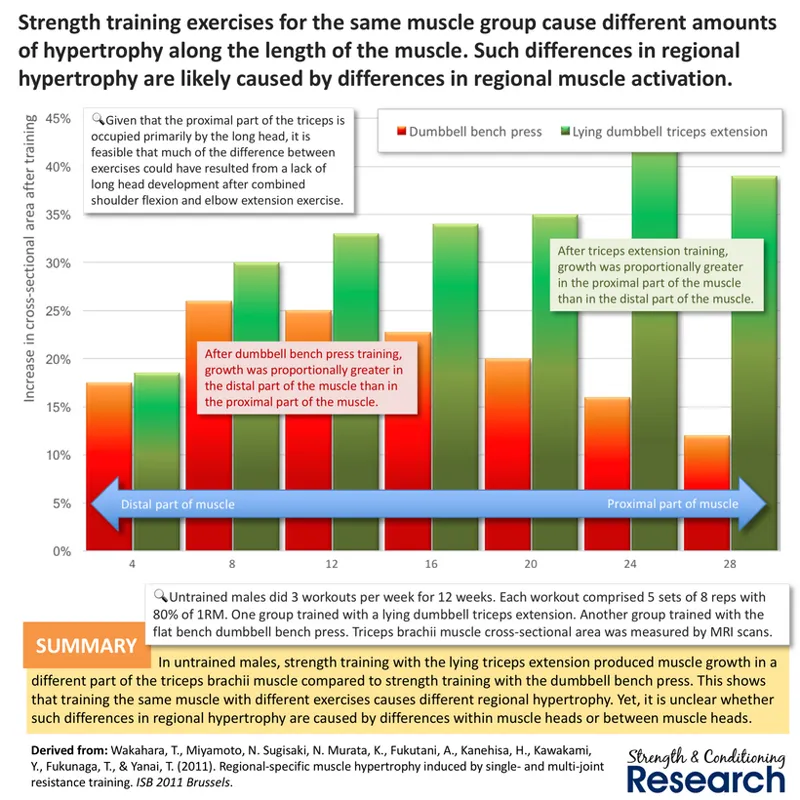
Hypertrophy after strength training happens only in those muscle fibers that were activated during the workout. We can see this easily from investigations into regional hypertrophy, where the muscle growth that happens occurs in the areas of muscle activation.
We can also see this from investigations into changes in motor unit action potential amplitude after training. Only the motor unit action potential amplitudes of high-threshold motor units increase after training, which indicates that only those muscle fibers experience growth. If we do a lot of reps with low levels of motor unit recruitment, then no hypertrophy will happen but we would still achieve very high muscle force-time integrals.
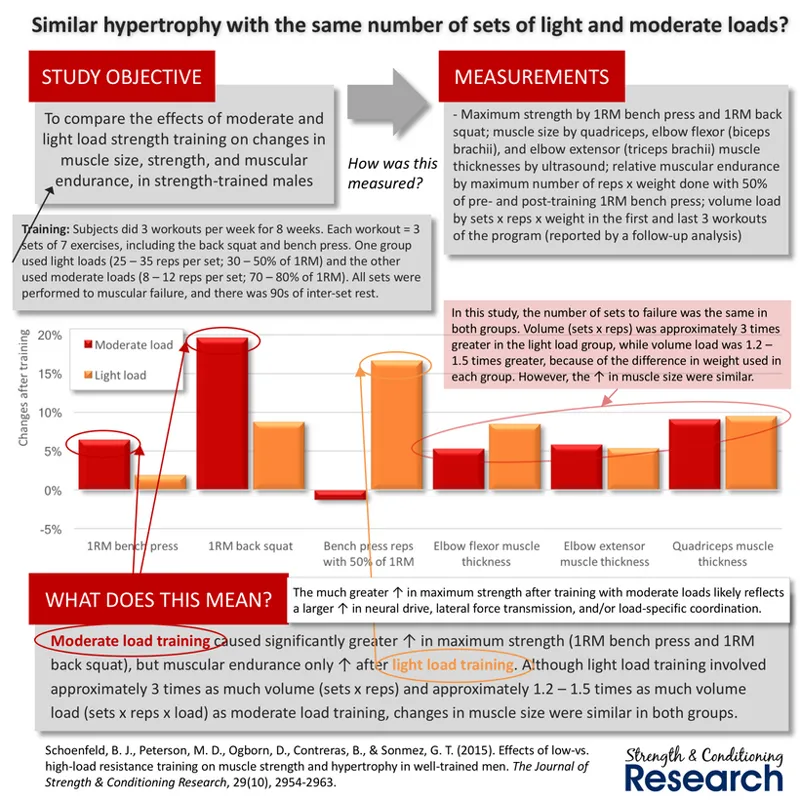
Indeed, this is why very light load strength training to failure does not stimulate hypertrophy. The very light load cannot produce high levels of motor unit recruitment at muscular failure (note that in this study the volume load and hence the muscle force-time integral was fixed).
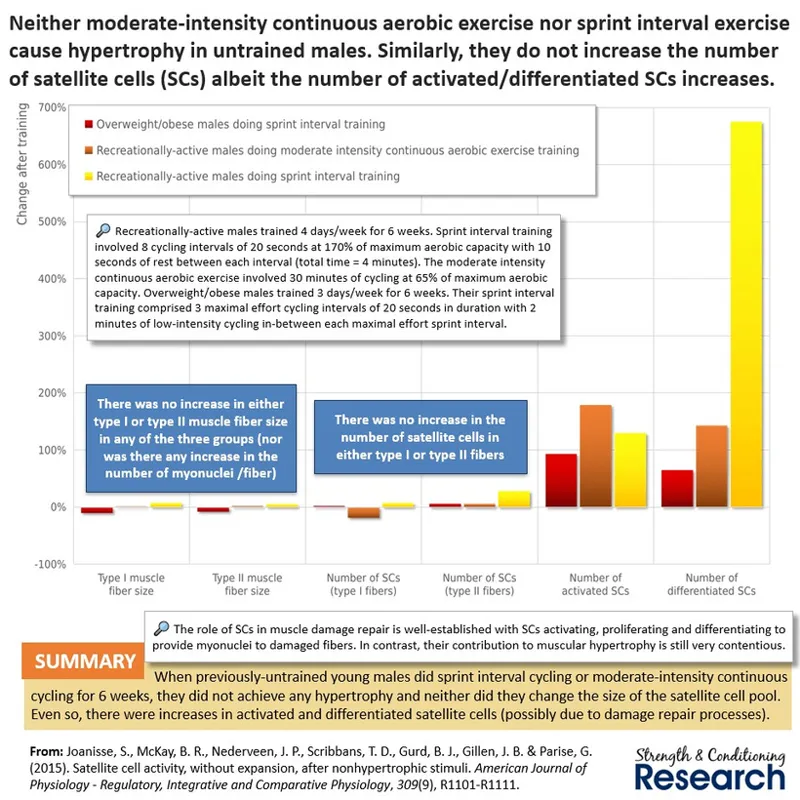
Also, we can also note that low-intensity cardiovascular exercise like long-distance running does not stimulate hypertrophy even in untrained individuals. Such activities involve low levels of motor unit recruitment and therefore do not apply loading to the responsive muscle fibers. Nevertheless, each running workout involves extremely high muscle force-time integrals.
#C. High single fiber mechanical tension is essential for hypertrophy
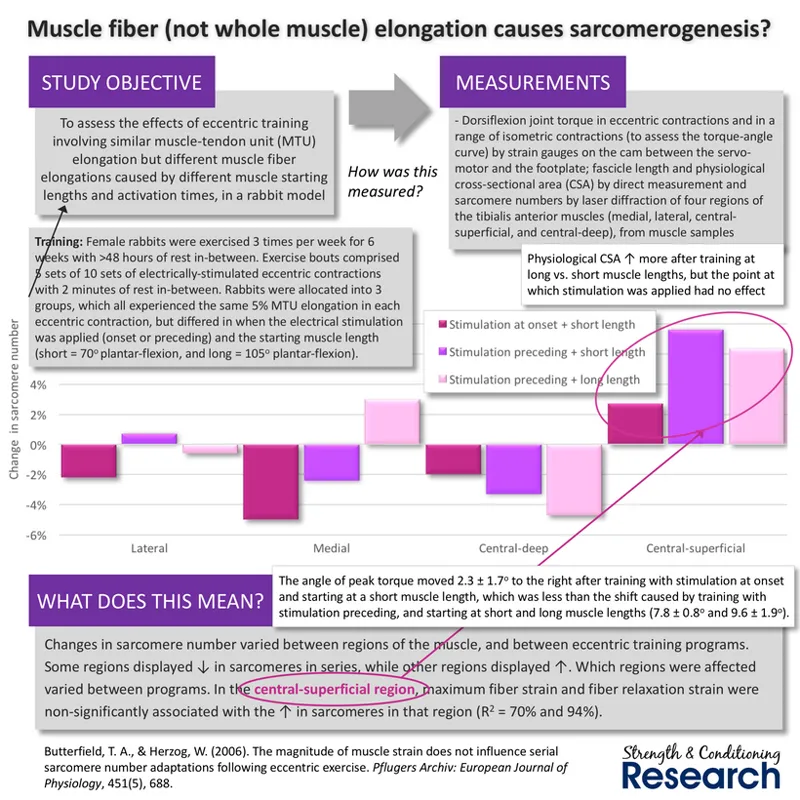
Hypertrophy after strength training only happens in those muscle fibers that experience sufficient levels of mechanical tension during the muscular contractions of the workouts. We can see this from regional sarcomerogenesis studies where the muscle fibers that experience the most growth were those same muscle fibers that experienced the greatest elongations.
Consequently, if we perform all of the reps in a set with a high movement velocity by stopping sets before velocity losses become too severe, then we fail to produce hypertrophy. But note that this failure to produce hypertrophy is not caused by the reduction in the total number of repetitions. The same result occurs when volume loads are equated in the training groups.
Also, we can also note that high-intensity cardiovascular exercise like cycling intervals does not stimulate hypertrophy even in untrained individuals. Such activities involve low levels of single fiber mechanical tension and therefore do not apply loading to the responsive muscle fibers. Yet, each cycling workout involves extremely high muscle force-time integrals.
#2. IS MUSCLE FORCE-TIME INTEGRAL THE SAME IN ALL SETS TO FAILURE REGARDLESS OF TEMPO AND REPETITION RANGE?
#A. Tempo likely affects the muscle force-time integral
Total time under tension across a set to failure differs greatly between slow, moderate, and fast tempos. Whether the number of reps changes is irrelevant because that does not impact on the force-time integral. Sure, faster tempos involve greater magnitudes of force but is the force-time integral equalized by that greater force despite the reduced time under tension across the set to failure? I don't think we can make that claim without data.
Physiologically, we would expect substantial differences between the muscle force-time integral produced during slow tempo strength training and fast tempo strength training when performing sets to failure because of the differences that exist in fast twitch fiber activation across the set and therefore in the nature of the fatigue mechanisms that occur throughout the set. More fast twitch fiber activation means more metabolic activity and therefore more metabolite accumulation and therefore less calcium ion-related fatigue mechanisms.
#B. Rep range definitely affects the muscle force-time integral
Volume load is calculated as the number of sets multiplied by the number of reps multiplied by the weight on the bar. We might reasonably expect volume load to be a good proxy for muscle force-time integral when comparing rep ranges. Therefore, the fact that volume load differs greatly between rep ranges implies that we cannot assume (at least without showing data) that muscle force-time integrals during sets to failure are the same across all rep ranges.
Moreover, volume load is not stable over time. It increases much more rapidly during light load strength training to failure compared to during moderate load strength training. This totally invalidates that idea of muscle force-time integrals as a proxy for the hypertrophy because it would imply that the hypertrophy stimulus being generated during light load strength training to failure workouts would INCREASE over time, which obviously does not happen.
And, as we mentioned earlier, sets of very light loads to failure do not produce hypertrophy even when they are done with the same volume load (and therefore likely the same muscle force-time integrals) as sets of light and moderate loads to failure.
#C. Blood flow restriction affects the muscle force-time integral
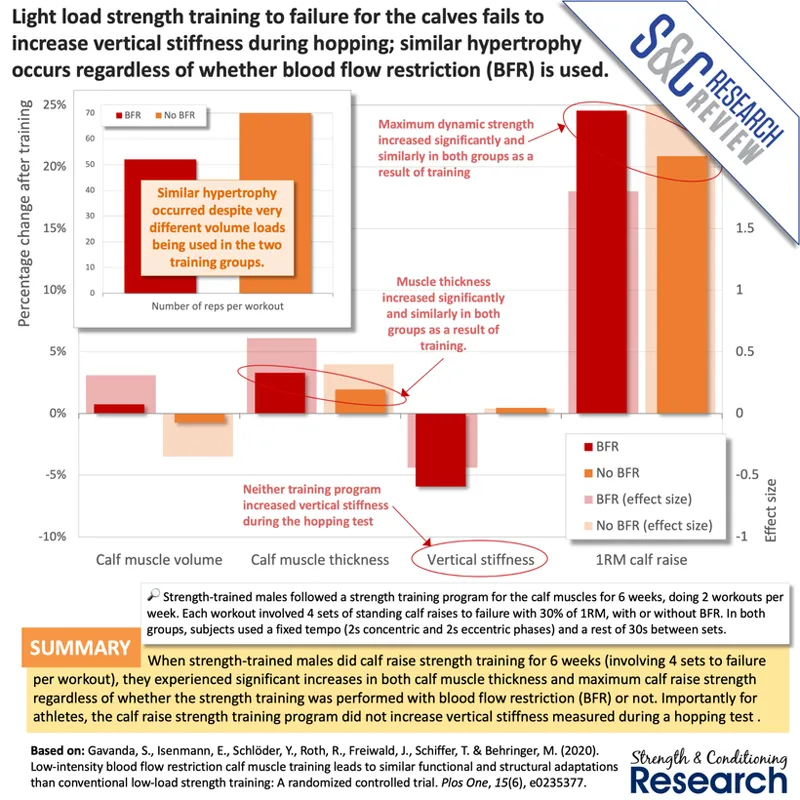
Blood flow restriction training is a very useful method for demonstrating that the muscle force-time integral can be varied substantially and yet hypertrophy will still be the same when the same number of sets to failure (and therefore the same number of stimulating reps) are performed. Indeed, volume loads are totally different when using blood flow restriction.
CONCLUSIONS
Recently, it has been suggested that [1] the force-time integral produced by a muscle during a workout can predict the amount of hypertrophy that is stimulated, and [2] that the muscle force-time integral can be approximated by a set to failure with any tempo and with any repetition range. Let us now examine these two claims. Muscle force-time integrals are calculated as the average muscle force multiplied by the time for which the force is produced. We can create a large muscle force-time integral irrespective of [1] the level of motor unit recruitment, and [2] the magnitude of single muscle fiber mechanical tension. Nevertheless, when large muscle force-time integrals are generated in conjunction with low motor unit recruitment levels (as in very light load strength training to failure or low-intensity cardiovascular exercise) this fails to cause hypertrophy. And, when large muscle force-time integrals are generated in conjunction with relatively low single muscle fiber mechanical tension (as in velocity-based training far from muscular failure or during high-intensity cardiovascular exercise) this similarly fails to cause hypertrophy. Therefore, we can reject the proposal that muscle force-time integrals predict hypertrophy. Moreover, there is no evidence that altering either tempo or load fails to alter muscle force-time integral. Both likely have an effect, especially load. Volume load not only differs with repetition range but even increases over time to a greater extent when training with light loads compared to moderate loads. This tells us that muscle force-time integral per set is not constant between repetition ranges or over time.
Comments (1)
Tremendous job Chris - thanks - it seems like the only issue is progress - please correct me - however I have always believed that maximal lifts produce hypertrophy - and the stimulating reps model affirms this with a designation of 1 stimulating rep - so that stimulation makes me more muscular and stronger - so why not just adopt a strength training program - if I lift 10 this week then 11 next week and so forth - does this not work? Meaning time under tension and volume load are irrelevant - just micro progress the load with frequency of lift experimentation