




Volume load does not predict hypertrophy
Some commentators have argued that all reps in a set are equally stimulating regardless of their proximity to failure and therefore that volume load (sets x reps x weight) is the main determinant of the muscle growth. We can reject this proposal if we can show either that [1] hypertrophy is altered by proximity to failure when volume load is equated, or that [2] hypertrophy is altered by altering motor unit recruitment even if volume load does not change (or changes in the opposite direction), or that [3] volume load can be altered without altering hypertrophy. We can show all three of these things.
.
#1. Hypertrophy is altered by proximity to failure when volume load is equated
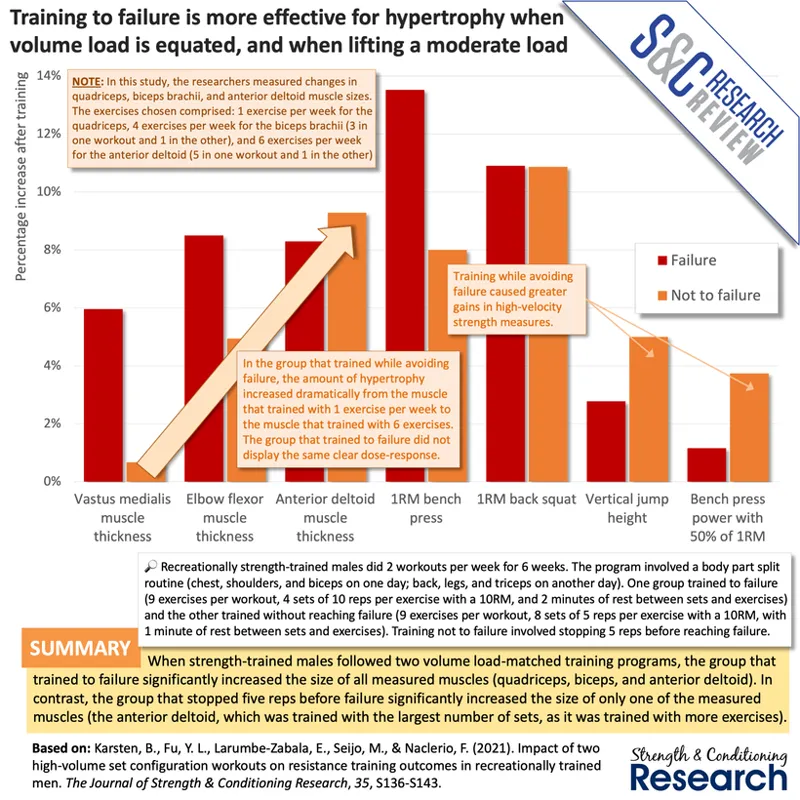
When matching the total volume load performed in each workout (sets x reps x weight), proximity to failure alters the hypertrophy that is achieved after strength training. For example, in the following study of different rep ranges, one leg trained closer to failure than the other but both legs performed exactly the same volume load. The leg that trained closer to failure displayed substantially more hypertrophy than the leg that trained further from failure.
.
In this example, two different groups of subjects trained with exactly the same volume load (reps x sets x weight) but one group trained closer to failure than the other. Specifically, one group trained to failure while the other took intra-set rest periods to avoid reaching failure. Evidently, the group that trained closer to failure achieved substantially greater hypertrophy.
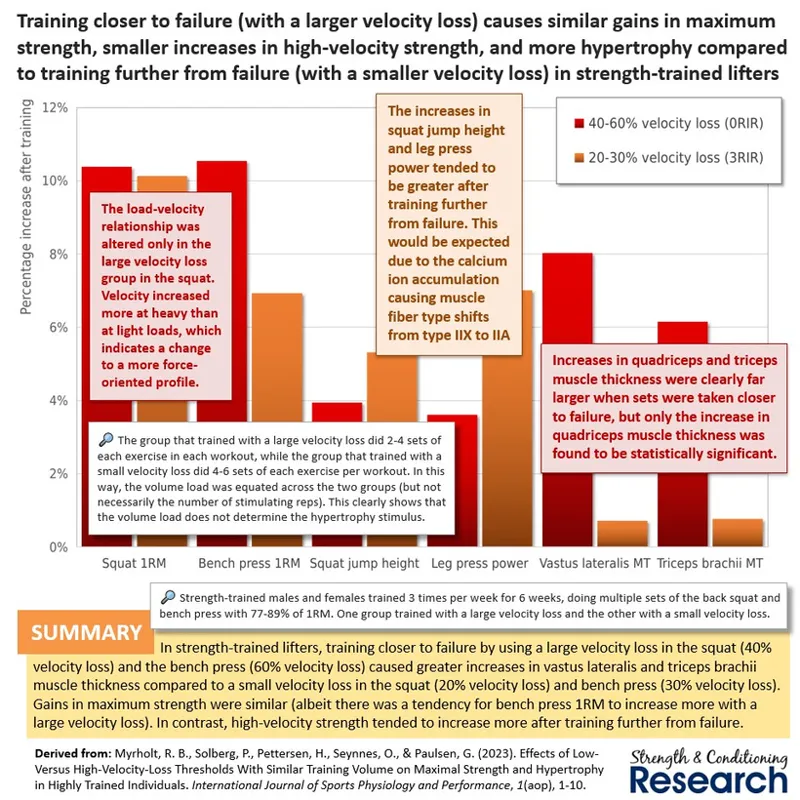
In this example, two different groups of subjects trained with exactly the same volume load (reps x sets x weight) but one group trained closer to failure than the other. Specifically, one group trained to failure but the other stopped after a set velocity loss to avoid reaching failure. Evidently, the group that trained closer to failure achieved substantially greater hypertrophy. In velocity-based training studies, the subjects train with maximal effort on each rep (which uses maximum levels of motor unit recruitment). Therefore, it is not correct to state that hypertrophy can be achieved on any rep so long as effort and therefore motor unit recruitment are high.
#2. Hypertrophy is altered by altering motor unit recruitment when volume load does not change (or changes in the opposite direction)
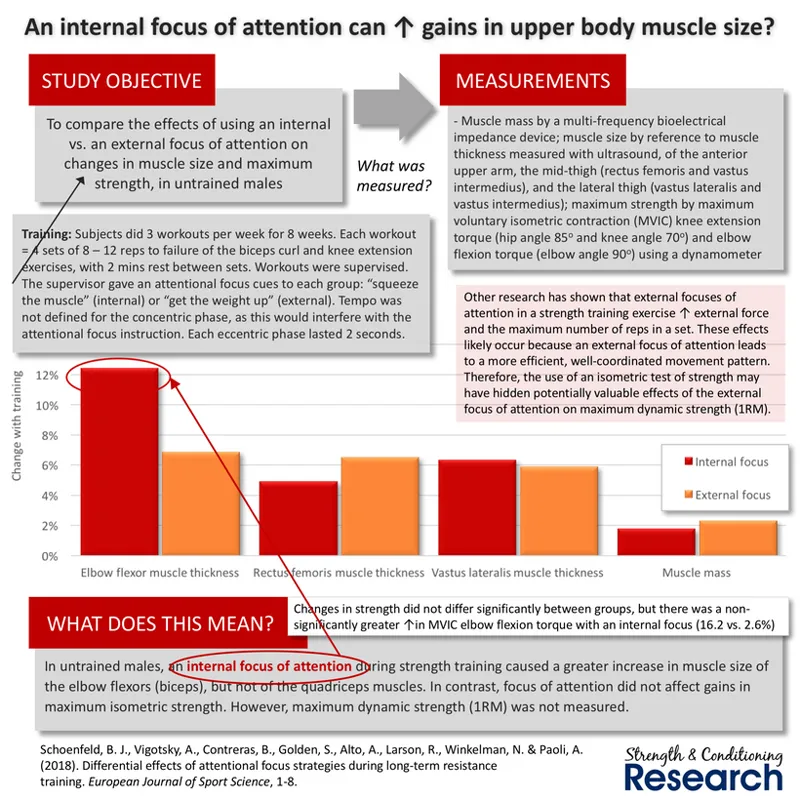
Using an internal focus of attention (involving fewer reps and a smaller volume load) causes more hypertrophy than using an external focus of attention (involving more reps and a higher volume load). This alone disproves any connection between volume load and hypertrophy.
Importantly, using an internal focus of attention increases the levels of motor unit recruitment that we achieve in the working muscle, even though it reduces the number of reps to failure.
Using a very light load (20% of 1RM) causes less hypertrophy than using light (40% of 1RM) or moderate (60-80% of 1RM) loads even when exactly the same volume loads are used in each case. This again disproves any connection between volume load and hypertrophy.
Importantly, very light loads involve much more central nervous system (CNS) fatigue than other rep ranges and this means that they involve far lower levels of motor unit recruitment at muscular failure, which means that they are not able to produce many stimulating reps.
.
#3. Volume load can be altered without altering hypertrophy
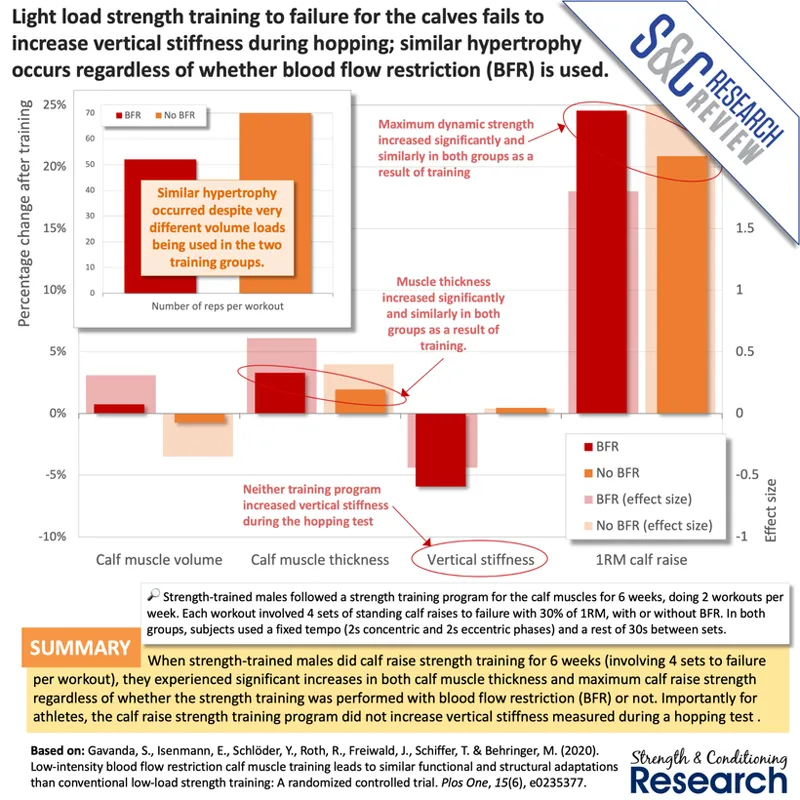
When using blood flow restriction, the number of reps (and hence the volume load) achieved in a set to failure with a light load is reduced. Yet, the hypertrophy is the same. This shows that volume load (sets x reps x weight) is irrelevant for the muscle growth stimulus. Evidently, the only thing that matters is the number of stimulating reps, which is the same in both cases.
Conclusions
Stimulating rep theory states that only those reps with simultaneously high levels of motor unit recruitment and mechanical tension cause hypertrophy. Such reps only occur close to failure. Opposing this idea, some people have argued that all reps in a set are equally stimulating regardless of proximity to failure and that volume load (sets x reps x weight) determines muscle growth. Since motor unit recruitment (due to effort) and mechanical tension (due to the force-velocity relationship) alter over a set, this proposal necessarily assumes that neither of these factors influence muscle growth. We can reject this proposal if [1] hypertrophy is altered by altering proximity to failure while volume load is equated, if [2] hypertrophy is increased by increasing motor unit recruitment without also increasing volume load, or if [3] volume load can be altered without altering hypertrophy. We can show all three things. Firstly, training closer to failure causes more hypertrophy even when volume loads are equated. This happens irrespective of whether proximity to failure is altered by leaving more reps in reserve, by using intra-set rest periods, or by stopping each set after a certain velocity loss. Secondly, an internal focus of attention (a mind-muscle connection that increases motor unit recruitment) causes more muscle growth than an external focus of attention despite involving fewer reps per set and lower volume load. Thirdly, the blood flow restriction literature shows that doing the same number of sets to failure with a light load causes the same hypertrophy irrespective of whether blood flow restriction is applied to a limb. Obviously, applying blood flow restriction greatly reduces the number of reps in the set and therefore the volume load.
Comments (2)
Chris, this "debunks" or evidences against a Strawman version of those who espouse the common sense that "Volume/ Load" is a factor. No one that is to be taken seriously believes that ALL reps in ALL sets are equally effective. "Volume/Load" in different ways simply acknowledges that Volume of work is a factor beyond "only intensity matters" which is the context that people talk about "volume" training. This information confirms what most "volume/load"...advocates?... believe..... it is NOT just "Intensity" (effort), and that volume of "hard reps" (say above 3-5 RIR) makes a difference. Basically, the "Set" system, with a "set" being the group of effective reps *even if all the reps are not effective*. Changing the name of "Set" to "Reps" in a Cluster system of some kind doesn't change this fact. Work Set, Rest, Work Set works better in most cases than Work Set stop, and Work Set, Rest, Work Set, Rest, Work Set works even better, assuming one can recover. Just as 5 reps, stop, isn't going to be as effective as 5 reps (20 sec), 2 reps, stop. I don't think any "Volume/Load"...believer?... is going to have an issue with eliminating "fatiguing" reps prior to work reps in Cluster type systems.
A cursory search of the internet will reveal many extremely influential people that do in fact believe that EVERY rep in ALL sets are equally effective. In fact, Paul and I will be doing our next podcast on this topic.