




Stretch-mediated hypertrophy
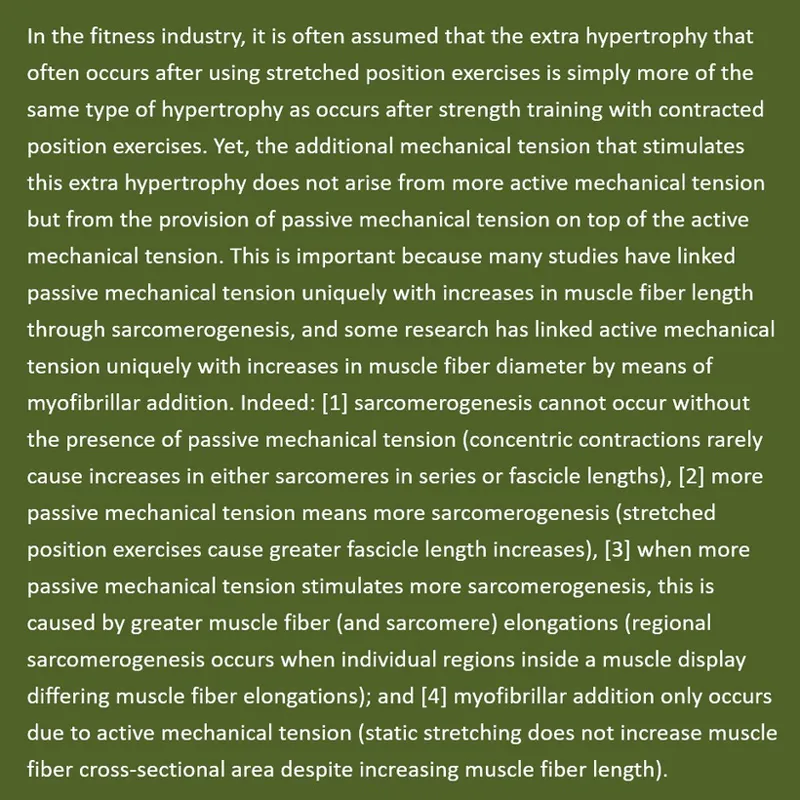
Stretch-mediated hypertrophy is a term that was originally coined to describe the muscle growth that is caused by static stretching but it has since been extended to include the additional growth that occurs when muscles perform contractions at long muscle lengths compared to what occurs when they experience similar contractions at short lengths.
.
#1. What is stretch-mediated hypertrophy?
Stretch-mediated hypertrophy involves the addition of sarcomeres, which occurs when the muscle fiber produces and experiences passive mechanical tension during either static stretching or in either isometric contractions at long muscle lengths or eccentric contractions (read more).
.
#2. What stimulates stretch-mediated hypertrophy?
Stretch-mediated hypertrophy (sarcomerogenesis) is stimulated by the stretching of individual sarcomeres. Importantly, stretching a muscle may not necessarily stretch individual sarcomeres. We can see evidence for both of these observations from studies into limb lengthening surgery. After limb lengthening surgery, the muscle is permanently elongated. Immediately after the surgery, the sarcomeres of its muscle fibers are also elongated. Nevertheless, over the following days, large amounts of sarcomerogenesis occur, which reduces the length of the individual sarcomeres until the length of each individual sarcomere is back to what it was before the surgery. Thereafter, there is no further stretch-mediated hypertrophy. Since the muscle remains stretched at this point and yet this stretching of the muscle does not stimulate any further growth, it is clear that the stretching of the sarcomere is the key factor that determines the adaptation.
.
#3. How much do sarcomeres need to be stretched to generate stretch-mediated hypertrophy?
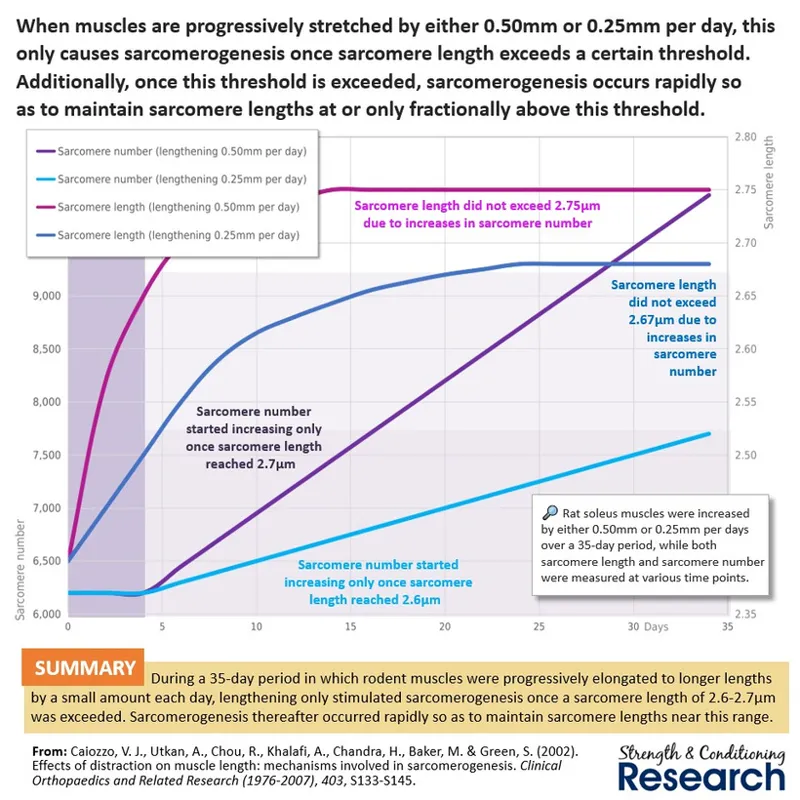
From progressive lengthening studies in animals, we can see that stretch-mediated hypertrophy (sarcomerogenesis) is only produced when sarcomeres are stretched beyond a certain threshold. If sarcomere operating lengths do not reach this threshold during the normal joint angle range of motion involved in an exercise, then that exercise will not be able to produce this adaptation.
.
Since static stretching and strength training both cause the addition of sarcomeres, this means that each workout that we compete reduces our ability to create stretch-mediated hypertrophy.
.
Indeed, this is why the data regarding changes in muscle fascicle length are very clear in humans. Muscle fascicle length stops increasing after only a couple of months of strength training.
.
Conclusions
Stretch-mediated hypertrophy is a term that was originally coined to describe the muscle growth that is caused by static stretching but it has since been extended to include the extra growth that occurs after muscles actively produce force at long muscle lengths compared to what occurs after they actively exert force at short lengths. Research into static stretching (mainly in animal models) has shown that most (if not all) of the hypertrophy caused by stretch takes the form of sarcomerogenesis. From limb lengthening surgery studies, we know that sarcomere length and not muscle length is the key driver of sarcomerogenesis. Obviously, after such surgeries, the muscle is permanently lengthened. Yet, sarcomerogenesis only occurs for a few weeks until the sarcomeres inside the muscle return to pre-surgery lengths. Upon reaching this point, the stimulus for hypertrophy is removed and muscle growth ceases. Similarly, from animal studies that have progressively stretched muscles to longer and longer lengths over a period of several weeks, we can see that there is a critical threshold for sarcomere length below which sarcomerogenesis does not occur. Yet, once this threshold is reached, sarcomerogenesis occurs rapidly in order to maintain sarcomere length as close to the threshold as possible. These findings explain why muscle fascicle lengths only increase for a couple of months before they plateau in human strength training studies. As sarcomere number increases, this reduces the length that all sarcomeres reach in the most stretched position of an exercise, which reduces the stimulus for sarcomerogenesis in later workouts.

Comments (1)
On the topic of SMH, you mention how the eccentric force-velocity relationship is pretty much flat and we don’t need slowing of contractions to generate tension, would this make max velocity ( or close to) sprinting an effective stimulus in terms of stimulating sarcomerogenesis? I’m coming from the perspective of a team sport athlete where getting in eccentric training + frequent sprint exposures in the one week can become difficult to manage. Appreciate any thoughts!