



Metabolites and muscle swelling
Muscle swelling (the pump) has been proposed to contribute to hypertrophy. While bodybuilders rarely present any mechanistic explanation for this phenomenon, some researchers have argued that it occurs by means of metabolic stress. We can see why they make this mistake by considering the relationships between metabolite accumulation, the pump, and the relative proportion of fast twitch fibers that a muscle contains.
.
#1. Muscle swelling happens during exercise involving concentric contractions but not during exercise involving eccentric contractions
When strength training workouts comprise only concentric contractions, muscles swell. In contrast, when they comprise only eccentric contractions, they do not swell (or swell less).
.
One key difference between concentric contractions and eccentric contractions is the amount of metabolite accumulation. This difference can be observed very easily in their pattern of fatigue development and recovery. The rapid-acting metabolite-related fatigue mechanisms recover quickly during and after concentric contractions, while the slow-acting calcium ion-related fatigue mechanisms recover slowly after eccentric contractions.
.
#2. Muscle swelling occurs due to metabolite accumulation
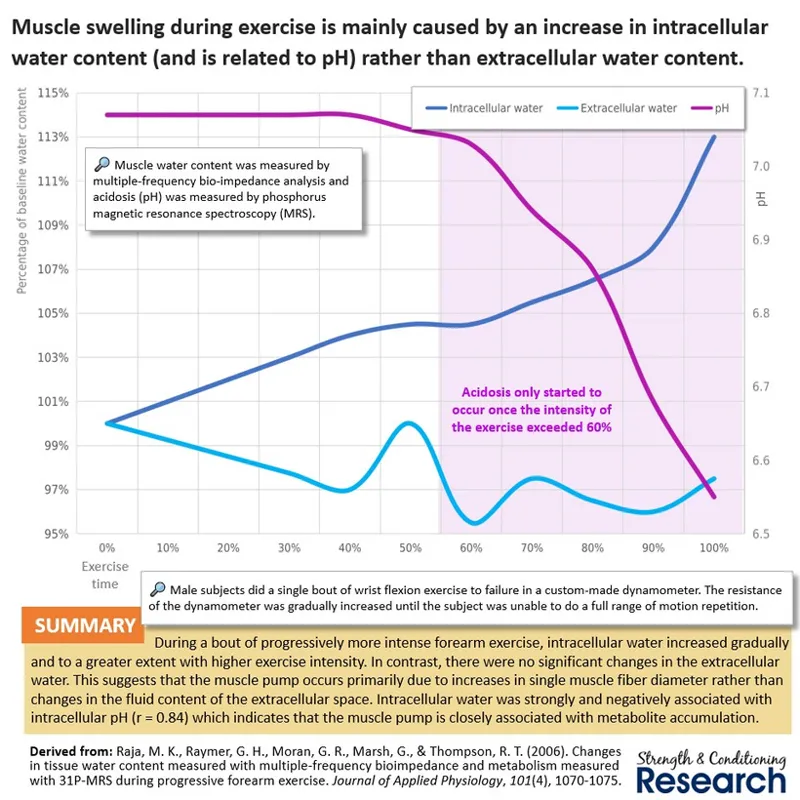
Muscle swelling during exercise is actually a relatively complex and not well-understood phenomenon. Of course, it is ultimately caused by the imbalance between the behavior of the arteries and the veins. When muscles contract with a force greater than approximately 30% of maximum force levels, they cause venous occlusion. As a result, while arteries can still bring blood into the muscle, the veins cannot transport any blood away from the muscle. As a result, the quantity of blood increases and causes an increase in total muscle fluid content.
.
As the fluid builds up inside the muscle, it is pulled inside muscle fibers because the accumulation of metabolites draws water into the intracellular space by osmosis, diluting the intracellular levels of metabolites in order to maintain the same concentrations as before exercise.
.
#3. Fast twitch fibers display more metabolite accumulation and therefore will produce more muscle swelling than slow twitch fibers
Fast twitch muscle fibers produce more metabolite accumulation. Consequently, a muscle with a higher proportion of fast twitch muscle fibers will display a much higher degree of metabolite accumulation and therefore also more swelling during a workout.
.
#4. Fast twitch fibers display more hypertrophy after strength training
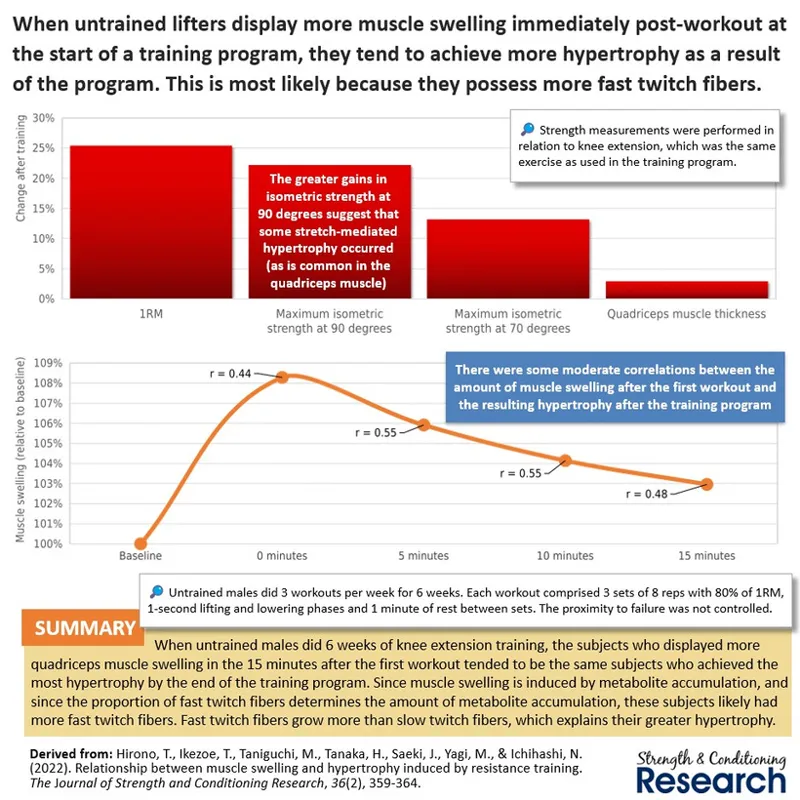
Some researchers have shown that when a muscle experiences more swelling at the start of any given strength training program, this is associated with more hypertrophy after finishing the training program. While this has been claimed as supporting evidence for the metabolic stress hypothesis, it is easily explicable by the fact that those lifters who start the program with more fast twitch fibers will experience more hypertrophy.
.
Conclusions
After strength training, muscles that contain a larger proportion of fast twitch muscle fibers (like the gastrocnemius) display more hypertrophy than muscles that contain a larger proportion of slow twitch muscle fibers (like the soleus). Similarly, fast twitch muscle fibers themselves display more hypertrophy than slow twitch muscle fibers after strength training. Therefore, we should always expect greater hypertrophy to occur when a muscle or an individual has a high proportion of fast twitch muscle fibers. Compared to muscles comprising mainly slow twitch fibers, muscles comprising predominantly fast twitch fibers produce more metabolites. The production of metabolites is the primary determinant of muscle swelling (the pump) during exercise. In other words, muscles with more fast twitch fibers will experience greater pumps. For this reason, we should expect that lifters who naturally experience bigger pumps during strength training workouts will subsequently experience much more hypertrophy after any given strength training program in comparison with lifters who experience smaller pumps. Such observations do not indicate that the pump causes hypertrophy or that techniques that produce greater pumps will produce more hypertrophy. They simply indicate that lifters who have more fast twitch fibers (who therefore generate more metabolites and greater pumps) will grow more than lifters who have fewer fast twitch fibers (who therefore generate less metabolites and smaller pumps).