




Maximizing the effects of higher volumes
Higher training volumes (up to a point) are often associated with greater hypertrophy. Nevertheless, there are clear indications of diminishing returns with each additional set. Understanding why this diminishing returns effect occurs is key to maximizing the effects of using higher training volumes.
.
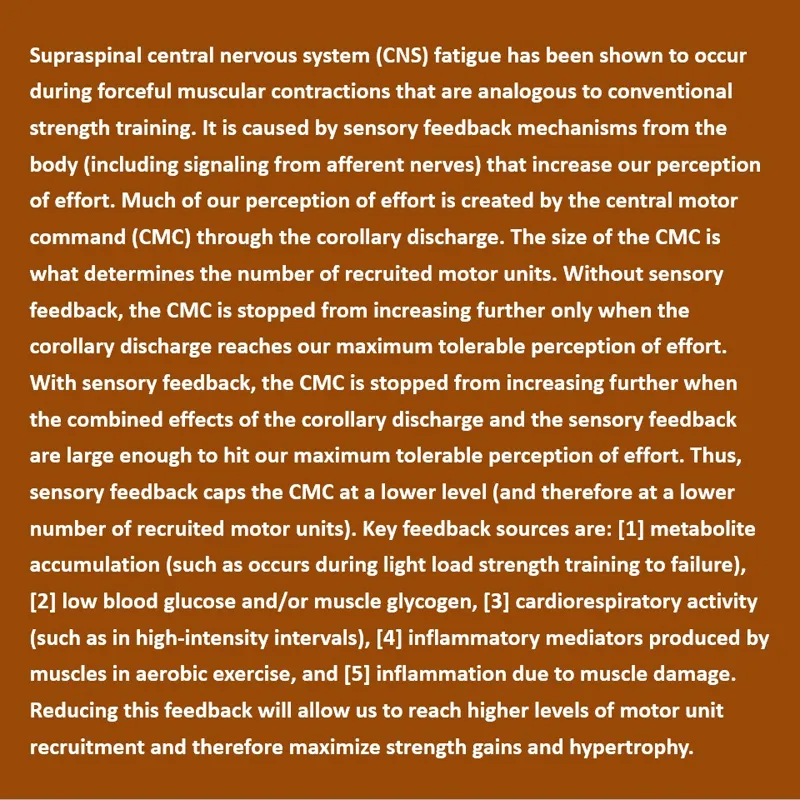
#1. More supraspinal CNS fatigue is present during later sets
Supraspinal CNS fatigue develops over the course of a workout, and therefore affects the later sets to a greater extent than the earlier sets. When supraspinal CNS fatigue is present, the central motor command corresponding to a given level of effort is lower and so fewer muscle fibers are activated. This reduces the amount of hypertrophy that is stimulated.
.
Supraspinal CNS fatigue is caused by a range of sensory feedback mechanisms that can be avoided if we program correctly. By avoiding exercise techniques that increase negative feelings such as being out of breath or having burning sensations in the muscles, we can maximize motor unit recruitment in each set of the workout (read more).
.
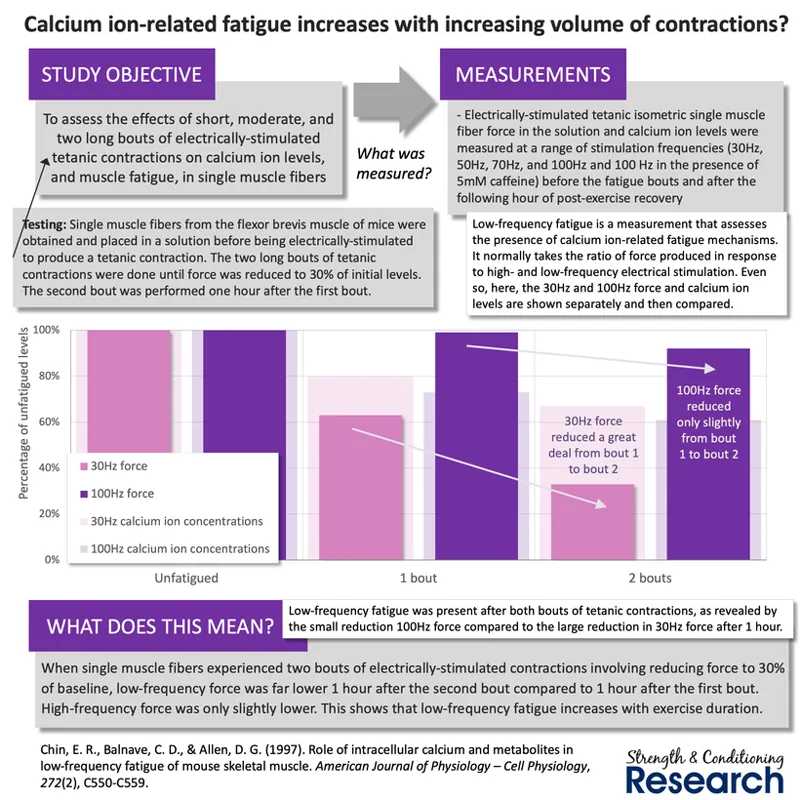
#2. More calcium ion-related fatigue is present during later sets
Calcium ion-related fatigue develops over the course of a workout, and therefore affects the later sets to a greater extent than the earlier sets. When calcium ion-related fatigue is present, the mechanical tension produced by the activated muscle fibers is reduced. This reduces the amount of hypertrophy that is stimulated.
.
Calcium ion-related fatigue (read more) is caused by calcium ion accumulation inside the cytoplasm. To stop this from happening, we want to use lower rep ranges, to leave a couple of reps in reserve, and to avoid exercises that involve peak forces in the lengthened position or slow lowering phases.
.
#3. More muscle damage is produced by later sets
Muscle damage impairs hypertrophy because the post-workout elevations in myofibrillar protein synthesis (MYOPS) rates must be devoted to either muscle damage repair or hypertrophy. Importantly, muscle damage increases with increasing amounts of training volume.
.
Muscle damage is also caused by calcium ion accumulation during the workout. Therefore, we can avoid it by the same techniques that we used to avoid calcium ion-related fatigue (read more).
.
Conclusions
Higher training volumes are associated with greater hypertrophy (up to a point). Yet, there are diminishing returns with each additional set. Understanding why this diminishing returns effect occurs is key to maximizing the effects of higher training volumes. One key reason for the diminishing returns effect is likely the development of fatigue mechanisms over the course of a workout. Such fatigue mechanisms include: [1] supraspinal central nervous system (CNS) fatigue (such that the number of activated muscle fibers is smaller in later sets), [2] calcium ion-related fatigue (such that the mechanical tension experienced by working muscle fibers is smaller in later sets), and [3] muscle damage (such that more of the post-workout muscle protein synthesis elevation from later sets is devoted to muscle damage repair instead of hypertrophy). We may be able to enhance the effects of higher volumes on hypertrophy by reducing supraspinal CNS fatigue, calcium ion-related fatigue during the workout, and muscle damage. Supraspinal CNS fatigue is caused by sensory feedback mechanisms. We can reduce these by using heavier loads, longer rest periods, and by stopping a couple of reps in reserve (to avoid the burning sensations in the muscle and cardiorespiratory activity). Calcium ion-related fatigue and muscle damage are both caused by calcium ion accumulation in the cytoplasm. We can reduce calcium ion accumulation by using heavier loads, stopping sets before failure, using exercises with peak forces in the contracted position, and avoiding slow lowering phases or any form of eccentric overload.