





Muscle damage
Everywhere in the fitness industry, we hear people saying that muscles are torn down and built back bigger. The idea that muscular contractions cause muscle fibers to be pulled apart is a sticky one but nevertheless still untrue. In fact, the mechanical pulling forces that all muscle fibers experience during exercise is not the cause of the damage that they experience.
.
#1. Muscle damage occurs when forces are low
If muscle damage were caused by the mechanical pulling forces that muscle fibers experience during eccentric contractions or isometric contractions at long muscle lengths, then it would be impossible for damage to occur when muscle forces are very low due to accumulated fatigue. Nevertheless, the majority of the damage that muscle fibers experience occurs when muscle forces are extremely low, while calcium ion-related fatigue mechanisms are advanced due to calcium ion influx.
.
#2. Muscle damage occurs after concentric contractions
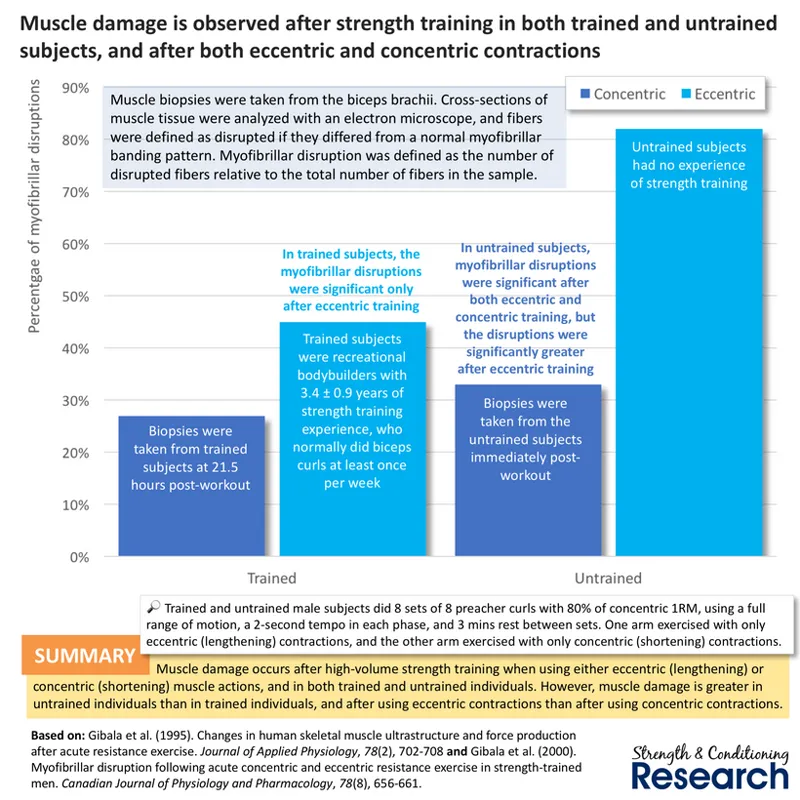
If muscle damage were caused by the mechanical pulling forces that muscle fibers experience during muscular contractions, then it would be impossible for damage to occur during concentric contractions. Nevertheless, concentric-only training can and does produce myofibrillar damage, as measured by electron microscopy.
.
#3. Muscle damage occurs mainly in the post-workout period
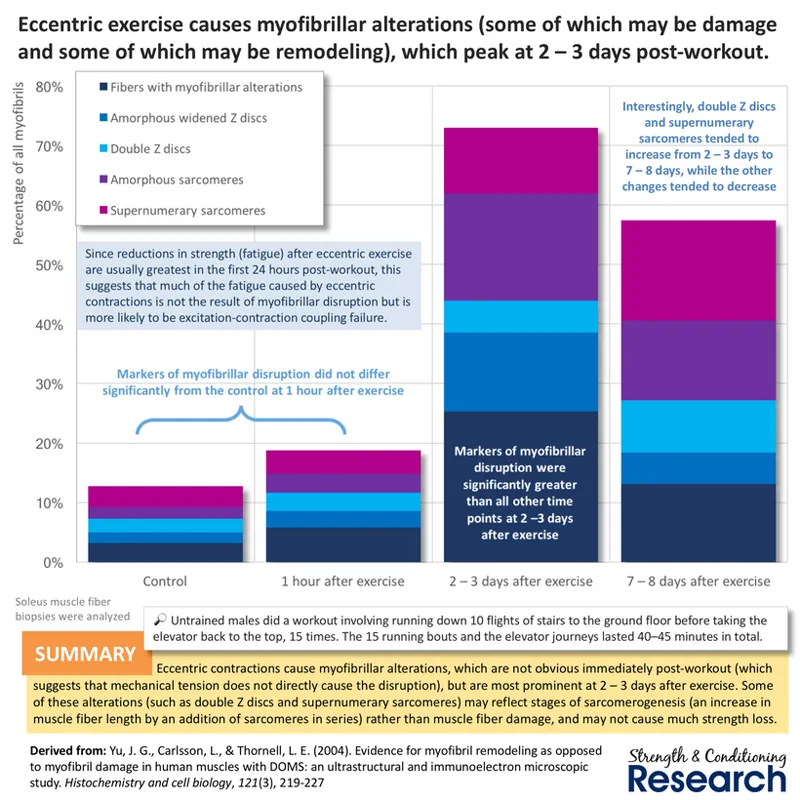
If muscle damage were caused by the mechanical pulling forces that muscle fibers experience during muscular contractions, then it would be impossible for damage to occur during the post-workout period. Nevertheless, the vast majority of the structural damage to myofibrils of the muscle fibers develops in the post-workout period and minimal damage actually occurs during the workout itself.
.
Indeed, a great many studies have been performed showing that the majority of the myofibrillar damage inside muscles occurs during the post-workout period.
.
The structural damage to myofibrils in the post-workout period involves the loss of both actin and myosin. Loss of these proteins causes a temporary reduction in strength because of a reduction in the number of crossbridges that can form.
.
#4. Muscle damage occurs in the post-workout period due to inflammation
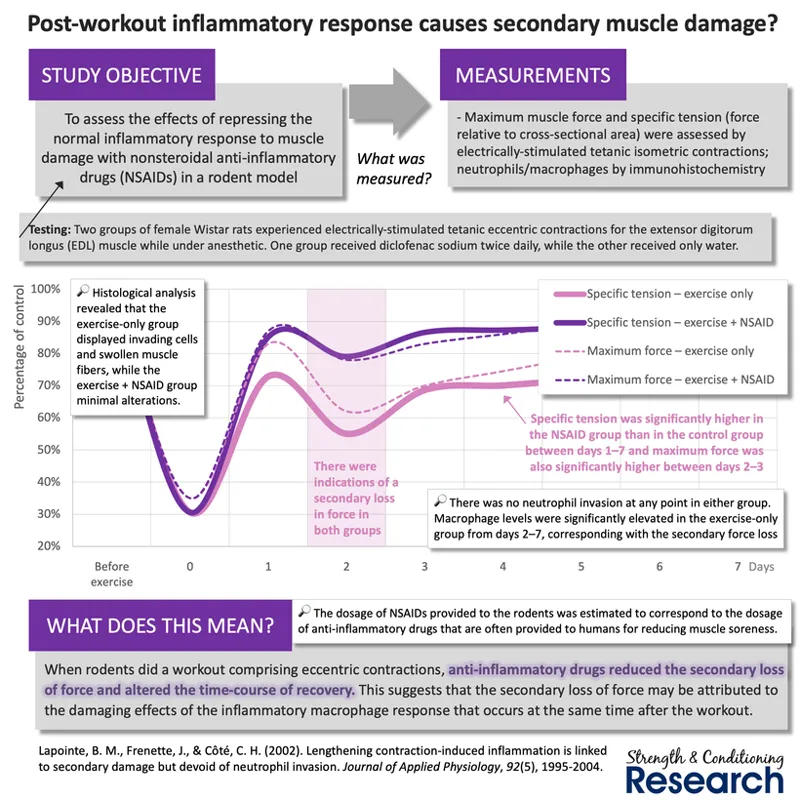
If muscle damage were caused by the mechanical pulling forces that muscle fibers experience during muscular contractions, then it would be impossible for damage to occur during the post-workout period. Yet, the inflammatory response that is generated in the post-workout period has been closely associated with the muscle damage and post-workout fatigue that is experienced. This can be seen from secondary muscle damage studies, which show that removing this inflammatory response inhibits the secondary loss of strength in the post-workout period.
.
It can also be seen from secondary muscle damage studies that have reported a very close connection between the inflammatory response (by reference to the infiltration of mononuclear cells) and the appearance of post-workout fatigue.
.
Conclusions
A common misconception about muscle damage is that it is caused by muscle fibers being pulled apart by eccentric contractions (and by isometric contractions at long muscle lengths). Nevertheless, the mechanical tension (pulling forces) that muscle fibers produce and experience during exercise does not damage them. Rather, muscle damage is caused by calcium ion accumulation leading to calpain activity and an inflammatory response. We know this for four reasons. [1] Most post-workout fatigue that muscles experience is generated while muscle forces are very low due to calcium ion-related fatigue. Low muscle forces cannot pull muscle fibers apart. [2] Myofibrillar damage is observed following concentric-only contractions (as well as after eccentric and isometric contractions). Muscle fibers cannot be pulled apart if they are not being stretched during muscular contractions. [3] Most myofibrillar damage occurs during the post-workout period and not in the workout itself. Pulling forces cannot cause muscle damage during the post-workout period while they are not present. [4] Post-workout inflammation subsequent to calcium ion accumulation (and calpain activity) in the workout appears to be the primary reason for myofibrillar damage. Reducing inflammation removes the secondary fatigue effect that occurs several hours after exercise. Obviously, if the post-workout inflammatory response is the main cause of muscle damage, then pulling forces are not.
Comments (3)
Where can i read more about mechanism of calcium ion accumulation? Thank you
is all muscle damage caused by calcium ion? and since calcium ion been siggested to cause fiber type shift of iix fibers, is there anyway for speed or power athletes to maintain their cardio health without loss in speed
Yes, all muscle damage is caused by calcium ions. Cardiovascular adaptations can be created with low levels of muscle activation when using long-slow type training. Muscle fibers will not shift if they are not activated.