



Training frequency
Training frequency for bodybuilding refers to how often each muscle can be trained in any given week. The optimal training frequency depends on three factors: [1] the duration of time required for the stimulus to cause hypertrophy, [2] the duration of time until atrophy of some muscle fibers occurs, and [3] the duration of time required to recover from fatigue mechanisms.
.
#1. The duration of the hypertrophy stimulus period
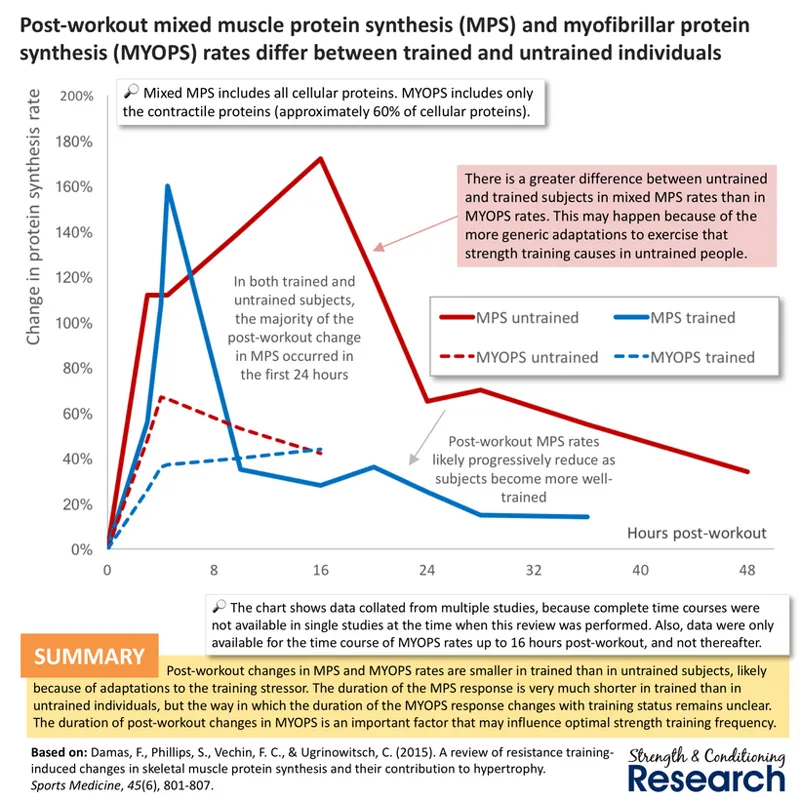
After a strength training workout, muscle fibers experience an increase in the rate of muscle protein synthesis (which contributes to an increase in the amount of various proteins within the fiber) and also in the rate of myofibrillar protein synthesis (which contributes to an increase in the amount of myofibrillar, contractile proteins in the fiber). This process must be completed for increases in muscle fiber diameter or muscle fiber length to occur. Currently, it is not entirely clear how long is required for the rates to increase and then return to normal levels. Similarly, it is not clear whether further increases can be stimulated to occur while rates are already increased. If myofibrillar protein synthesis rates are elevated for more than 24 hours (which seems quite likely), then it may not be ideal to train muscles every day.
.
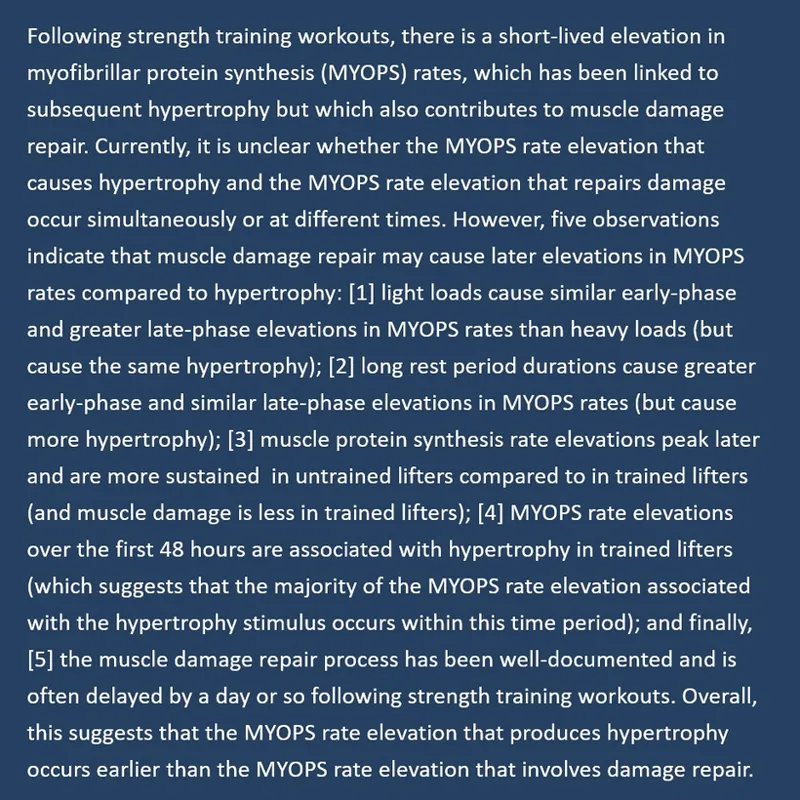
Importantly, the elevation in myofibrillar protein synthesis rates that occurs after a workout performs two functions. Firstly, it produces hypertrophy of the affected muscle fibers. Secondly, it repairs the damaged parts of the trained muscle fibers. The elevation in myofibrillar protein synthesis rates that creates hypertrophy seems to occur faster and finish earlier than the elevation that is intended to repair muscle damage, which implies that the duration of the stimulus period could easily be shorter than 48 hours (read more).
.
#2. The duration of time before atrophy of some muscle fibers occurs
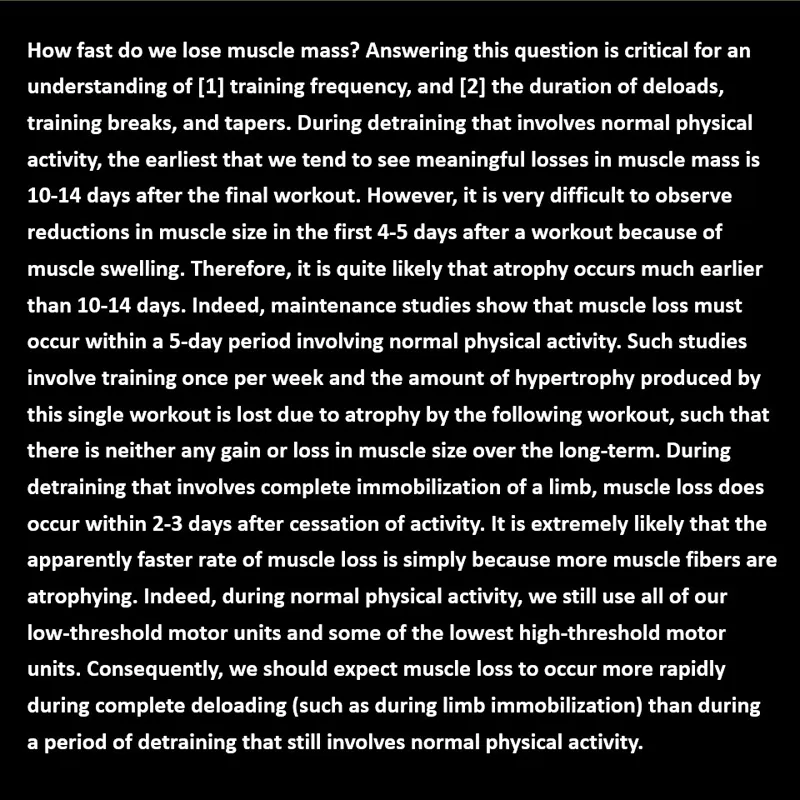
Although it is often assumed that muscle fibers only begin to reduce in size after a couple of weeks of detraining, this is not true. Detraining studies have reported significant losses of muscle size within 2 weeks of stopping a strength training program. Moreover, bed rest and limb immobilization cause significant atrophy within only 2-3 days (read more).
.
More recent research continues to support a shorter and shorter time period for atrophy to happen between workouts. Indeed, the latest detraining study has proven that muscle atrophy occurs within a single week after finishing a strength training program.
.
#3. The duration of time needed to recover from fatigue
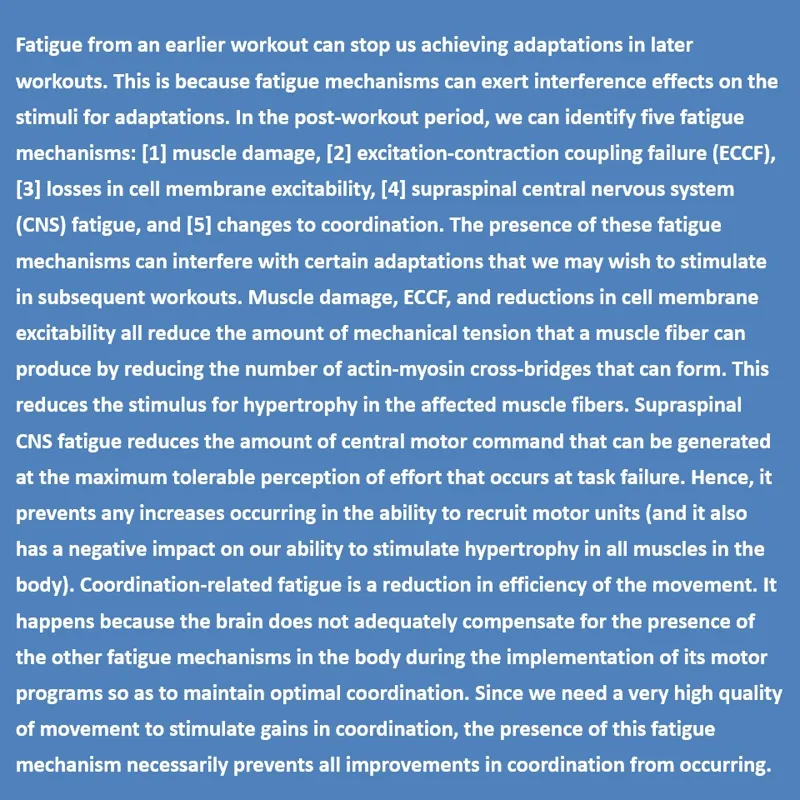
Post-workout fatigue occurs after each strength training workout and always comprises three major mechanisms that can persist for days (read more).
.
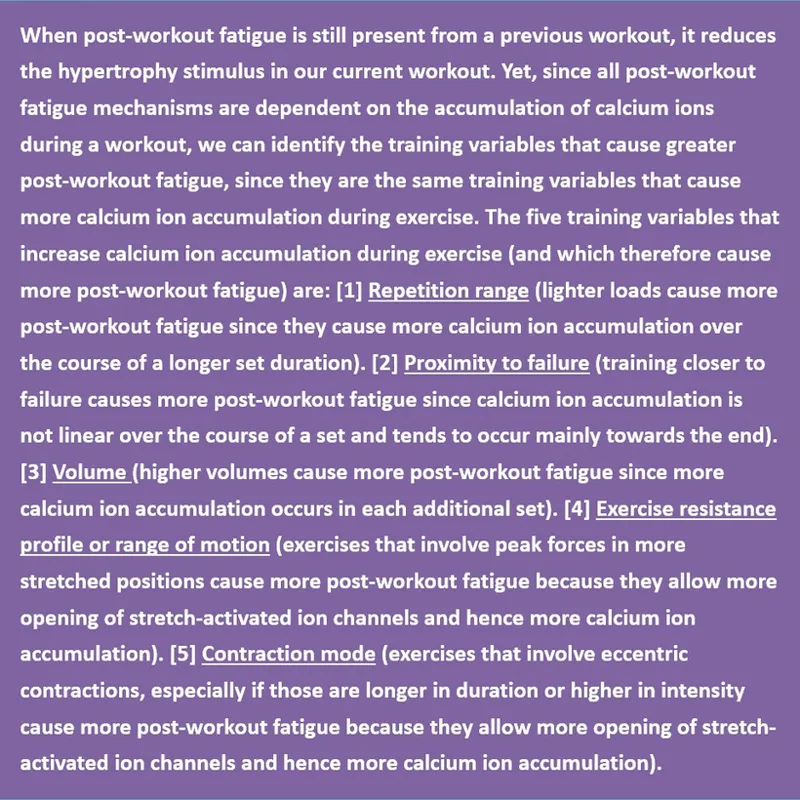
Post-workout fatigue can interfere with our ability to stimulate hypertrophy in subsequent workouts since it can [1] reduce our ability to recruit high-threshold motor units, and [2] reduce the levels of single muscle fiber mechanical tension (read more).
.
Importantly, post-workout fatigue varies between lifters. Some individuals experience a great deal of fatigue after a workout, while others experience very little. This means that we should expect the effects of training frequency to vary a lot between individual lifters (perhaps more than any other training variable).
.
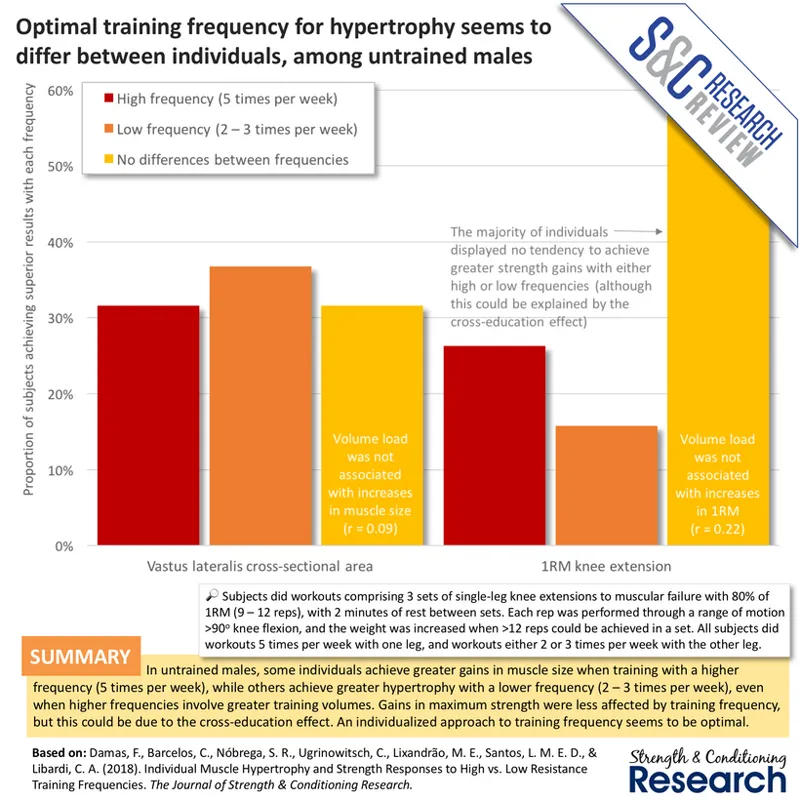
Indeed, recent research has indicated that some individuals experience more hypertrophy after using higher training frequencies, while other lifters respond better to lower training frequencies.
.
Those individuals who tend to experience more fatigue after a workout may benefit from employing strength training methods that reduce the amount of calcium ion-related fatigue that is experienced, such as training with heavier loads and lower volumes, stopping sets further from muscular failure, and using partial ranges of motion (read more).
.
Conclusions
Training frequency for bodybuilding refers to how often a muscle can be trained. Optimal training frequency probably depends upon three factors: [1] the duration of time required for the stimulus to cause hypertrophy, [2] the duration of time until atrophy of some muscle fibers occurs, and [3] the duration of time required to recover from post-workout fatigue mechanisms. The duration of time required for a stimulus to cause hypertrophy is probably <48 hours (albeit the exact duration is unclear). Subsequent workouts may not stimulate much hypertrophy if performed within this period of time. The limb immobilization research indicates that the duration of time until atrophy of some muscle fibers occurs is less than 2–3 days, while the detraining and maintenance literature both show that whole muscle atrophy occurs within a single training week. Therefore, it is quite likely that some muscle fiber size gains are lost if muscles are not trained every 2–3 days. Finally, research indicates that the presence of post-workout fatigue can impair hypertrophy by reducing the mechanical tension that can be produced (by calcium ion-related fatigue mechanisms, which include muscle damage) or by reducing the motor unit recruitment level achieved (by supraspinal central nervous system fatigue). Subsequent workouts may therefore not stimulate as much hypertrophy if they are done when either of these fatigue mechanisms are still present.



Comments (20)
Do you think high effort, low fatigue, high velocity unloaded movements can be used to prevent reduction in muscle size in between workouts? The idea would be to engage the HTMUs just enough to keep them in place until the following workout, while incurring minimal fatigue. I'm thinking something like explosive wall pushups, unloaded jump squats, or even something like a few "air punches", high velocity shoulder flexions/extensions and such. I wonder what the minimum necessary stimulus would be.
Probably not, because we believe that the stimulus for hypertrophy is a sufficient level of mechanical tension, and the high velocity involves a low level of mechanical tension due to the force-velocity relationship.
I was waiting for this post of yours! I just have few questions regarding bodybuilding style programming and strength training programming I remember you saying that you like to run a program for 6+ months, why would you change a program after that? 1. Would you ever increase volume? 2. Do you change exercises after that? Also, I was reading more about Hepburn training method. He suggests to do 8 sets of 2 reps twice per week for a particular exercise, after that he uses higher reps of the same exercise. IMO, 8x2 twice per week is way too much. 3. In your opinion, is it enough to do 5 sets of 2 ONCE per week, and one accessory exercise of some kind to increase MAX strength? 4. Additional question: if powerbuilding (hypertrophy + one rep max increases) is the goal, would also suggest using Hepburn training? Or is it more optimal to stick with 3x5-7 with no doubles or singles? Thanks, Chris. Maybe my question is too long. I will understand if you will not answer it.
Regarding long-term programs of 3+ months, the variability depends on the goals. For hypertrophy, I never usually change volume once I know what the optimal session volume is for adaptations relative to fatigue. However, I do change exercises, making sure to cover similar bases in terms of muscle regions, albeit with slightly different emphases. For strength, I might change volumes (sets to failure) when changing loads, since I would typically want to spend some time training with 5RM loads, and some time training with slightly heavier loads.
Chris, is there a list of the recommended exercises that impact muscle damage less? But, to be a bit contrarian, doesn't recent data show that training a muscle in the lengthened position result in better hypertrophy? It seems I saw a study comparing partials at the contracted phase against partials at the lengthened phase and against full ROM. The partials at lengthened phase gave superior results. How would you balance these seemingly conflicting issues? Thanks
For some reason, there does not seem to be an FAQ entry for this question, so I will make one soon. Looking at the literature, we see that there are some studies that show a benefit of stretched position exercises and some studies that do not. Generally speaking, those studies that show a benefit were performed with the quadriceps or hamstrings, while those studies that do not show a benefit were performed with the triceps and biceps (there are one or two exceptions). This suggests that the muscle being trained affects the benefits provided by stretched position exercises. Indeed, this is logical, because different muscles have sarcomeres that work in different operating length ranges. The quadriceps work on the plateau and the descending limb, which enables high passive forces to be generated during stretch. In contrast, the triceps work on the plateau only, which means little passive forces are produced during stretch. For this reason, some muscles do not necessarily benefit from being trained in stretched positions, and we can train with the peak force in contracted positions. Additionally, since passive forces are determined by the sarcomere stretch (and no muscle stretch, as is often assumed), the amount of passive force reduces with increasing training status. Indeed, we can see that fascicle length improvements reach a plateau after only a few months of training, suggesting that the extra benefits of stretched positions are dramatically reduced in intermediate and advanced lifters compared to beginners.
Although, thinking out loud, is this moot as the studies messing actual growth show no significant difference between frequencies. And now I think of how that doesn’t address N=1. Maybe I am more responsive to one end or the other of the spectrum rather than being at the average of the distribution. Probably just answered my own question
IMO, the reason for the lack of differences in the long-term training studies is that the subjects in the groups training with a lower frequency always recover from one workout to the next, while the subjects in the groups training with a higher frequency do not. If we tested a lower session volume, I think that the higher frequency would be superior.
So it’s better to limit per session volume to prevent fatigue from lasting longer than 2-3 days to allow for the muscle to be trained again? I personally can only do about 3 sets per muscle in order to maintain a frequency of 3x a week
Yes, limiting session volume (and training with 1–2RIR, using 5–7 reps per set, and preferring contracted position exercises) can help increase frequency. I'm exactly the same insofar as I need to limit myself to 3 sets per muscle group to be able to train 3x per week, but at that volume I can run a program for 6+ months.
Chris, is the word “not” missing from this line in the article? “ Muscle fiber size gains are likely lost if subsequent workouts are performed after 2–3 days”
It's a little unclear. If subsequent workouts are performed WITHIN 2–3 days, then muscle fiber size gains will not be lost. However, if subsequent workouts are performed AFTER 2–3 days, then some of the gains will be lost.
I think that this head-on comparison is rather approximate and synthetic. So why we lift 1RM or sprint with maximal effort after the rest period up to week and more? After all, the HTMU had to atrophy
I am not sure that I understand the question. If you mean why do tapers work for high-velocity movements like sprinting, then they work (despite a loss of muscle fiber size) because of [1] a removal of fatigue, and [2] a shift in muscle fiber type from type IIA to type IIX that causes a large increase in speed.
Do we really experience a complete limb immobilization in our day to day ?
No, but…the ‘ highest-threshold motor units cannot detect whether they are being left unused between workouts or whether they are being left unused due to limb immobilization.’
So does that mean for an optimal bodybuilding program you should be doing some sort of upper-lower or PPL split where you hit the same muscles every 2-3 days (with low volume of course)?
Yes, I think that training a muscle 3 days per week is likely to be the optimal training frequency for most bodybuilding programs.
This limb time imobilization doesn't imply the limb isn't moving at all ? So normal daily activity would not be good enough to at least delay this muscle loss ?
We can learn from limb immobilization literature even though the situation is different in day-to-day. To learn, all we have to do is understand that the muscle fibers of most high-threshold motor units cannot tell the difference between a limb being immobilized and a limb just taking part in the activities of daily life.