





Myofibrillar protein synthesis rates
After strength training workouts, there is often a post-workout elevation in muscle protein synthesis (MPS) and/or myofibrillar protein synthesis (MYOPS) rates. Such elevations are often interpreted as an indication of the amount of hypertrophy that has been stimulated and of the duration of the post-workout stimulus phase. However, elevations in MPS/MYOPS are also needed to bring about muscle damage repair. So do the two elevations in MPS/MYOPS rates coincide with one another or does one precede the other?
.
#1. Muscle damage repair only starts 1-2 days after exercise
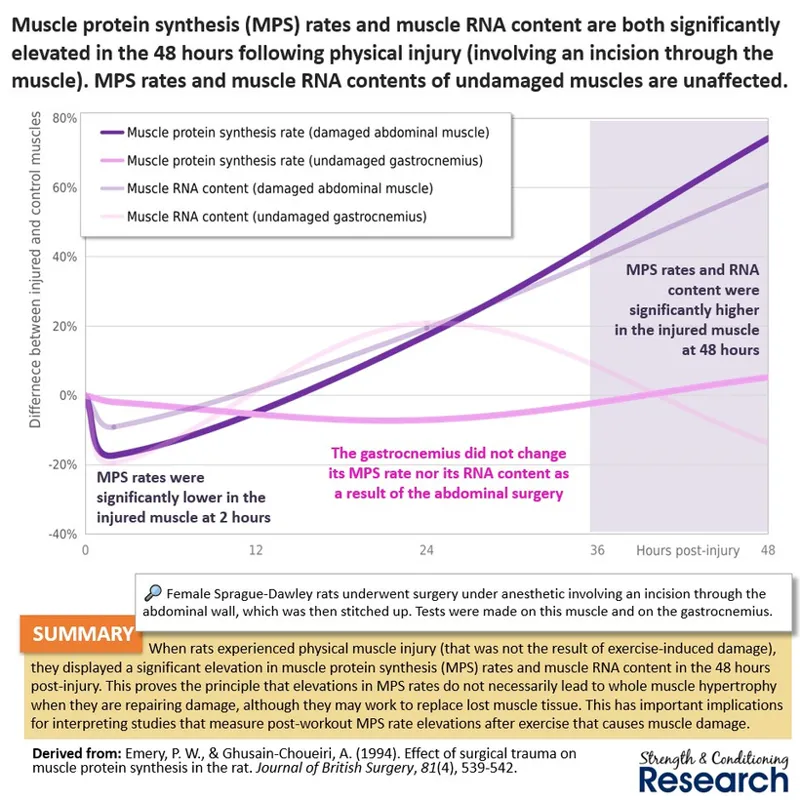
Studies that have recorded MPS or MYOPS rate elevations after injuries (rather than exercise) are extremely useful because they do not involve any MYOPS rate elevation for hypertrophy, merely for muscle damage repair. Such studies all show that MYOPS rate elevations appear only after 24-48 hours post-injury.
.
Multiple studies have been performed involving different causes of muscle injury. However, they all tend to show the same trend with elevations in either MPS or MYOPS only really being significant at 48 hours post-injury.
.
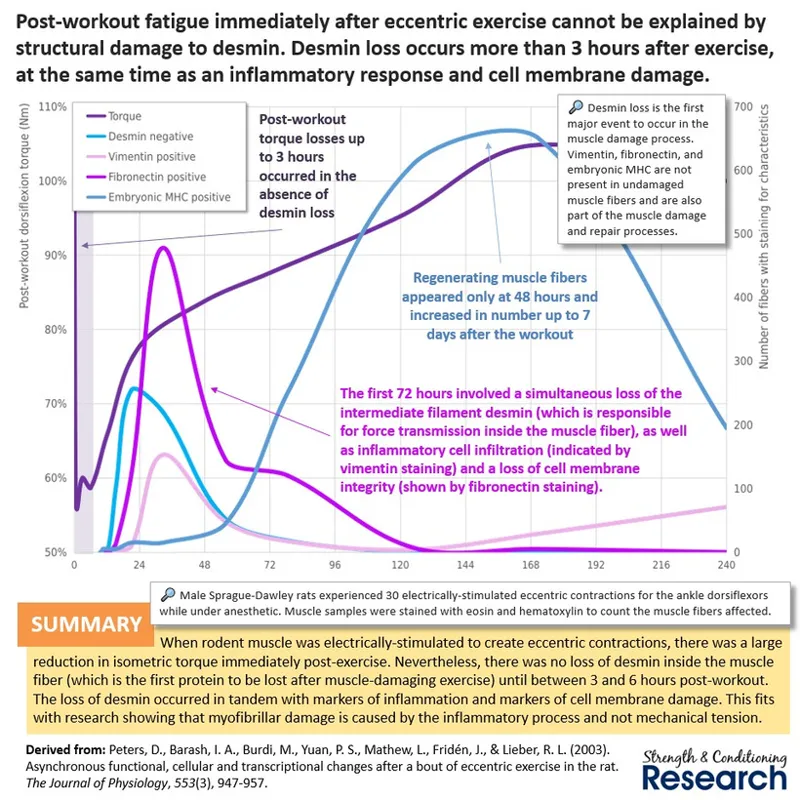
And we can see that muscle damage repair behaves in the same way after exercise. Clearly, we cannot use MPS or MYOPS rate elevations to see this because there is no way of discerning how much of the MPS/MYOPS rate elevation is going towards hypertrophy and how much is going to the muscle damage repair process. Yet, we can see that regenerating muscle fibers only appear after 48 hours post-workout. This suggests that replacing damaged or lost proteins will similarly be delayed by 1-2 days (and obviously MPS/MYOPS rate elevations are what replace these damaged or lost proteins).
.
Multiple studies have reported this exact same finding. Muscle fiber regeneration does not happen until the muscle damage process (instigated by calcium ions and subsequent calpain production) has run its course.
.
In this context, it is important to remember that muscle damage is always caused by exactly the same phenomenon (accumulation of calcium ions) irrespective of whether the damage is instigated by exercise or injury or whatever. So it is totally valid to compare the data collected in each muscle damage model (read more).
.
#2. Compared to heavy loads, light loads cause greater elevations in MYOPS only after 24 hours post-workout
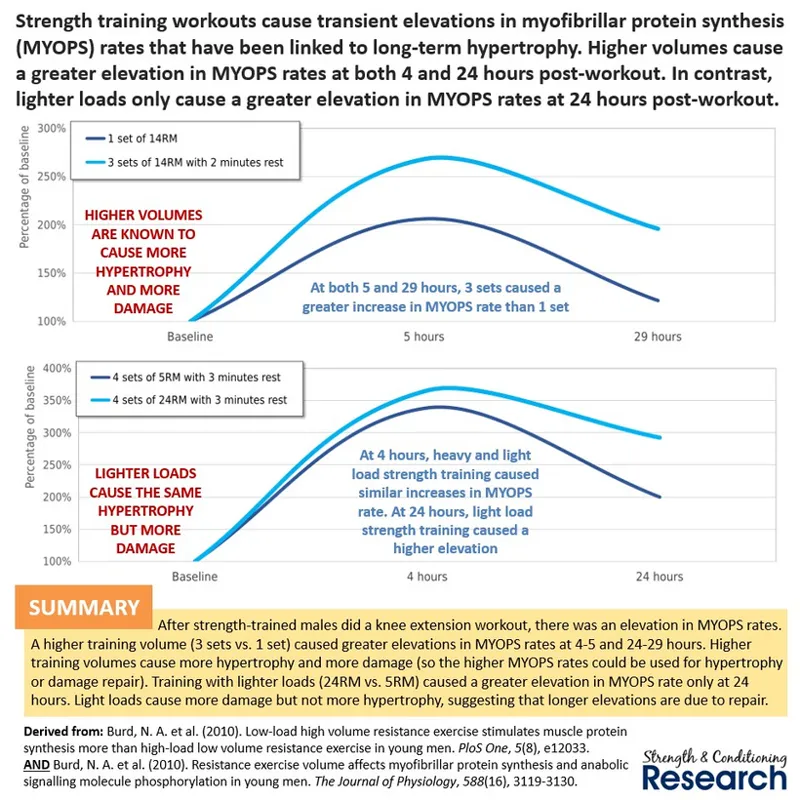
Studies have compared post-workout elevations in MYOPS rates across training variables like rep range and volume. In comparison with heavy load training, light load training causes greater MYOPS rate elevations only from 24 hours onwards. Since lighter loads do not cause more hypertrophy than heavier loads (but they do cause much more muscle damage), this confirms that the hypertrophy stimulus occurs earlier in the post-workout period, while the muscle damage repair processes occur later.
.
#3. Compared to short rests, long rests cause greater elevations in MYOPS only in the first 24 hours post-workout
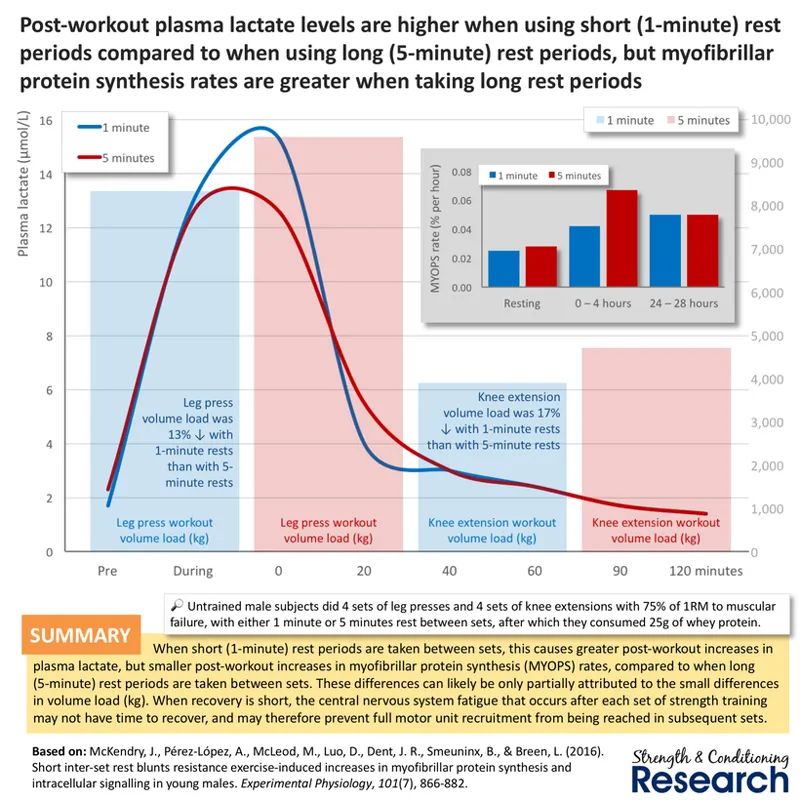
Multiple studies have now confirmed that longer rest periods are superior for hypertrophy. When measurements of MYOPS rates are taken after workouts involving either long or short rest periods, the long rest periods only create greater elevations in MYOPS in the first 24 hours (at most). In the second 24 hours, there is no difference in MYOPS rate elevations between long and short rest periods. This similarly confirms that the hypertrophy stimulus occurs earlier in the post-workout period, while muscle damage repair processes occur later.
.
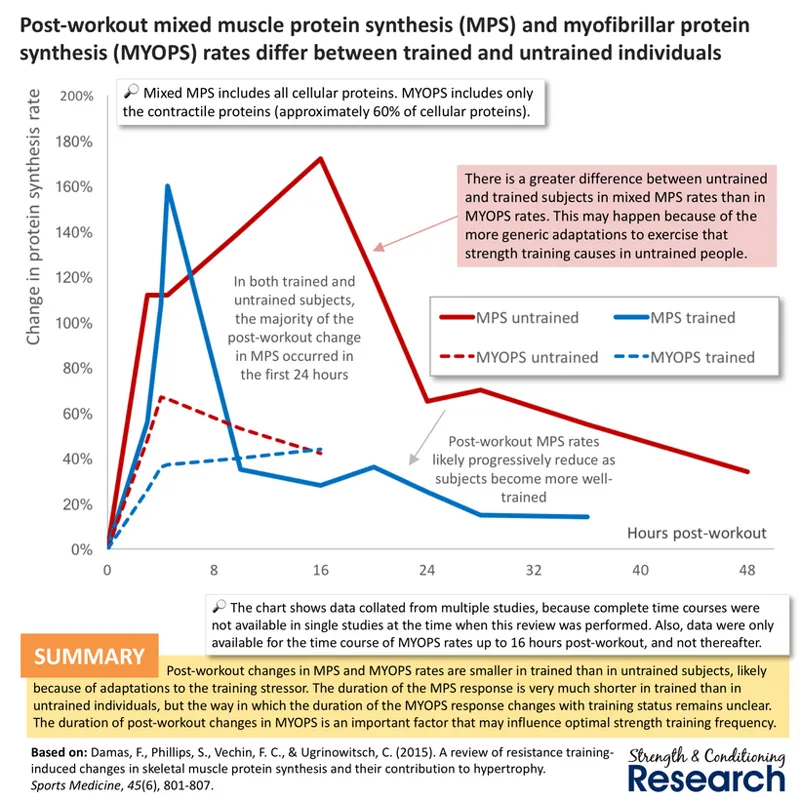
#4. Muscle protein synthesis rate elevations last much longer in untrained lifters than in trained lifters
Post-workout muscle protein synthesis rates (not myofibrillar protein synthesis rates) are more sustained in the untrained population. Since untrained lifters experience more muscle damage than trained lifters, the most obvious explanation for this observation is that the longer-duration elevations in muscle protein synthesis rates in the untrained subjects are caused by greater muscle damage repair processes.
.
#5. MYOPS rate elevations over the first 48 hours post-workout are associated with hypertrophy
After accounting for the contribution of muscle damage to the MYOPS rate elevations, the MYOPS rate elevations that occur in the first 48 hours after a workout are associated with the resulting hypertrophy after the training program. This suggests that the majority of the hypertrophy is stimulated within this period.
.
Conclusions
Following strength training workouts, there is an elevation in myofibrillar protein synthesis (MYOPS) rates. This MYOPS rate elevation is used for both hypertrophy and muscle damage repair processes. Five observations indicate that the MYOPS rate elevation that produces hypertrophy occurs before the MYOPS rate elevation that produces muscle damage repair. [1] Muscle injury studies (in which there is no MYOPS rate elevation for hypertrophy) report that MYOPS rates are only elevated AFTER 24-48 hours post-injury. In line with this, when myofibrillar damage has been directly measured following exercise, it only appears 1-2 days after a workout. [2] light load workouts (which create more muscle damage but similar hypertrophy to moderate load workouts) produce the same elevations in MYOPS rates in the first 24 hours post-workout but greater elevations in the second 24 hours. [3] workouts with long rests (which create similar muscle damage but more hypertrophy than workouts with short rests) produce greater MYOPS rate elevations in the first 24 hours post-workout but similar elevations in the second 24 hours. [4] muscle protein synthesis rate elevations last longer in untrained lifters than in trained lifters (and muscle damage is less in trained lifters); and [5] MYOPS rate elevations over the first 48 hours are associated with hypertrophy in trained lifters (suggesting that the majority of the MYOPS rate elevation associated with a hypertrophy stimulus occurs within this time).

Comments (2)
Does pressing on 60 deg incline with a barbell work side delts much? I know OhP works side delts but wasn’t sure if that level of incline still did or if it’s mainly front delt and tricep. Thanks
Great job as usual - thanks Chris - I'm curious if you and Paul can tackle an issue that I do not feel is addressed with science? Why are there high and low responders? And why is this process finite? Thanks!