



Recovery rates of muscle groups
Muscles typically experience a couple of days of post-workout fatigue and soreness after strength training workouts. However, the time required for recovery of each muscle differs. Why is this?
.
#1. What causes fatigue after a workout?
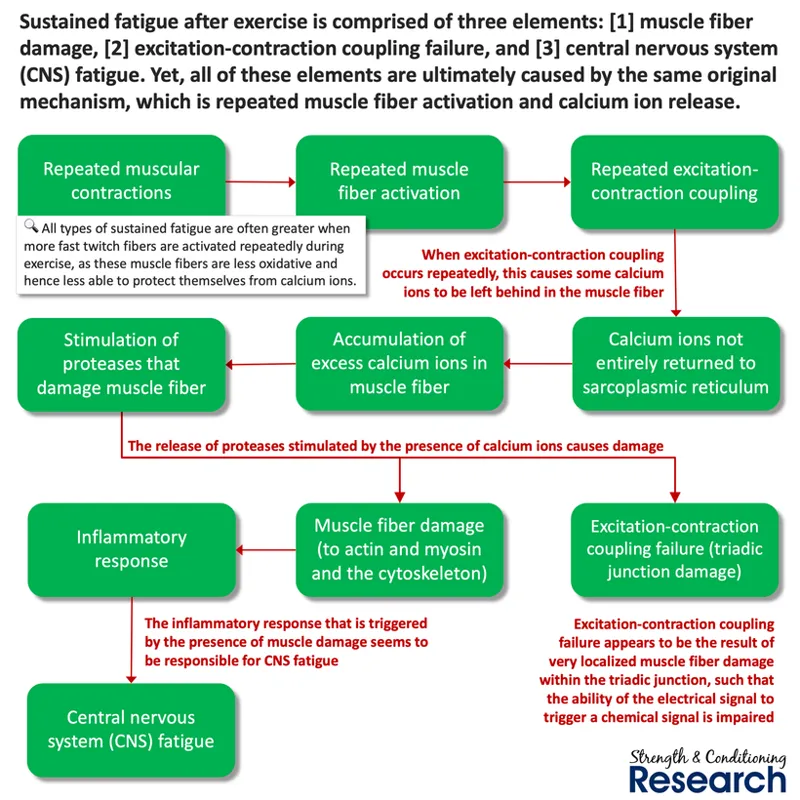
Fatigue after a workout is caused by three different fatigue mechanisms, being (1) excitation-contraction coupling failure, (2) muscle damage, and (3) central nervous system fatigue. However, ultimately, all three of these mechanisms are caused by the accumulation of calcium ions inside muscle fibers during a workout as a result of repeated muscle activation.
.
#2. What causes muscle fibers to experience more post-workout fatigue? (fiber type)
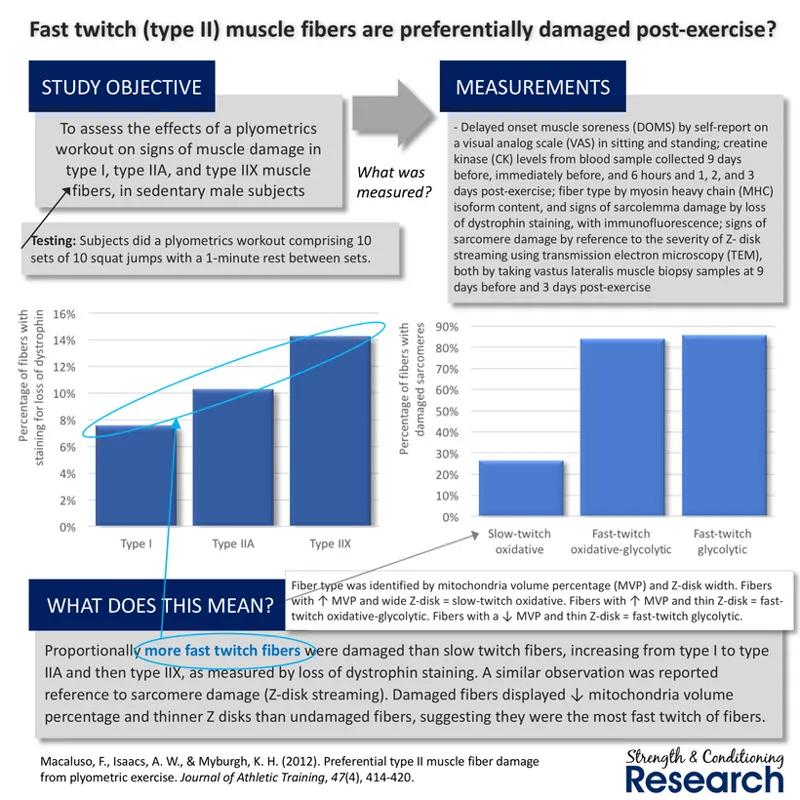
Fast twitch muscle fibers experience more excitation-contraction coupling failure and muscle damage after workouts compared to slow twitch muscle fibers.
.
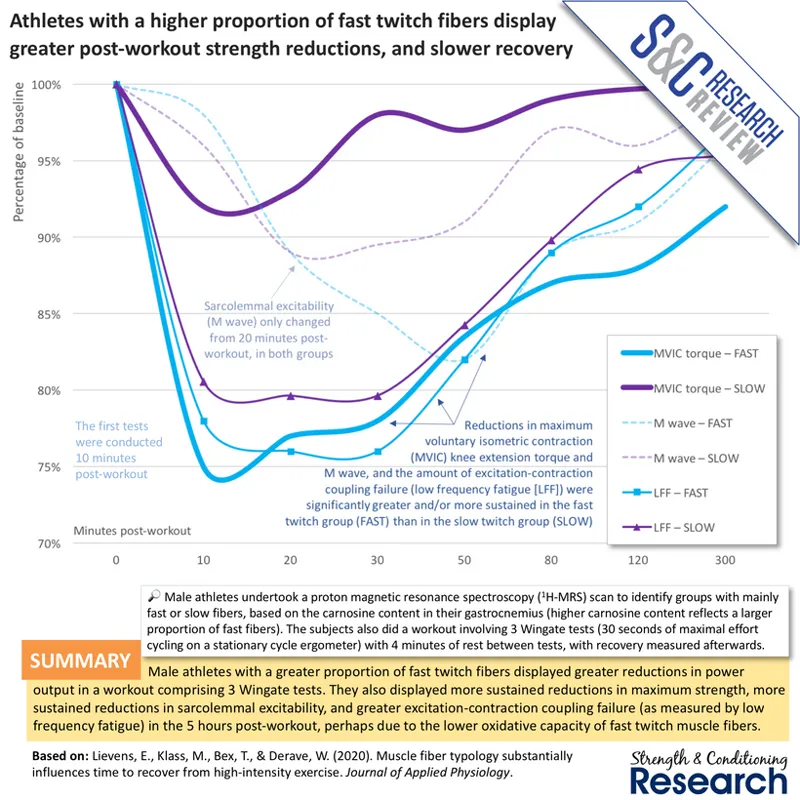
Consequently, when lifters have a higher proportion of fast twitch muscle fibers, they also experience more excitation-contraction coupling failure and muscle damage after a workout, and they display a slower rate of recovery.
.
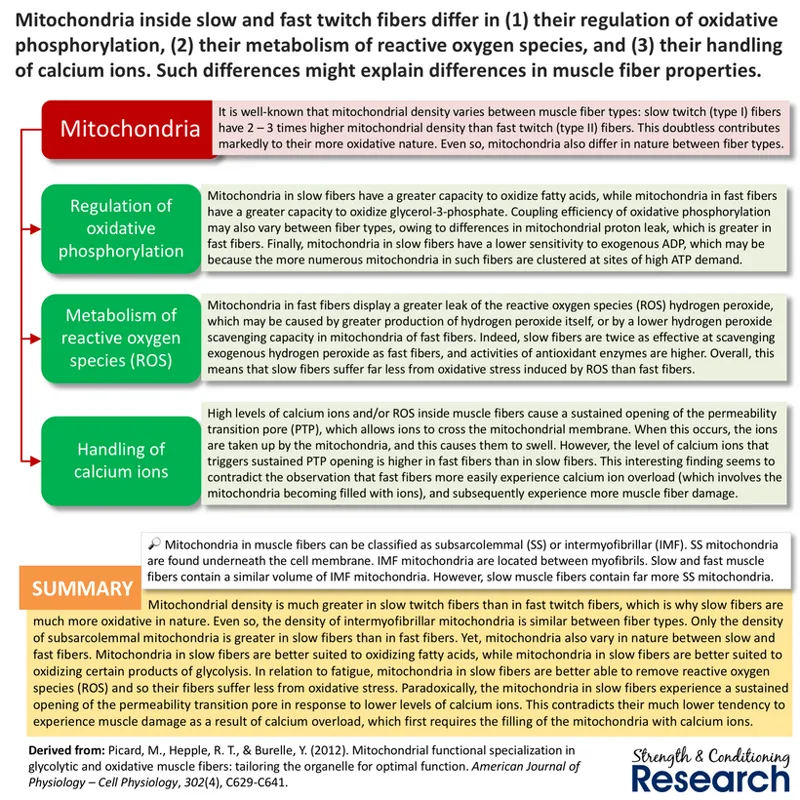
Fast twitch and slow twitch muscle fibers differ in several respects. However, one very important difference between them is the nature and number of their mitochondria. The mitochondria inside fast twitch muscle fibers are fewer in number and less capable of handling calcium ions. Thus, calcium ions can build up inside fast twitch muscle fibers much more easily during repeated muscular contractions. This makes fast twitch muscle fibers much more susceptible to calcium ion-related fatigue mechanisms.
.
Most muscles tend to have a similar amount of slow twitch muscle fibers and fast twitch muscle fibers. Even so, we can identify muscles that have more slow twitch muscle fibers (such as the soleus, adductor magnus, and erector spinae), muscles that have an equal balance of slow and fast twitch muscle fibers (such as the latissimus dorsi), and muscles that have more fast twitch muscle fibers (such as the biceps, triceps, and pectoralis major).
.
#3. What causes muscle fibers to experience more post-workout fatigue? (voluntary activation)
When the relative proportions of fast and slow twitch muscle fibers within a muscle are measured, this does not take into account how many of the muscle fibers can actually be voluntarily activated. Therefore, the level of voluntary activation that a muscle can achieve is also relevant for determining how susceptible a muscle might be to fatigue mechanisms. When a muscle can achieve a higher level of voluntary activation, more of its fast twitch muscle fibers can be activated (and therefore damaged). Such muscles tend to be smaller. In contrast, when a muscle can only achieve a low level of voluntary activation, fewer of its fast twitch muscle fibers can be activated (and therefore damaged). Such muscles tend to be larger.
.
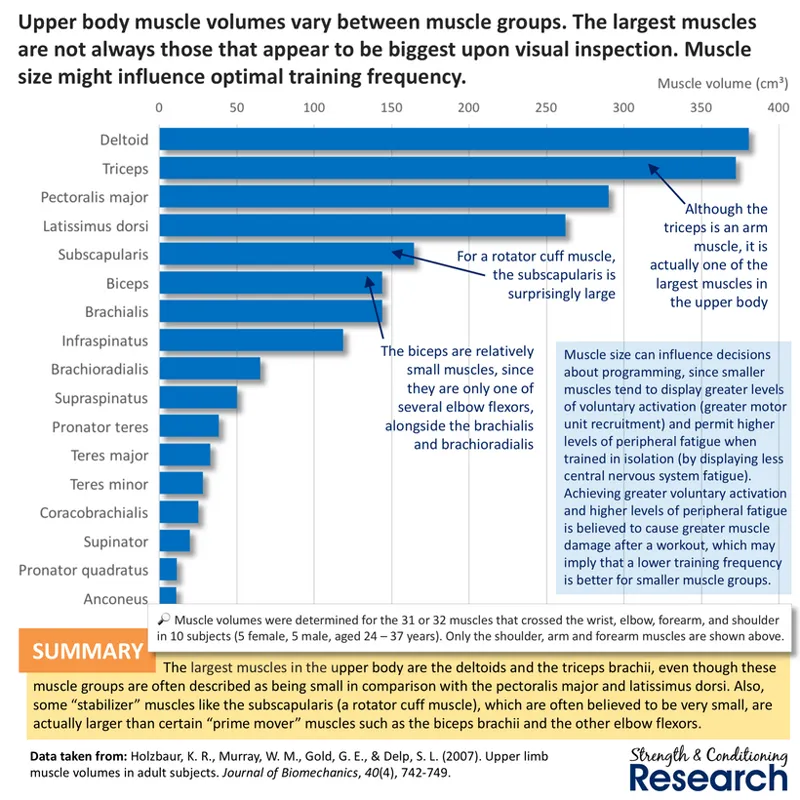
In terms of size, it is worth noting that the apparent size of a muscle does not always reflect its true size. Indeed, the pectoralis major is often assumed to be larger than the triceps brachii, but the opposite is in fact the case.
.
#4. Which muscles recover most slowly after a workout?
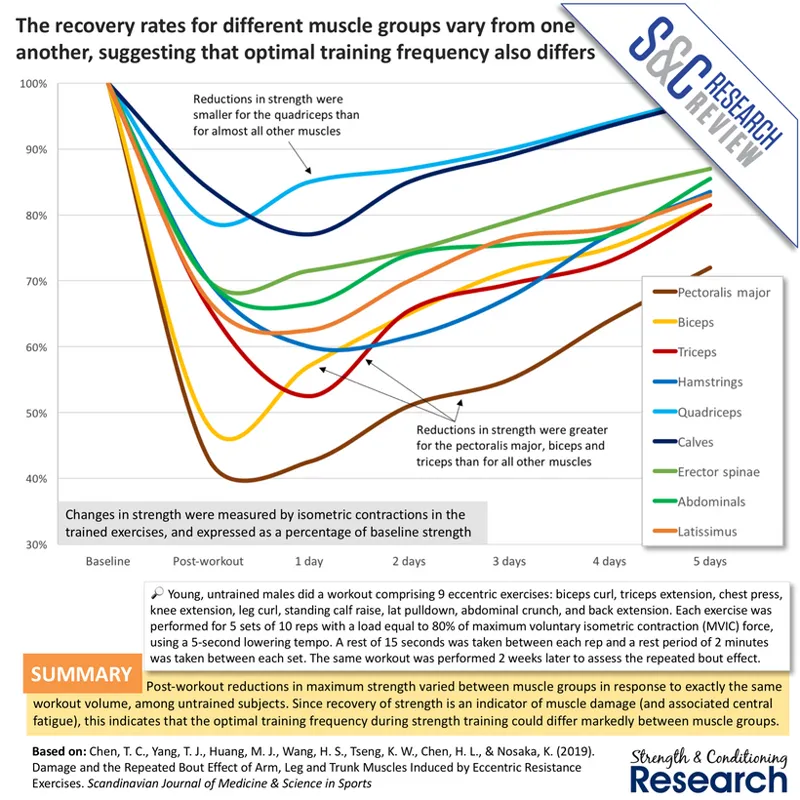
Muscles will experience more fatigue after a workout when they [1] have more fast twitch muscle fibers, and [2] are easier to activate (such muscles usually tend to be smaller). Muscles that experience the most fatigue after a workout are those that are both fast twitch-dominant and easy to activate (such as the biceps and triceps). Muscles that experience the least fatigue after a workout are those that are either very slow twitch-dominant and less easy to activate (like the soleus) or which have an equal proportion of slow and fast twitch muscle fibers and yet are extremely difficult to activate (such as the quadriceps).
.
Conclusions
Muscles can experience a couple of days of post-workout fatigue after strength training workouts. Yet, the time required for recovery of each muscle differs. Why is this? Post-workout fatigue primarily comprises excitation-contraction coupling failure, muscle damage, and central nervous system (CNS) fatigue. All three mechanisms ultimately result from the accumulation of calcium ions inside muscle fibers due to repeated muscle activation. Mitochondria defend the muscle fibers from the fatiguing effects of these calcium ions. Since they possess more mitochondria, slow twitch fibers are less susceptible to post-workout fatigue than fast twitch fibers. Consequently, muscles that have either [1] a high proportion of slow twitch fibers, or [2] a low voluntary activation level (such that few fast twitch fibers are activated anyway) will recover much more quickly after a given workout. For this reason, the soleus recovers very quickly after a workout (because it is very slow twitch). Similarly, the quadriceps (which has a balanced fiber type) also recovers very quickly (because it has an extremely low voluntary activation level). In contrast, the biceps and triceps muscles are fast twitch and also have high voluntary activation levels. Therefore, they recover very slowly after strength training workouts.
Comments (9)
Hi Chris, 1. Since in strength/hypertrophy training we’re concerned with training high twitch fibers, why should the composition of muscle fibers matter for recovery? Presumably, in any given muscle the fast twitch fibers will still take longer to recover? For example, we might attempt to train the slow-twitch predominant soleus muscle more frequently, but the fast twitch fibers we’re concerned would still be fatigued, wouldn’t they? So does it really make sense to train the soleus more frequently (for strength/hypertrophy)? In a sense, the reduction in performance (fatigue) is lower in slow-twitch dominant muscles because the initial performance is lower (compared to what it would have been with proportionally more fast-twitch fibers). Looking at this another way, this analysis seems to conflate whole muscle recovery with individual fiber recovery. Is it known whether CNS fatigue reduces CMC at whole muscle level or individual motor unit level? Regardless, since peripheral fatigue would still be present, would more frequent training really be productive? N=1, I haven’t noticed that I can train any muscle more frequently than others, but I’ll need to pay better attention to this factor going forward. --- 2. Another aspect of this is larger muscles with low activation levels such as the quads. If we analyze at individual fiber/motor unit level, will training more frequently activate fast-twitch motor units that were not activated in the “last workout.” Does the CNS “rotate” which fast twitch fibers are activated? If many fast twitch units were not activated in the “last workout”, why would they be activated in “this workout” just because we rested less rather than more between the workouts? === Hope I’m making sense. I am really just exploring here. Would love to hear your thoughts. Thanks for your work.
Bump.
Thanks for all the great info!
Where do glutes, shoulders and traps fall in this list?
Glutes are similar to quads insofar as they experience little damage and therefore recover quickly. This is because of their large voluntary activation deficit.
So in terms of hypertroohy is crucial to wait longer between training the muscles with slower recovery… i.e. If you wait 5-7 days between training pecs, tri or bi they will grow more?
Waiting longer between workouts has the disadvantage of losing gains due to the lack of a stimulus during the catabolic period. Ideally, we would use lower volume, less damaging exercises (partials, contracted position exercises), heavier loads, and 2RIR to reduce the amount of fatigue produced in those muscles
Hi, Chris. Can type IIx switch to IIa or to Ia? And what conditions should be for this switching?
Generally, it looks like type IIX fibers tend to shift to type IIA fibers after most types of exercise. I have written another Patreon post to explain how the shift occurs, and what types of exercise cause the greatest shifts.