


Perceptions
Perceptions are an important source of feedback during strength training, and we can make use of many of them to help us adjust training programs for optimal effect. Even so, in order to do that, we first need to understand how the messages originate and what they actually mean. Here are four common perceptions that we regularly experience, and which are often misunderstood.
.
#1. Perception of effort
The perception of effort is a feeling that we experience during exercise that tells us how hard we are exerting ourselves in order to perform a movement. According to the sensation of innervation theory, the perception of effort is largely produced by the corollary discharge from the central motor command. Consequently, perceiving that we are exerting a high level of effort tells us that we are producing a high level of motor unit recruitment. This is important, because we often experience very high levels of effort at the end of a set involving training to failure. These high levels of effort are indicators of high levels of motor unit recruitment, and are unrelated to the mechanical tension experienced by individual muscle fibers (indeed, we cannot perceive how much mechanical tension individual muscle fibers are experiencing).
.
The sensation of innervation theory been developed over a number of years as a result of careful studies into the nature of fatigue and task failure and is a very important concept to understand.
.
#2. Perception of burning inside a muscle
When metabolites accumulate inside a muscle, this causes metabolite receptors to send afferent feedback to the brain that creates the perceptions of burning inside the muscle. These perceptions therefore tell us that we are accumulating metabolites. Since metabolites do not stimulate hypertrophy or strength gains, this accumulation is not particularly desirable during strength training.
.
Indeed, we might even note that since the perceptions of fatigue increase the perception of effort and cause us to reach our maximum tolerable limit for effort earlier than normal, we can see that afferent feedback produced by metabolites actually causes central nervous system (CNS) fatigue. This will impair the stimulus for strength gains when it is present, and potentially also slightly reduce the stimulus for hypertrophy.
.
#3. Perceptions of soreness and post-workout perceived recovery
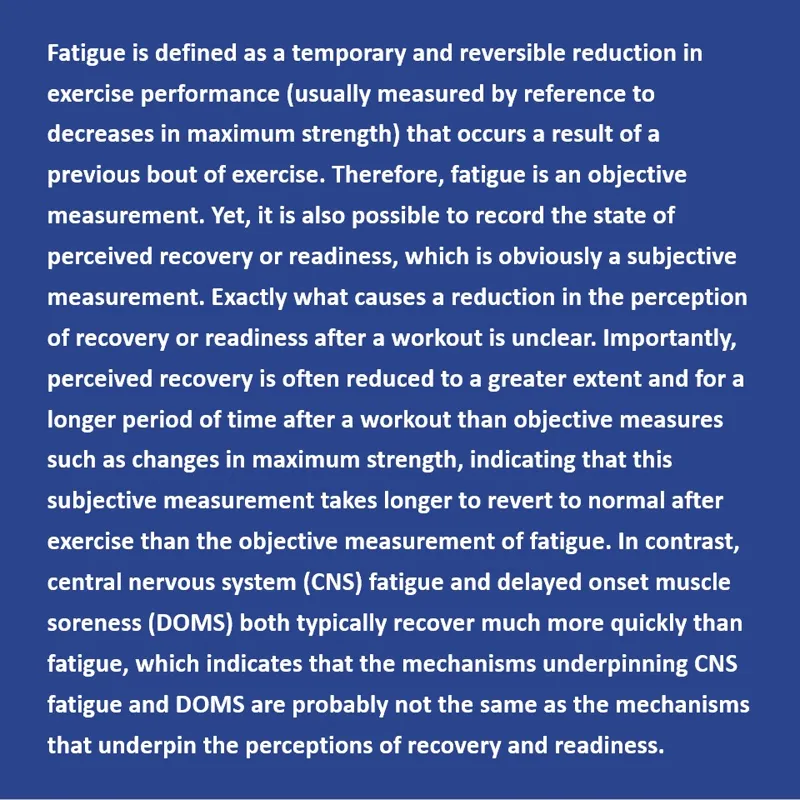
The perception of soreness after a workout is called delayed onset muscle soreness (DOMS). Unfortunately, we still do not know exactly what causes DOMS to occur. Importantly, while DOMS does seem to be greater when fatigue is greater, the time course followed by DOMS does not follow the same time course as fatigue. Thus, the presence of absence of DOMS probably is not a good indicator of whether fatigue is present.
.
We can also measure perceived recovery after a workout. Unfortunately, we do not know exactly what causes this rating to be high or low. And (just like DOMS), perceived recovery is not closely related to post-workout fatigue either. Thus, it cannot easily be used for readiness testing or setting training frequency (read more).
.
#4. Perception of stretch
The perception of stretch is produced by receptors inside a muscle including muscle spindles. Importantly, muscle spindles are separate from muscle fibers and therefore provide information about the length of the whole muscle, and not the extension of individual muscle fibers or their sarcomeres. Therefore, whether we perceive that a muscle is being stretched does not provide information about whether individual muscle fibers are experiencing high levels of passive tension (that can stimulate hypertrophy). This is probably why some individuals can experience much more benefit from training with full ranges of motion than others.
.
Conclusions
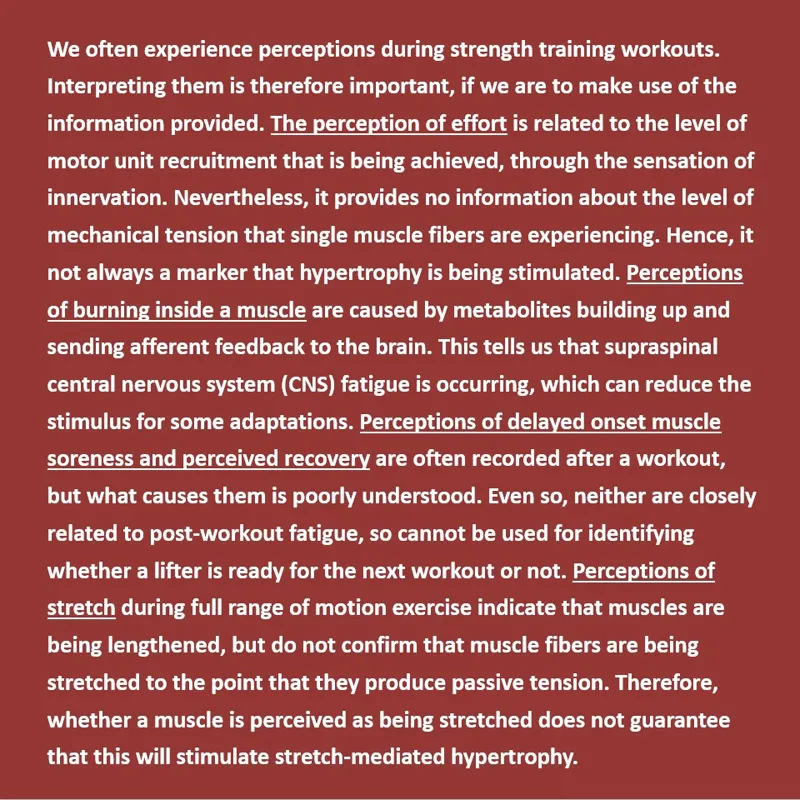
We often experience perceptions during strength training workouts. Interpreting them is important, if we are to make use of the information provided. The perception of effort is related to the level of motor unit recruitment that is being achieved, through the sensation of innervation. Yet, it provides no information about the level of mechanical tension that single muscle fibers are experiencing. Hence, it not always a marker that hypertrophy is being stimulated. Perceptions of burning inside a muscle are caused by metabolites building up and sending afferent feedback to the brain. This tells us that supraspinal central nervous system fatigue is occurring, which can reduce the stimulus for some adaptations. Perceptions of delayed onset muscle soreness and perceived recovery are often recorded after a workout, but what causes them is poorly understood. Even so, neither are closely related to post-workout fatigue, so cannot be used for identifying whether a lifter is ready for the next workout or not. Perceptions of stretch during full range of motion exercise indicate that muscles are being lengthened, but do not confirm that muscle fibers are being stretched to the point that they produce passive tension. Thus, whether a muscle is perceived as being stretched does not guarantee that this will stimulate stretch-mediated hypertrophy.
Comments (2)
Thank you Chris for the continued amazing information - this is fascinating because based upon your writings I have come to a general conclusion about training. Please correct me. People think that if they are working harder that necessarily the muscle is working harder. However this is a faulty assumption. In fact oftentimes the increase in effort is to compensate for less muscle working. Is this perspective accurate? Thanks!
Yes, it's true that we cannot assume that because we feel like we are working harder, then the muscle is also working harder. Perceptions of effort/fatigue are not perfectly related to motor unit recruitment levels, and perceptions of stretch are not at all related to the amount of passive mechanical tension produced.