



Perceived recovery
Fatigue is best defined as a temporary and reversible reduction in exercise performance (usually measured by reference to maximum strength) after a previous bout of exercise. Thus, fatigue is an objective measurement. Yet, it is also possible to record the state of perceived recovery or readiness, which is a self-reported, subjective measurement. Exactly what the perception of recovery or readiness is influenced by is still unclear.
.
#1. Perceived recovery status seems to take longer to recover than fatigue
When fatigue (which is an objective measurement) is compared with the state of perceived recovery (which is a subjective measurement), we can see that perceived recovery takes longer to return to normal than the fatigue itself.
.
Indeed, this may be because perceived recovery is more sensitive than many objective measurements of fatigue, as shown by the larger reductions that occur in the days following the workout.
.
#2. Does perceived recovery result from the same mechanisms as CNS fatigue?
It is possible that perceived recovery may be caused by the same underlying mechanisms as central nervous system (CNS) fatigue. CNS fatigue in the days after exercise seems to be caused by an inflammatory response that is stimulated to occur by the presence of muscle damage.
.
Indeed, the post-workout inflammatory response has been shown to coincide very closely with the presence of CNS fatigue after strenuous exercise.
.
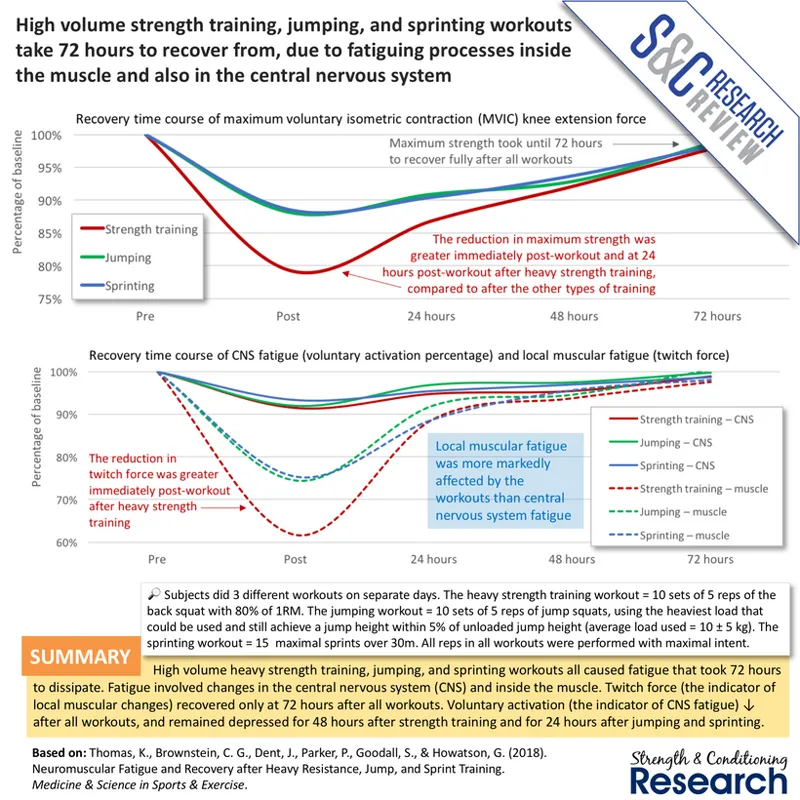
Nevertheless, CNS fatigue is well-known to dissipate slightly ahead of overall fatigue, which suggests that the inflammatory response to muscle damage cannot be the primary mechanism that causes a reduced perception of readiness after a workout.
.
#3. Does perceived recovery relate to delayed onset muscle soreness (DOMS)?
It is also possible that perceived recovery may be caused by the same underlying mechanisms as delayed onset muscle soreness (DOMS), although the exact causes of DOMS are still very unclear. Yet, again, several studies have demonstrated that DOMS usually also dissipates more quickly than fatigue itself, which stops it from being the main mechanism that underpins changes in perceived recovery.
.
Conclusions
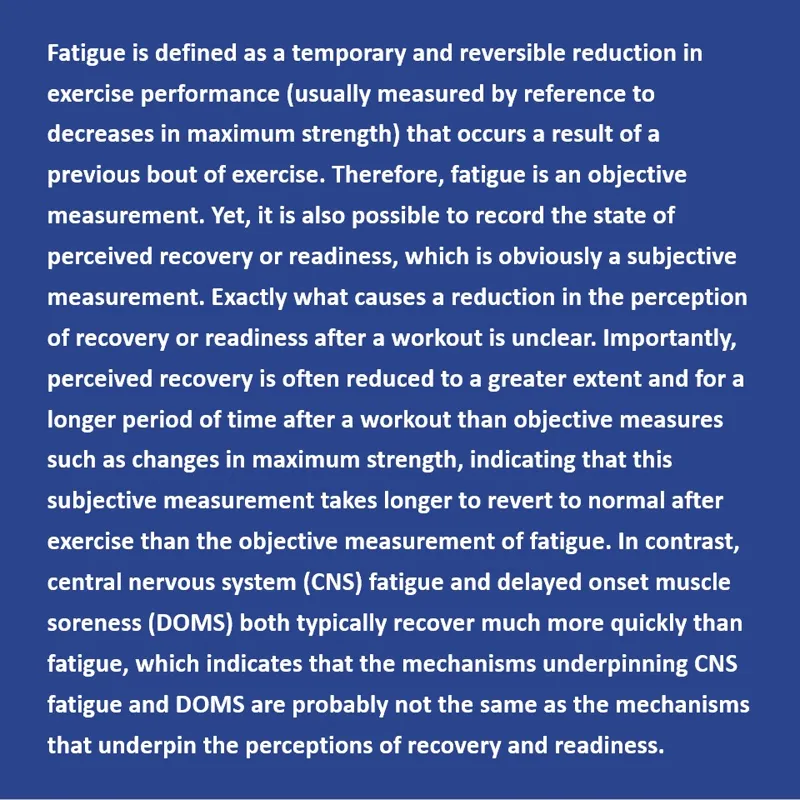
Fatigue is defined as a temporary and reversible reduction in exercise performance (usually measured by reference to decreases in maximum strength) that occurs a result of a previous bout of exercise. Therefore, fatigue is an objective measurement. Yet, it is also possible to record the state of perceived recovery or readiness, which is a subjective measurement. Exactly what causes a reduction in the perception of recovery or readiness after a workout is unclear. Importantly, perceived recovery is often reduced to a greater extent and for a longer period of time after a workout than objective measures such as changes in maximum strength, indicating that this subjective measurement takes longer to revert to normal after exercise than the objective measurement of fatigue. In contrast, central nervous system (CNS) fatigue and delayed onset muscle soreness (DOMS) both typically recover much more quickly than fatigue, which indicates that the mechanisms underpinning CNS fatigue and DOMS are probably not the same as the mechanisms that underpin the perceptions of recovery and readiness.
Comments (3)
Thank you for the great answer as alway. I really appreciate it.
Hi chris, hope you are doing great. Since the fatigue as measured by maximal performance/strenght return to baselines values faster than our perceived sensation of recovery, do you think that using different questionnaire or methods like the RPE is still usefull for monitoring the fatigue during a long period of time ? Since the only thing that matter is our performance and not our subjective feeling ? Does the velocity based approach could be better for that reasons ? Thanks in advance
High-velocity strength tests like vertical jumps and throws are probably the best measurements because they are more sensitive. I wrote about how they might be used here: https://www.patreon.com/posts/detecting-cns-44470812