






Tendon stiffness
Tendons adapt after strength training by increasing in stiffness. An increase in tendon stiffness means that the tendon elongates less during a muscular contraction for a given magnitude of muscular force.
.
#1. Tendons increase in stiffness after mechanical loading
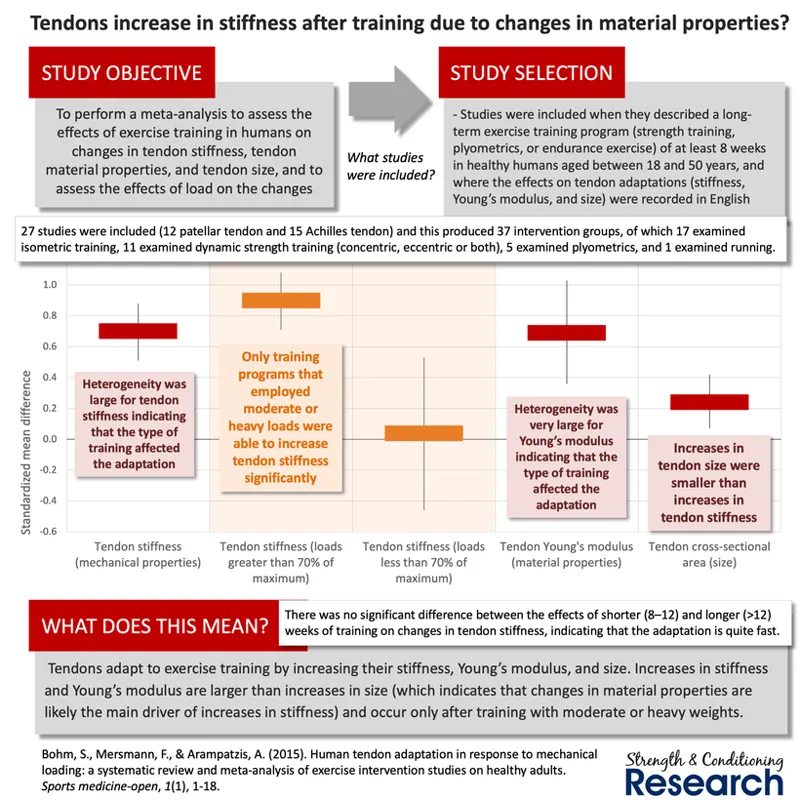
Tendon stiffness is calculated as the amount of force (stress) required to produce a given change in tendon length (strain). High values of tendon stiffness mean that a large force is required to elongate the tendon by even a small amount. The stiffness of a structure can be increased either by increasing the amount of material present in the structure (in this case by an increase in tendon size) or by changing the nature of the structure itself. Young's modulus is a measure of stiffness that normalizes the force applied to the resting cross-sectional area of the structure and the length change to its resting length. Therefore, when Young's modulus increases, this means that the increase in stiffness has occurred because of a change in the nature of the materials that make up the structure. Strength training has been shown to cause large increases in tendon stiffness and Young's modulus, but only small increases in tendon size.
.
Indeed, some recent research indicates that strength training is actually a very poor stimulus for increasing tendon size.
.
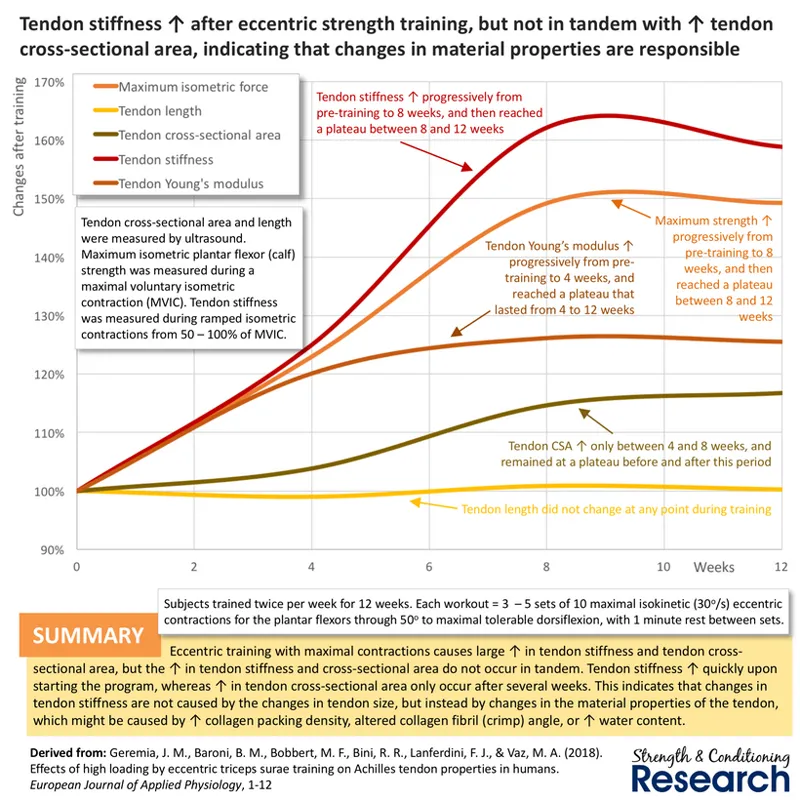
Additionally, while tendon stiffness and tendon size both increase after strength training programs, they do not do so at the same rate. In fact, the increases in tendon stiffness are much more rapid. This makes sense given that tendon stiffness changes are very apparent after strength training, while any change in tendon size is rarely very apparent.
.
This suggests that tendons actually change their material properties after strength training. How do they do this? Many hypotheses have been proposed, including increases in tendon water content (perhaps bound to proteoglycans), an increase in collagen fibril density, an increase in the number of enzymatic and non-enzymatic cross-links that bind the collagen molecules inside the tendon together, or even a change in the crimp angle that is associated with the collagen fibrils or fibers.
.
While research in this area is fairly minimal, there are indications that numerical (if not statistically significant) increases in collagen fibril density occur in tandem with increases in tendon stiffness after strength training.
.
#2. Changes in tendon stiffness are affected by load
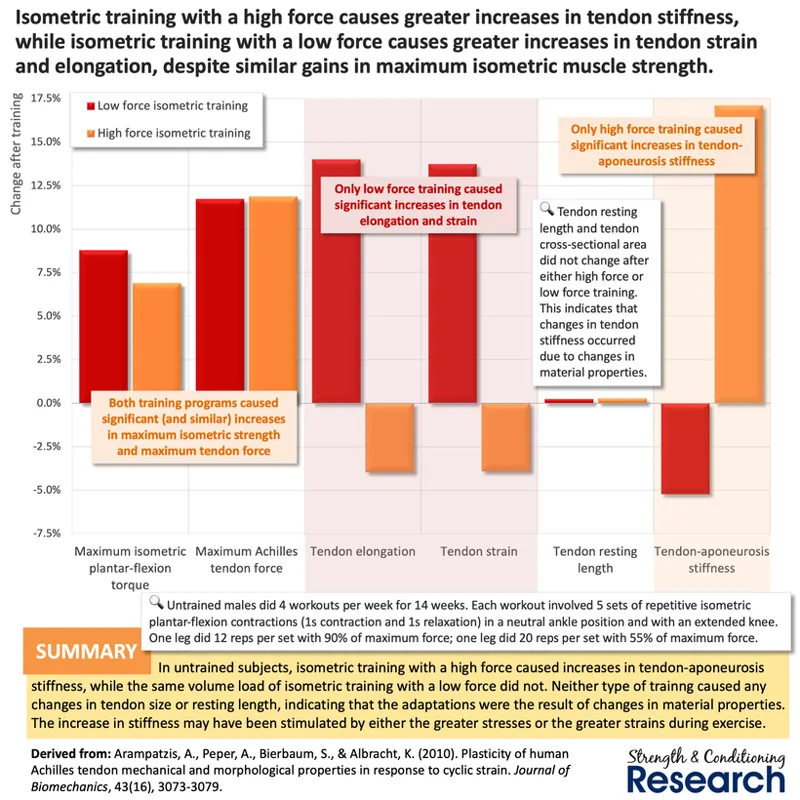
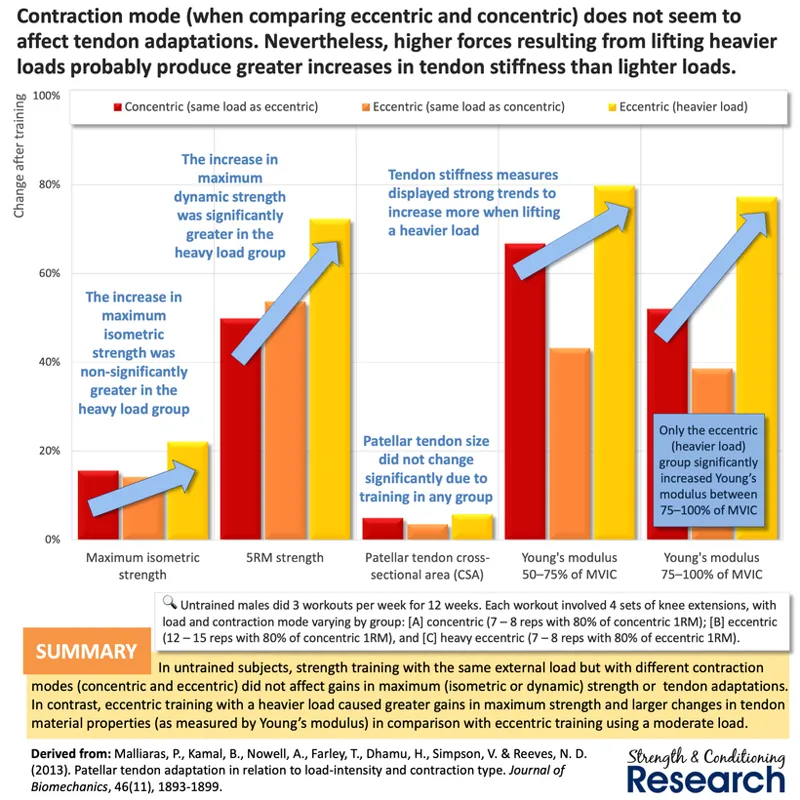
Tendon stiffness tends to increase to a greater extent when lifting heavier loads or when using higher forces. This means that tendons are elongated less by the applied muscle force after a heavy strength training program. In contrast, when light loads are used during training and the muscle increases in strength due to hypertrophy but the tendon does not increase in stiffness, this allows the muscle to pull the tendon to longer lengths during test contractions after training.
.
When comparing concentric-only and eccentric-only contractions, it seems that contraction mode does not really play a role in determining changes in tendon stiffness. Rather, it is just the load that produces the adaptations.
.
#3. Changes in tendon stiffness are affected by contraction duration
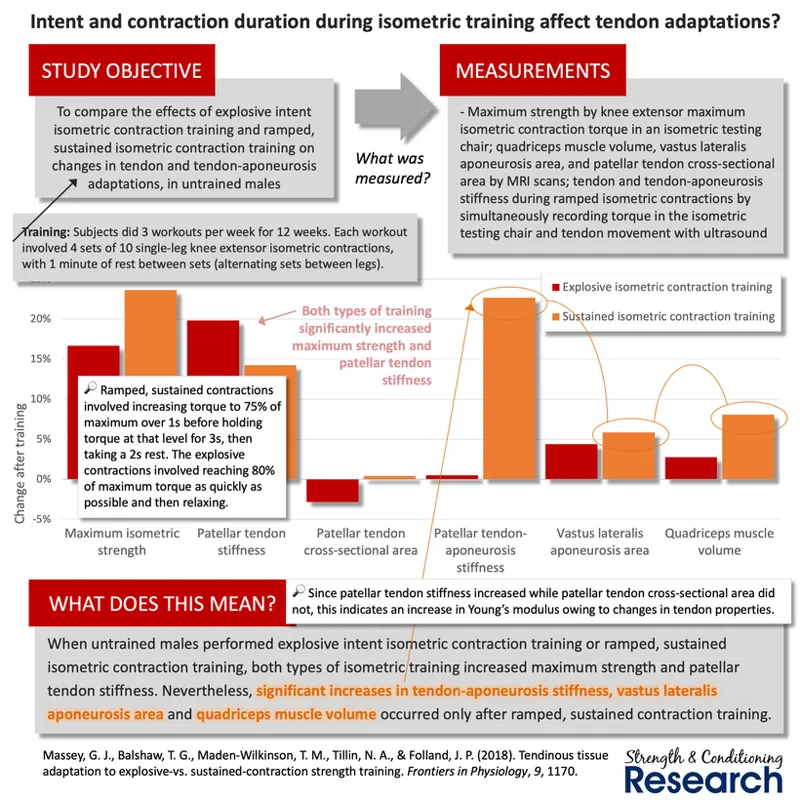
Tendon stiffness tends to increase to a greater extent after performing a training program involving ramped, sustained, isometric contractions in comparison with very brief, maximal intent isometric contractions, even when the total time and the load magnitude are the same.
.
Exactly how contraction duration affects changes in tendon stiffness is unclear, especially since there seem to be different effects on the tendon itself and the tendon-aponeurosis.
.
#4. Changes in tendon stiffness are greater after isometric training
Tendon stiffness also tends to increase to a greater extent after performing a training program involving isometric contractions in comparison with dynamic contractions, even when the total time under tendon and the load magnitude are equated.
.
#5. Different tendon adaptations after repetitive, low load exercise
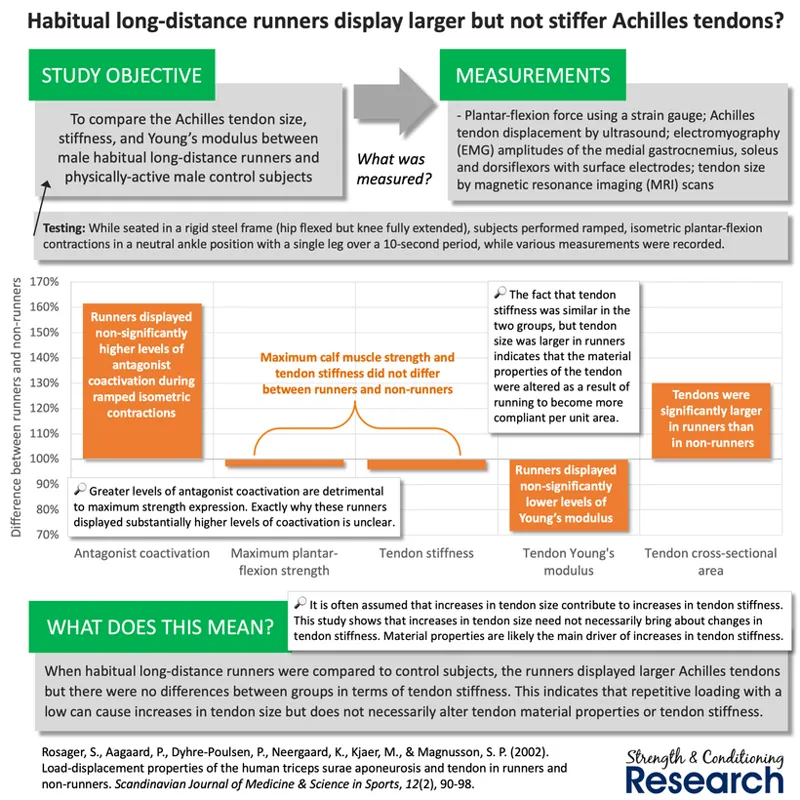
Some research has shown that tendons adapt after repetitive, low load exercise. However, it is noteworthy that several studies have reported substantial increases in tendon size after this type of exercise, with small or even minimal changes in tendon stiffness.
.
This increase in tendon size may be an adaptation subsequent to experiencing fatigue damage. Fatigue damage is a materials science term that refers to specific types of damage that occur to load-bearing structures. This fatigue damage may occur due to repetitive elongations (strains) of the tendon without large forces (stresses) being experienced at the same time.
.
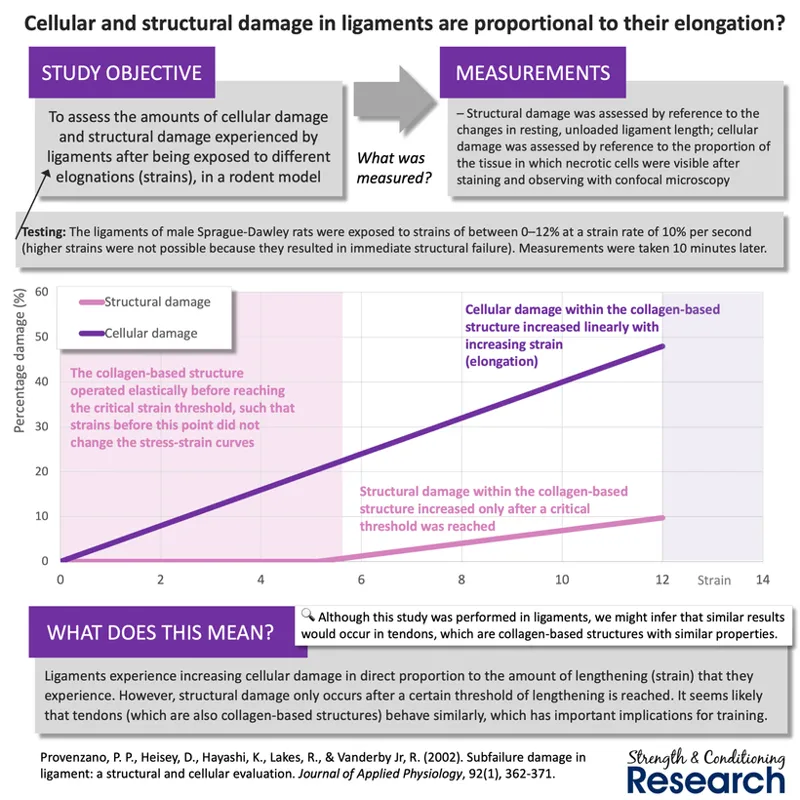
Indeed, collagen-based structures do tend to experience fatigue damage in response to strain (elongation). In fact, some studies have reported very close relationships between the amount of strain experienced and the amount of damage that results. This provides support for the hypothesis that tendon damage primarily occurs when tendons are exposed to repeated lengthening, as typically occurs when muscles contract against light loads or low forces (as is common during long-distance running and other aerobic exercise activities).
.
Conclusions
Tendons adapt after strength training by increasing in stiffness. An increase in tendon stiffness means that the tendon elongates less in a muscular contraction for a given magnitude of applied force. Tendons also increase in Young's modulus, which is a measure of stiffness that is normalized to the size of the tendon. Since an increase in tendon size cannot explain the increases in stiffness, tendons must change their material properties after strength training. This change may occur due to increases in tendon water content (bound to proteoglycans), an increase in collagen fibril density, an increase in the number of enzymatic and non-enzymatic cross-links that bind collagen molecules inside the tendon together, or even a change in the crimp angle associated with the collagen fibrils or fibers. Tendon stiffness increases more after strength training programs that involve heavier loads (compared to lighter loads), that involve longer-duration contractions (compared to shorter-duration contractions), and after isometric training (compared to dynamic training). Hence, it seems likely that achieving a fairly high tendon force (stress) is the key to stimulating the adaptations in material properties that underpin increases in tendon stiffness. Yet, large tendon elongations (strains) do not stimulate an increase in tendon stiffness, at least when experienced in the absence of a high tendon force (stress) as evidenced by the unchanged tendon stiffness levels of long-distance runners. Interestingly, runners do display larger tendon size despite unchanged tendon stiffness, and this may be an adaptation or a response to strain-induced fatigue damage (creep and cracks) that occurs as a result of a high volume of repeated tendon strains.
Comments (5)
Arampatzis et al have studies with 90% MVIC 3sec on/off, also seeming very effective? For these heavy loads longer isos seem less optimal, any idea why? (compared to the longer isos being more effective in the study you posted) And which approach would be less straining for the tendon/less damage? I remember your idea that longer iso would be better because less repetitive strains and that heavier would be less strain because of the viscoelasticity. Did your opinion change? Asking because in those studies its commonly assumed that strain is the factor that increases stiffness and also that increasing force linearly increases strain. Thanks.
Hey Chris, Really like this post. If we are looking at a sport like baseball in which the tendons/ligaments around the elbow/shoulder are constantly exposed to dynamic stretching due to the throwing action. Do you think there is some merit to exposing them to an inertia impulse style of training to build up the capacity for elasticity and improve their resilience to 'fatigue damage?' Thanks again
Not sure about the ligaments, but certainly I think we can reduce the tendon damage that occurs during repeated, high-velocity SSC movements like throwing by doing some heavy or moderately-heavy strength training for the same joint. Of course, the downside is that the SSC is impaired because of the increased tendon stiffness, which may then reduce throwing performance somewhat. See the plyometrics article in this FAQ for more information on that issue.
Hi Chris, great article! In your book on strength training you write about the inclusion of eccentric overload training for athletes because of several type of adaptations. One of them was increased stiffness of tendons. Do I understand you actually recommend the use of isometrics more if the goal is improving sport specific tendon properties? Is maximum load/intensity still important for tendon stiffness? Or is >70% MVIC with 30-45 sec TUT all that is needed for this goal? How do overloaded eccentrics compare with heavy isometrics when looking at formation of costameres and increased lateral force transfer? Thanks for any help with this one
Yes, now it seems clear that isometrics have the advantage over other contraction modes for increasing tendon stiffness. I suspect that this is because isometrics involve only one small strain at the start of the contraction, while dynamics involve repeated strains. Thus, the main stimulus during an isometric is the stress, while the stimulus during dynamics is a combination of stresses and strains. Since stress causes increases in tendon stiffness, this means that isometrics are a more targeted way of increasing tendon stiffness, without also increasing tendon size.