





Single-limb and single-joint strength training
Much is made about the advantages and disadvantages of bodybuilding training with single-limb exercises versus two-limb exercises, as well as about the advantages and disadvantages of bodybuilding training with multi-joint exercises versus single-joint exercises. Yet, few analyses examine the most important physiological difference between these exercise types.
.
#1. Comparing multi-joint and single-joint exercise
When comparing multi-joint exercises and single-joint exercises during training to failure, researchers have shown that single-joint exercise leads to greater peripheral fatigue at task failure than multi-joint exercise. In contrast, this then implies that multi-joint exercise involves greater central nervous system (CNS) fatigue at task failure than single-joint exercise.
.
#2. Comparing two-leg and single-leg exercise
When comparing two-leg exercise and single-leg exercise during training to failure, researchers have shown that single-leg exercise leads to greater peripheral fatigue at task failure than two-leg exercise. In contrast, this then implies that two-leg exercise involves greater CNS fatigue at task failure than single-leg exercise.
.
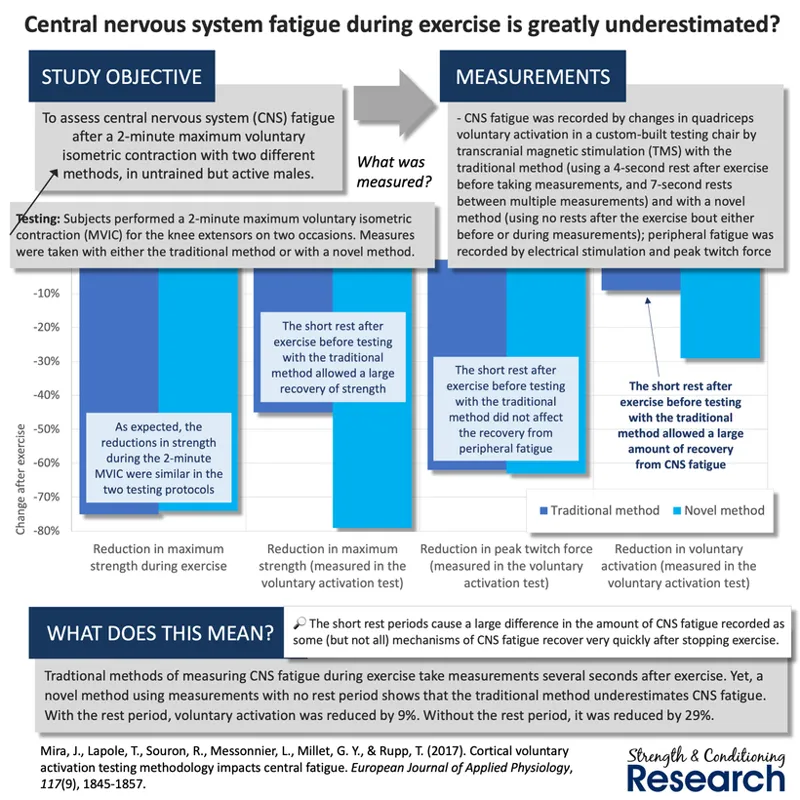
The fact that this greater CNS fatigue is not apparent when measured following the exercise test is likely because of the short rest period allowed afterwards. Historically, CNS fatigue measurements have been performed after a couple of minutes of rest (owing to the need to set up the equipment) and this allows some (but not all) CNS fatigue mechanisms to dissipate. Indeed, a recent study that compared measuring CNS fatigue immediately after exercise and after a couple of minutes of rest found large differences between the two measurements. Thus, if the key mechanism of CNS fatigue experienced during two-leg exercise dissipated quickly, then this could reduce the differences in CNS fatigue observed when a short rest is taken.
.
#3. Comparing upper body and lower body exercise
When comparing upper body exercises and lower body exercises during training to failure, researchers have shown that upper body exercise leads to greater peripheral fatigue at task failure than lower body exercise. In contrast, this then implies that lower body exercise involves greater CNS fatigue at task failure than upper body exercise. Indeed, in this case greater reductions in voluntary activation have been observed immediately after lower body exercise in comparison with immediately after upper body exercise.
.
#4. Why do these differences happen?
The above comparisons demonstrate that [A] multi-joint exercise involves more CNS fatigue at muscular failure than single-joint exercise, [B] two-leg exercise involves more CNS fatigue at muscular failure than single-leg exercise, and [C] lower body exercise involves more CNS fatigue at muscular failure than upper body exercise. In each case, the exercise type that involves a greater amount of muscle mass (multi-joint exercise, two-leg exercise, and lower body exercise) involves more CNS fatigue than the exercise type that involves a smaller total amount of muscle mass (single-joint exercise, one-leg exercise, and upper body exercise). It is possible that this happens because the greater muscle mass involved requires a larger central motor command for the same level of motor unit recruitment, because the central motor command is what determines the perception of effort.
.
The perception of effort is important because it determines the point at which muscular failure occurs. Muscular failure does not occur when the muscle is unable to produce any more force (contrary to popular belief) but instead occurs when the perception of effort reaches its maximum tolerable level. Since the central motor command is a key determinant of the perception of effort (through the corollary discharge), an exercise that involves a greater amount of muscle mass will necessarily involve a greater magnitude of central motor command for any given level of motor unit recruitment across the working muscles. Therefore, perception of effort for a given level of central motor command will be higher, and hence the maximum tolerable level of effort will be reached at a lower average level of motor unit recruitment across the working muscles.
.
Even so, simply sending a greater central motor command due to the greater amount of muscle mass might not be the only reason why exercises involving a larger amount of muscle mass involve greater CNS fatigue. Indeed, the cardiovascular response to exercise is known to generate supraspinal CNS fatigue because of the feeling of being out-of-breath and this response is greater when the amount of muscle mass involved in the exercise is bigger.
.
#5. What does this mean in practice?
This phenomenon has multiple different practical implications, some of which are more obvious than others. The most obvious implication is that the use of a smaller amount of muscle mass during an exercise should be able to cause greater hypertrophy as well as greater increases in the ability to recruit high-threshold motor units when used in training over time, since reaching a high level of motor unit recruitment during a workout seems to be the stimulus that increases motor unit recruitment afterwards (read more).
.
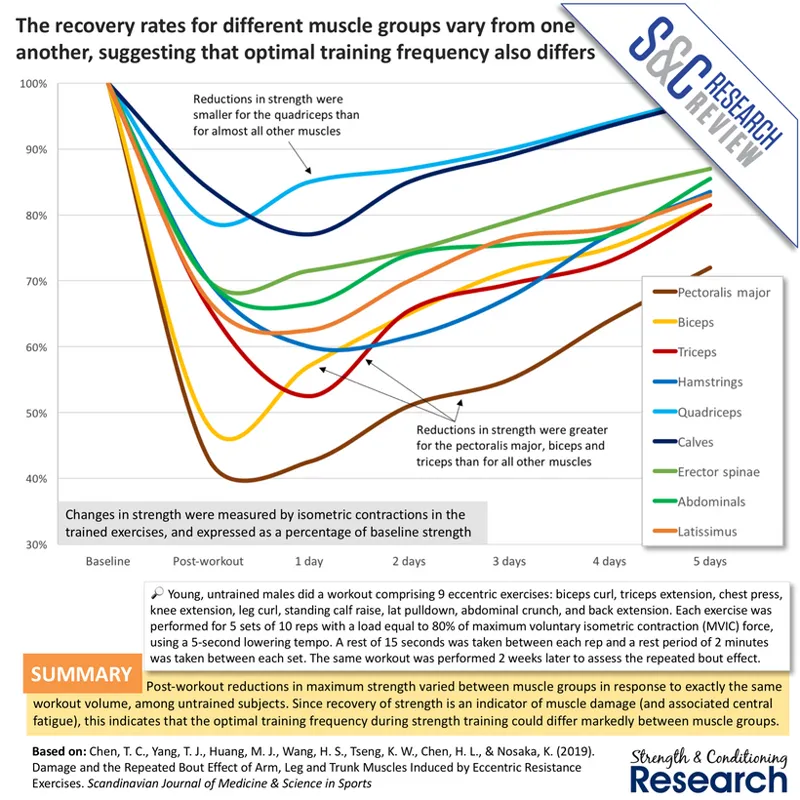
Nevertheless, reaching a higher level of motor unit recruitment achieved during upper body exercises is likely one of the reasons why these muscles then take longer to recover after a workout. Since fast twitch muscle fibers are more easily damaged, and since higher threshold motor units control more fast twitch muscle fibers, the achievement of a higher level of motor unit recruitment at task failure necessarily leads to greater post-workout fatigue and a longer recovery period afterwards.
.
Similarly, when performing maximal efforts on every rep of a set, the access to more high-threshold motor units (and therefore more fast twitch muscle fibers) during each rep leads to more rapid fatigue development during a single-limb exercise in comparison with a two-limb exercise.
.
Conclusions
Some strength training exercises involve more central nervous system (CNS) fatigue and less peripheral fatigue at muscular failure than others: [1] multi-joint exercise involves more CNS fatigue at muscular failure than single-joint exercise, [2] two-leg exercise involves more CNS fatigue at muscular failure than single-leg exercise, and [3] lower body exercise involves more CNS fatigue at muscular failure than upper body exercise. In each case, the exercise type that involves a greater amount of muscle mass (multi-joint exercise, two-leg exercise, and lower body exercise) causes more CNS fatigue and thus involves a lower level of motor unit recruitment at muscular failure. Muscular failure occurs when we reach a maximum tolerable level of perceived effort. The largest contributor to our perception of effort is the corollary discharge from the central motor command through the sensation of innervation. When more muscle mass is involved in an exercise, more total central motor command must be produced to be sent to each muscle and this likely means that full motor unit recruitment for individual muscles becomes progressively harder, the more muscle mass that is involved. Also, exercises that involve more muscle mass are known to cause a greater cardiovascular response, which produces a supraspinal CNS fatigue effect through the feeling of being out of breath, since this sensation also contributes to our perception of effort. In practice, this means that exercises that involve less muscle mass may well be [1] more effective for stimulating hypertrophy, [2] more effective for stimulating increases in voluntary activation after exercise as a neural adaptation, and [3] more likely to cause muscle damage in the days following a workout (by activating more fast twitch fibers).

Comments (1)
Hello Chris , since bilateral movements cause more CNS fatigue ,would it then make sense to have bilateral and unilateral days within a micro-cycle in order to mitigate fatigue ? Particularly speaking for athletes who sports like football, basketball etc