


Stimulating reps ≠ high effort reps
Recently, there has been a tendency for some researchers and strength training experts to emphasize the role of effort in stimulating hypertrophy (which is a good thing) rather than assuming that volume load in the form of work done is the primary determinant (which it is clearly not). However, although a high effort is necessary for hypertrophy to occur, it is not sufficient. In other words, we cannot produce hypertrophy without producing a high effort, but simply producing a high effort will not always produce hypertrophy.
.
#1. What is effort?
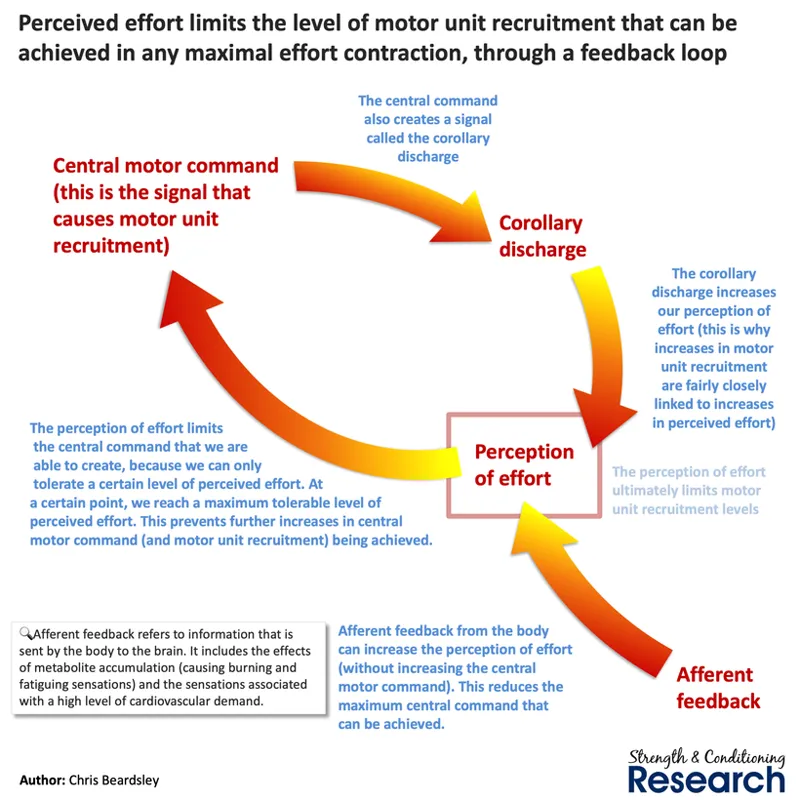
If we want to classify reps or sets as being high in effort (whether we use those exact words or whether we refer to reps or sets as being "hard" or some other term), then we need to understand the physiology of perceived effort. The perception of effort is produced by several factors, but the most important one is the corollary discharge, which is a signal that is created by the central motor command. When a low central motor command is generated (leading to a low level of motor unit recruitment), this creates a low perception of effort. When a high central motor command is generated (leading to a high level of motor unit recruitment), this creates a high perception of effort. Therefore, there is a good (but not perfect) relationship between the level of effort that we experience during a muscular contraction and the level of motor unit recruitment.
.
#2. Why is a high effort not sufficient to produce hypertrophy? (reason number one)
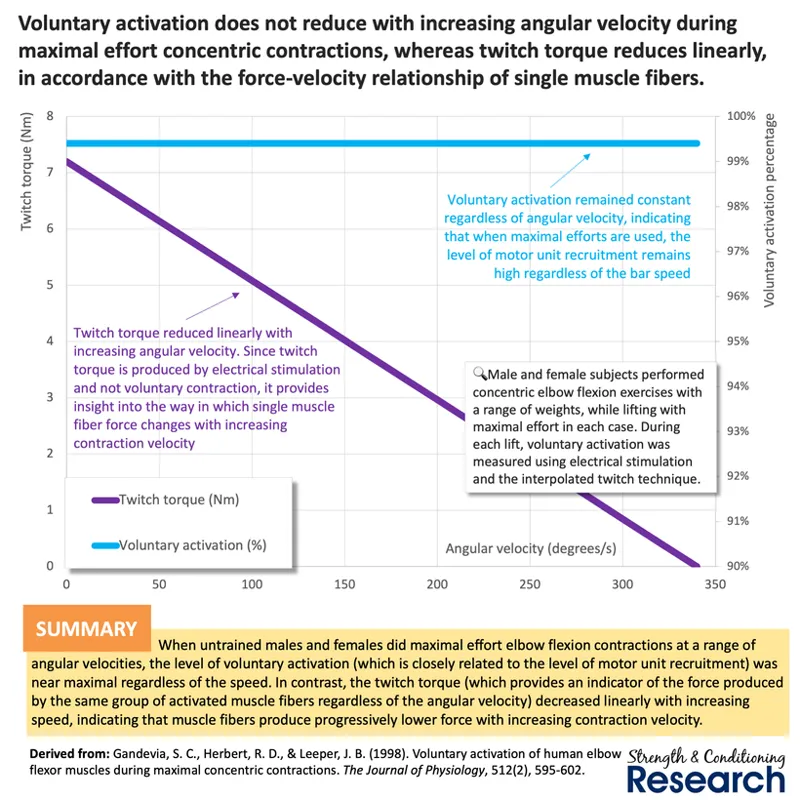
We can easily demonstrate that simply achieving a maximal effort (and therefore also a high level of motor unit recruitment under most circumstances) is not sufficient to produce hypertrophy, because maximal efforts can be exerted with any load and at any state of fatigue. In practice, this means that maximal efforts can be exerted during extremely fast sporting movements that involve very low mass and inertia, such as throwing a ball. Similarly, maximal efforts can be exerted during strength tests at very high speeds (and therefore relatively low forces). Such sporting movements and exercises do not stimulate hypertrophy, despite the high levels of motor unit recruitment that are attained. This is because the movement velocity of the individual muscle fibers is fast, and hence the mechanical tension that they produce (and experience) is low, due to the force-velocity relationship.
.
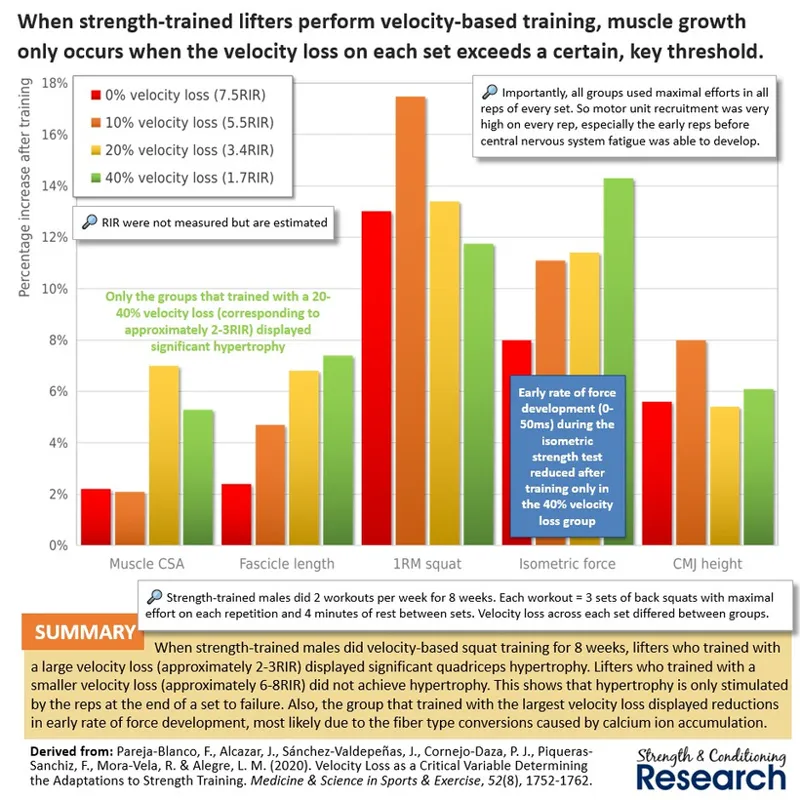
Indeed, during velocity-based strength training, all reps of every set involve maximal efforts being exerted, and yet only those sets that involve reps that drop below a certain bar speed are able to stimulate hypertrophy.
.
#3. Why is a high effort not sufficient to produce hypertrophy? (reason number two)
Nevertheless, even when a high effort is exerted in the presence of a slow bar speed, this may not necessarily produce the expected hypertrophy, if the high effort has been generated in part due to negative feelings such as come from pain, feeling out of breath, or the burning sensations inside the muscles, which we call afferent feedback. These negative feelings inflate the perceived level of effort associated with a given level of central motor command and essentially makes us think that we are working at a high level of motor unit recruitment than we actually are. In this way, the resulting number of motor units that are developed is reduced.
.
Conclusions
Although a high effort is necessary for muscular hypertrophy to be stimulated during a strength training set, it is not sufficient. That is to say: we cannot stimulate hypertrophy without producing a high effort, but exerting a high effort will not always stimulate hypertrophy. The perception of effort is mainly determined by the level of central motor command sent to the muscle to produce motor unit recruitment. For this reason, high effort levels are often a good indicator that a high level of motor unit recruitment has been achieved, which is a necessary element for muscle growth to be generated. Yet, a high level of motor unit recruitment is not sufficient on its own for hypertrophy to be stimulated. Fast movements like throwing and jumping involve very high levels of motor unit recruitment but do not stimulate hypertrophy, because the muscle fiber shortening velocity is fast, and therefore single muscle fiber mechanical tension is low. Moreover, we can experience high levels of perceived effort without necessarily achieving a high level of motor unit recruitment. Any negative feeling contributes to an increase in the level of perceived effort. Negative feelings can include pain, the feeling of being out of breath, and burning sensations in the muscles (which is afferent feedback due to metabolite accumulation). This is why when we perform sets to muscular failure in a very fatigued state, we do not actually achieve maximal levels of motor unit recruitment and this impairs the hypertrophy stimulus.
Comments (8)
Hi Chris, Thank you for putting all this information together in such an orderly and digestible way. You’re a favorite source of information of mine for muscle-related research, so thanks again for being the excellent resource you are! I have a question. It seems like you’re positing that muscle fibers generate/experience higher mechanical tension in reps done with maximal effort at the end of a set (with lower MPVs) than in reps done with maximal effort at the beginning of the same set (with higher MPVs). Are you positing that? If you are positing that, how can you reach that conclusion with the observation that the forces applied to the external resistance are higher in the initial reps than in the final reps (higher MPVs almost certainly involve higher accelerations and thus higher forces). How can the muscle fibers generate/experience lower mechanical tension when the forces applied to the external resistance are the highest and higher mechanical tension when the forces applied to the external resistance are lowest? I understand that studies investigating the force-velocity relationship of muscle fibers show that muscle fibers generate/experience less mechanical tension as shortening velocity increases. So, the higher the shortening velocity, the less force a muscle fiber can generate/experience at that velocity. I can see how with that in mind a conclusion could be drawn that because the initial reps of a set involve higher shortening velocities, the muscle fibers must generate/experience lower forces than in the final reps of a set that involve lower shortening velocities. Yet, each rep, regardless of whether it’s the first or the last in a set, or how high or how low the maximum shortening velocity is, involves a phase where shortening velocity is equally low, specifically the transition from the negative phase of work to the positive phase of work. This is where/when the muscle fibers generate/experience the highest amount of tension that they’re capable of. Mustn’t muscle fiber force generation be highest in the transition from the negative phase of work to the positive phase of work in the initial rep(s) where we observe their output in the acceleration/MPV of the external resistance to also be the highest? Thanks for any response or additional insight you can provide!
If you look at the way in which the various fatigue mechanisms work (acidosis, phosphates, calcium ions) and which fibers are affected most by each mechanism during maximal effort dynamic reps, it becomes clear how muscle fiber force is preserved in less oxidative fibers (more metabolite-related fatigue) and not in more oxidative fibers (more calcium ion-related fatigue) during a set. After that, it's just the force-velocity relationship as normal.
Hello Chris - thank you for a great article - stimulating repetitions have high motor unit recruitment and high crossbridge formation. The final very high effort repetitions have diminished recruitment and crossbridge formation interference. They also are the most stressful. So is the best policy to stop all of my sets with at least 1 or maybe 2 repetitions in reserve? Thanks!
In general yes, although the negative effects of training with a closer proximity to failure are enhanced when working in higher rep ranges. Training close to failure in the 1-5RM rep range is probably not going to cause much sustained fatigue, whereas training close to failure in the 10–12RM rep range will
Excellent article! Do you classify lower motor unit recruitment levels caused by afferent feedback that is due to metabolite accumulation as central fatigue - despite it's origins in metabolite accumulation? Also, in terms of practical implications, is there any way to determine if performance decreases within a workout are due limited central motor command or not?
Interestingly, all CNS fatigue is caused by feedback from peripheral sources. It is defined as CNS fatigue because the mechanism by which strength is reduced is a reduction in motor unit recruitment levels. Technically, the CNS itself is never "fatigued" in any real sense. The CNS simply dials back its central motor command in response to feedback from the rest of the body.
Interesting article. My question is loosely related. If high velocity strength exercises don’t cause any hypertrophy then is it necessary to always work the antagonist? For example, a workout might involve high velocity knee extension. A lot of people tend to automatically include some kind of knee flexion exercise into the workout in order to do a balanced workout. It doesn’t necessarily have to revolve around the knee but the general principle applies?
No, for high-velocity strength development, I don't think it is necessary to balance out agonist/antagonist muscle work in the same way as it is probably helpful to do so for maximum strength development, where peripheral adaptations can be more substantial.