





Potentiation mechanisms
Potentiation is as a temporary increase in exercise performance as a result of a previous bout of exercise. It can be subdivided into workout potentiation effects that affect exercises performed in the same workout and delayed potentiation effects that affect exercises performed in a later workout.
.
#1. Workout potentiation: warm-up
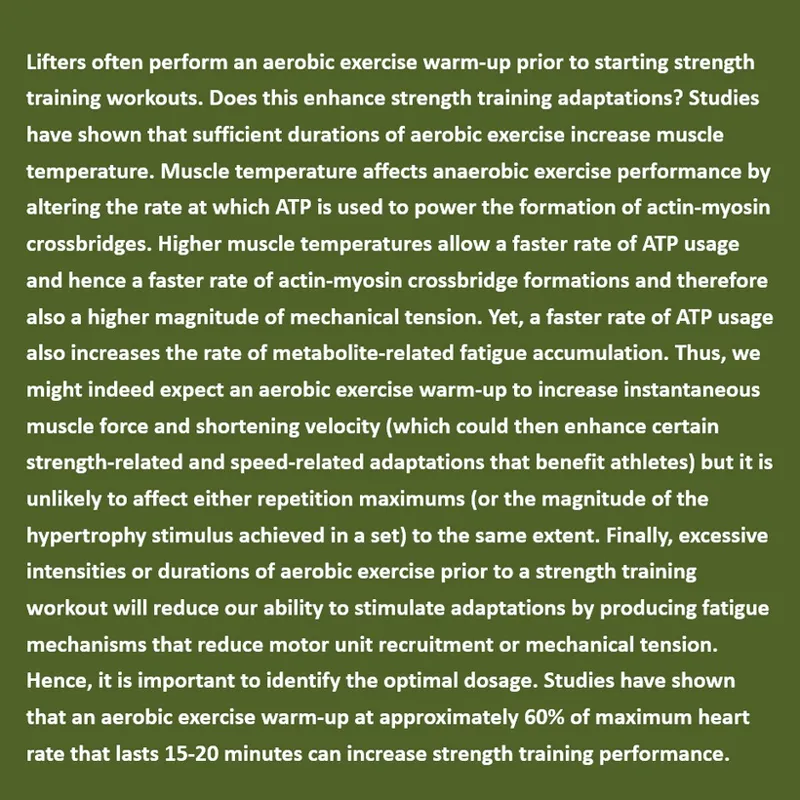
Although they are not often categorised as such, aerobic exercise warm-ups have been shown to have potentiation effects for a period of time afterwards. The exact duration of the warm-up effect likely depends on how long the warmed-up muscle stays warm (read more).
.
#2. Workout potentiation: PAP and PAPE effects
There are two very well-studied potentiation effects that can be produced within a workout. They have different time courses and different underlying mechanisms (read more).
.
#3. Delayed potentiation effect: same-day effects
We currently have no well-defined mechanisms that can explain what causes delayed potentiation. Nevertheless, several studies have been done that provide insight into the potential mechanisms, because they have compared either [A] the delayed potentiation effects of workouts on different performance tests, or [B] the delayed potentiation effects of different workouts on the same performance tests. For example, one older study showed that only throwing performance was potentiated by a morning back squat and power clean workout, while vertical jump height was not. This could be due to vertical jump height being less easy to potentiate, or it could be because the morning workout caused more lower body fatigue than upper body fatigue, which affected the vertical jump more than the throw.
.
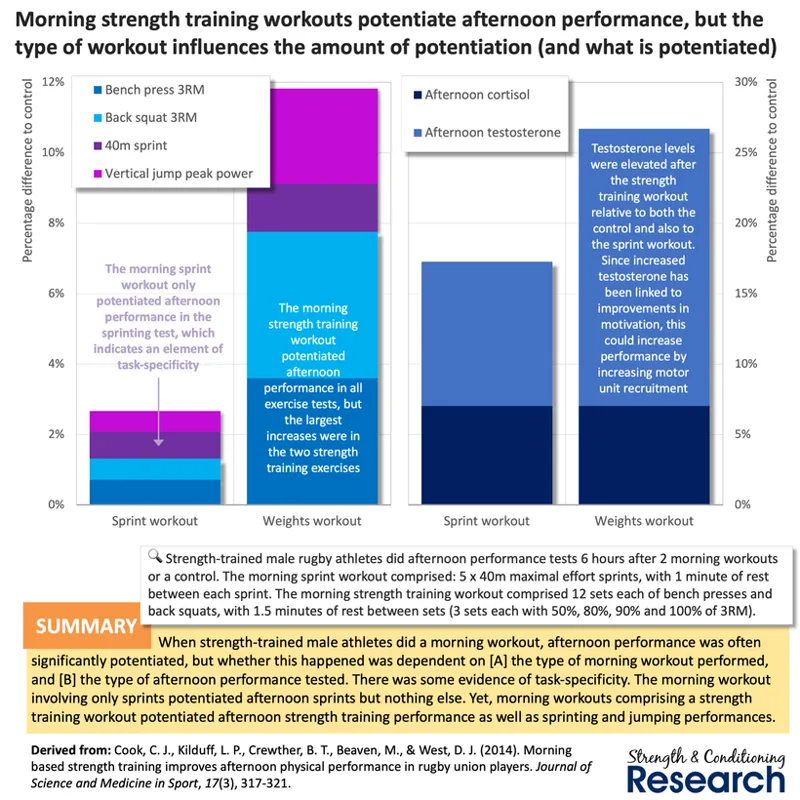
Another study found that a morning sprint workout potentiated performance in afternoon sprints, but not in any other exercise test. Conversely, a morning strength training workout potentiated afternoon performance in a range of different exercise tests, including sprints, jumps and strength training exercises. This suggests that there may be an element of movement-specificity in the delayed potentiation effect. However, it also provides evidence for a more systemic effect (which this study suggested might be hormonal, by virtue of increased testosterone levels increasing motivation, and hence motor unit recruitment for a given level of effort).
.
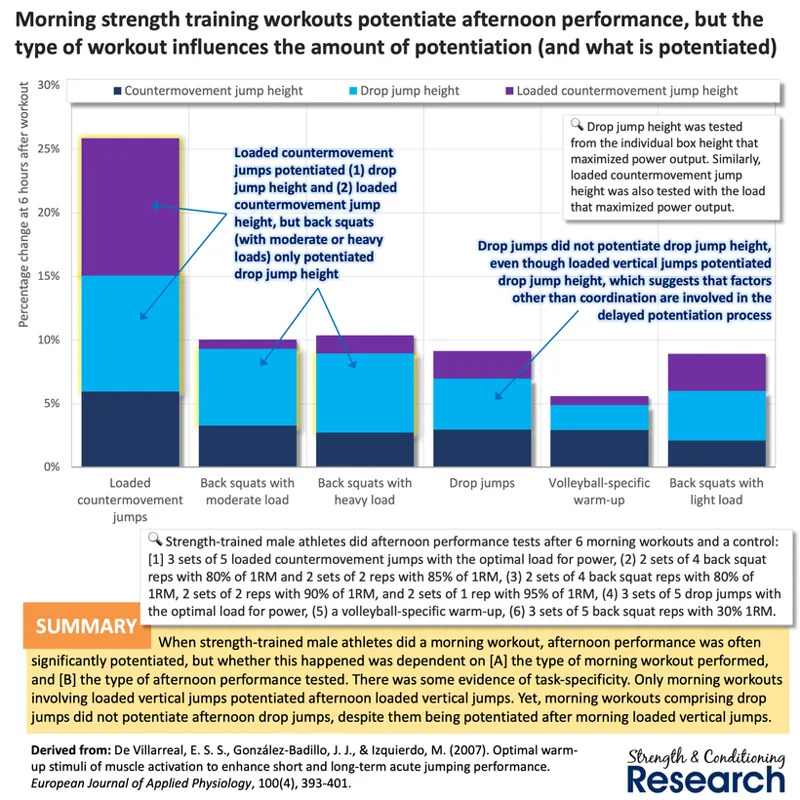
Yet another study showed that a morning workout with a heavy load potentiated performance in afternoon exercises with a heavy load (albeit as well as in an unloaded vertical jump), but not with the optimal load for power. Conversely, there was a trend for a morning workout with the optimal load for power to potentiate performance in exercises with the optimal load, but not with a heavy load. This suggests that there could be an element of load-specificity as well as movement-specificity in the delayed potentiation effect (although since coordination differs between both movements and loads, this could be caused by the same underlying mechanism, if rapid changes in coordination are involved).
.
One final study showed that a morning workout involving the loaded countermovement jump (CMJ) potentiated performance in afternoon loaded CMJs and also in afternoon drop jumps. Conversely (and surprisingly), a morning workout involving the drop jump did not potentiate performance in afternoon drop jumps. This further confirms the idea that there is an element of movement-specificity in the delayed potentiation effect, but again it is clear that this task-specificity is not a perfect model for what is happening.
.
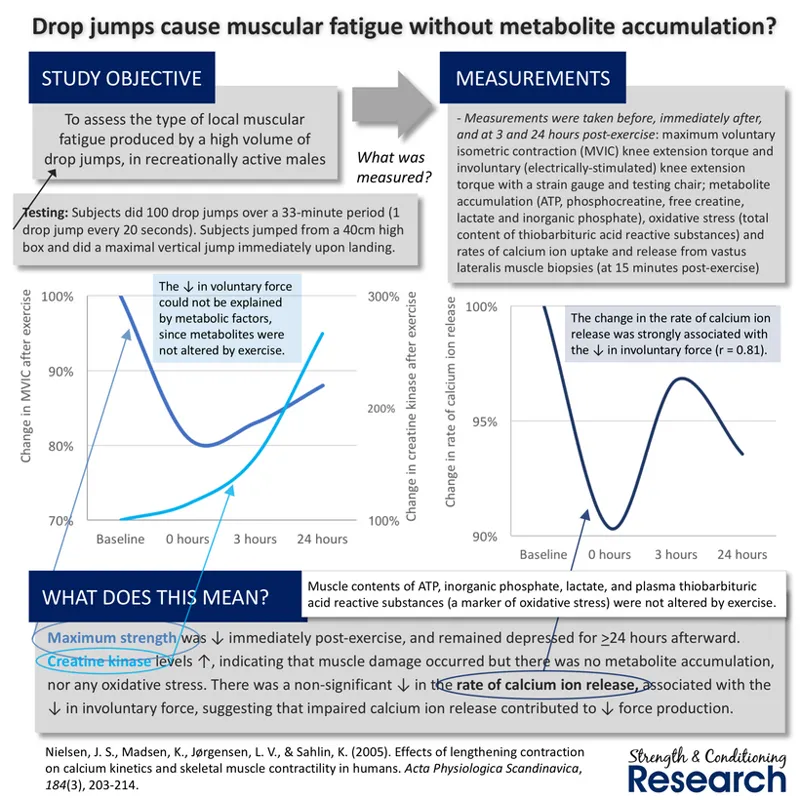
Indeed, the failure of drop jumps to cause delayed potentiation might be a genuine failure of this type of exercise to cause delayed potentiation, or it could be because drop jumps involve eccentric contractions, which can cause extensive sustained fatigue, including both muscle damage and excitation-contraction coupling failure. Thus, any delayed potentiation effect after drop jumps might be hidden behind the sustained fatigue.
.
#4. Delayed potentiation effect: subsequent-day effects
Potentiation has been observed at 24-48 hours after exercise but the exact reasons are really unclear. If the following study had been performed in less well-trained athletes, we would immediately call it a learning effect but clearly that is not the case given the study population.
.
Conclusions
Potentiation is defined as a temporary increase in exercise performance as a result of a previous bout of exercise. It can be subdivided into [1] workout potentiation effects that affect exercises performed in the same workout, and [2] delayed potentiation effects that affect exercises performed in a later workout. Workout potentiation effects include: [A] aerobic exercise warm-ups, [B] the post-activation potentiation (PAP) effect, and [C] the post-activation performance enhancement (PAPE) effect. Delayed potentiation effects have been observed [A] on the same day as the conditioning contractions that produced the potentiation effects, and [B] on subsequent days. Same-day potentiation effects may arise due to an increase in testosterone levels caused by morning exercise on afternoon motivation levels, which can increase levels of motor unit recruitment. Indeed, there is evidence that the potentiation effects are quite global in nature and movement patterns that were not performed in the morning workout can be potentiated in the afternoon workout. Even so, there is also evidence that certain exercise types are more potentiating (or potentiated) than others and the reasons for this are unclear. Obviously, the potential for fatigue to mask potentiation is always a confounding factor. Subsequent-day potentiation effects are still relatively poorly-researched and little data is available. Nevertheless, there are clear signs of potentiation occurring at 24-48 hours that cannot easily be attributed to any other cause.

