




Repetitions in reserve
The repetitions in reserve (RIR) system can be used to measure the proximity to muscular failure at any given point in a strength training set. However, it is not always related to the rating of perceived effort, as has been suggested by some researchers.
.
#1. What are repetitions in reserve?
The repetitions in reserve (RIR) system is a self-reported scale that can be used to identify the proximity to muscular failure at any given point in a strength training set. The RIR scale is relatively reliable and accurate, although its accuracy does increase as the end of the set approaches.
.
The RIR scale is very valuable, because it often allows us to identify which of the reps in a set are stimulating for hypertrophy within the stimulating reps model (read more).
.
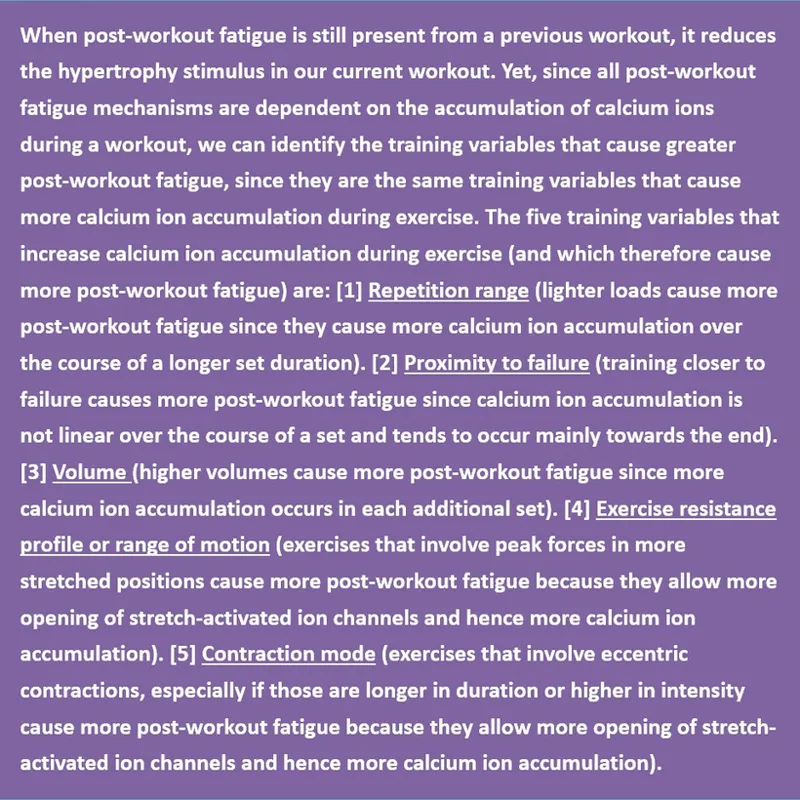
Additionally, it allows us to identify which of the reps in a set are most likely to cause post-workout fatigue in the form of excitation-contraction coupling failure and muscle damage (read more).
.
#2. How are repetitions in reserve related to the perception of effort?
The perception of effort that we experience during a strength training set is primarily generated by the central motor command that is sent to the muscle in order to produce motor unit recruitment because of the sensation of innervation.
.
According to the "sensation of innervation" theory, the central motor command is related to the perception of effort through the corollary discharge. The corollary discharge is a copy of the signal generated by the motor cortex that is sent to the muscle to produce motor unit recruitment. The corollary discharge is sent to the part of the brain that detects perceived effort.
.
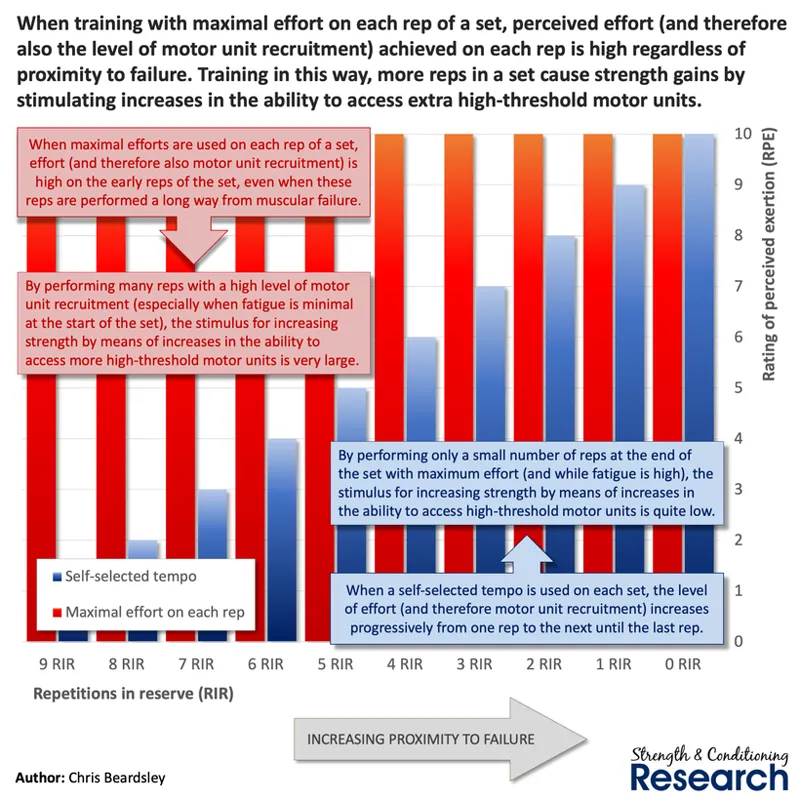
Whether the perception of effort relates to the number of reps in reserve depends on the way in which a set is performed. If a set is done with a self-selected tempo, then the perception of effort (and hence the level of motor unit recruitment) gradually increase together to maximal levels at the end of the set, while the number of reps in reserve gradually decreases. In contrast, if each rep of a set is performed as fast as possible (as is in velocity-based training), then the perception of effort (and hence also the level of motor unit recruitment) is maximal on every single rep of the set, even though the number of reps in reserve gradually decreases in the same way as it does when lifting with a self-selected tempo.
.
Conclusions
The repetitions in reserve (RIR) system is a self-reported scale that identifies the proximity to muscular failure at any given point in a strength training set. The RIR system helps us see whether repetitions can stimulate hypertrophy and whether they are likely to cause calcium ion-related fatigue mechanisms such as excitation-contraction coupling failure. The rating of perceived effort (RPE) is another self-reported scale that describes the level of exertion that we experience during an exercise. A major contributor to our experience of exertion is the sensation of innervation, which is a perception that is created by the brain that mirrors the central motor command sent to the muscle in order to produce motor unit recruitment. Thus, exactly how RIR relates to RPE depends entirely on the way in which a set is performed. If a set is performed with a self-selected tempo, then RPE and the level of motor unit recruitment gradually increase together to maximal levels at the end of the set, while the number of RIR simultaneously decreases towards zero. In this case, there is a inverse relationship between RPE and RIR. In contrast, if each rep of a set is performed as fast as possible (as is common during velocity-based training), then the RPE and the level of motor unit recruitment are maximal on every rep of the set, although the number of RIR still gradually decreases towards zero at the end of the set in exactly as it does when using a self-selected tempo. In this case, RPE and RIR are completely unrelated to one another.


Comments (5)
Oh, finally I’m understand. Corollary discharge is a neurological phenomenon in a sensory cortex and not a part of the brain cortex itself. I’ve got the problem with the translation on my mother language. We’ve got the direct translation only for the “efferent copy”, but no meanings of the “corollary discharge”
So, it’s a system that PREDICTS the sensation of effort, right?
I guess it depends what "it" refers to in that sentence? The perception of effort is generated from multiple sources, including the corollary discharge and various other inputs, including mental effort from handling complex movements and afferent feedback from metabolite buildup inside muscles. The brain combines those into a perception of effort, which we then can grade on a self-perceived scale (usually from 1-10) in the form of the Rating of Perceived Effort/Exertion (RPE). This rating is what we use to compare effort levels between different reps.
Hi Chris with no doubt it’s one more great article, thank you! Can you explain the concept of the mirror of central motor command and corollary discharge? I’ve been reading a lot, but there is some misunderstanding. Is this the part of the brain, or just a neurological process with no precise localisation?
I just added an extra infographic into the article to provide extra detail regarding the corollary discharge. It can be viewed as a copy of the signal sent to the muscle to produce motor unit recruitment. The copy signal is essentially registered within the brain as a contributor to the perception of effort.