





Cluster sets
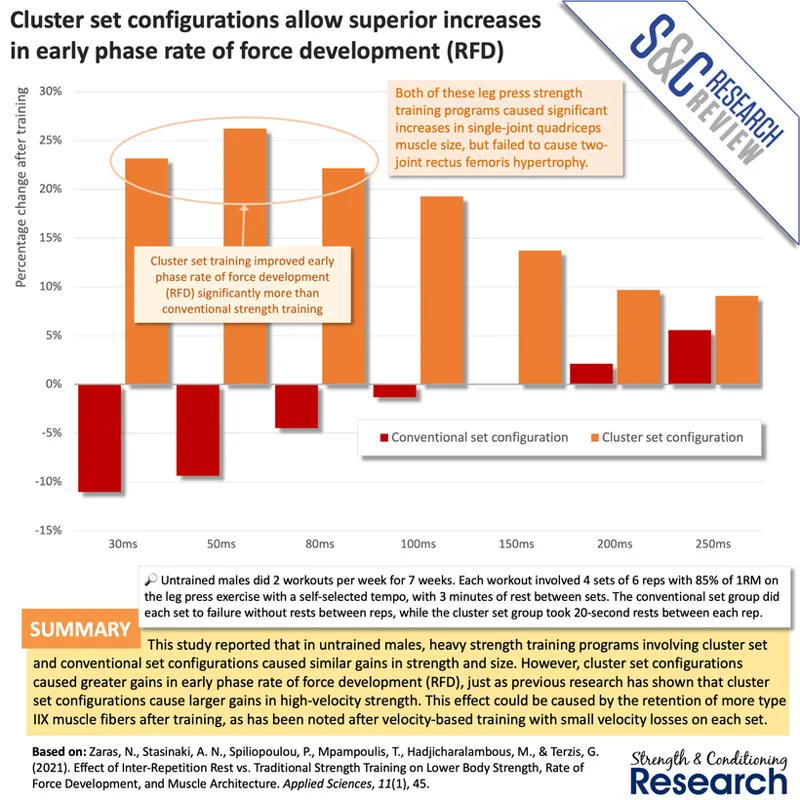
Cluster sets are different from conventional strength training sets because they involve intra-set rest periods. Such intra-set rest periods create clusters (or subsets) within a single set. Any number of intra-set rest periods can be used, from taking only a single intra-set rest period (to divide the set into two halves) to taking an intra-set rest period after every single rep. By taking intra-set rest periods, the amount of fatigue that is accumulated at any given point within the set is reduced. The cluster set technique is most commonly used to allow a fixed amount of work (in the form of reps with a given weight) to be performed with a reduced amount of fatigue (and this is the way in which cluster sets are usually studied by researchers).
.
#1. Cluster sets increase speed to a greater extent
By using a cluster set configuration during a heavy strength training program (which, when work done is matched, reduces the amount of fatigue experienced in a workout), the gains in maximum theoretical velocity measured in a force-velocity profile are improved. In this way, cluster set configurations produce similar results to velocity-based training programs that involve stopping each set further from muscular failure.
.
#2. Cluster sets increase rate of force development to a greater extent
Similarly, after using a cluster set configuration during a heavy strength training program (which, when work done is matched, reduces the amount of fatigue experienced in a workout), gains in rate of force development are improved. Again, this shows that cluster set configurations produce similar results to velocity-based training programs that involve stopping each set further from muscular failure.
.
#3. Cluster sets increase high-velocity force production to a greater extent
Finally, we can see that after using a cluster set configuration during a heavy strength training program (which, when work done is matched, reduces the amount of fatigue experienced in a workout), gains in high-velocity force production are improved. Again, this is similar to the well-established effects of velocity-based training programs that involve stopping each set further from muscular failure.
.
#4. What is the underlying mechanism?
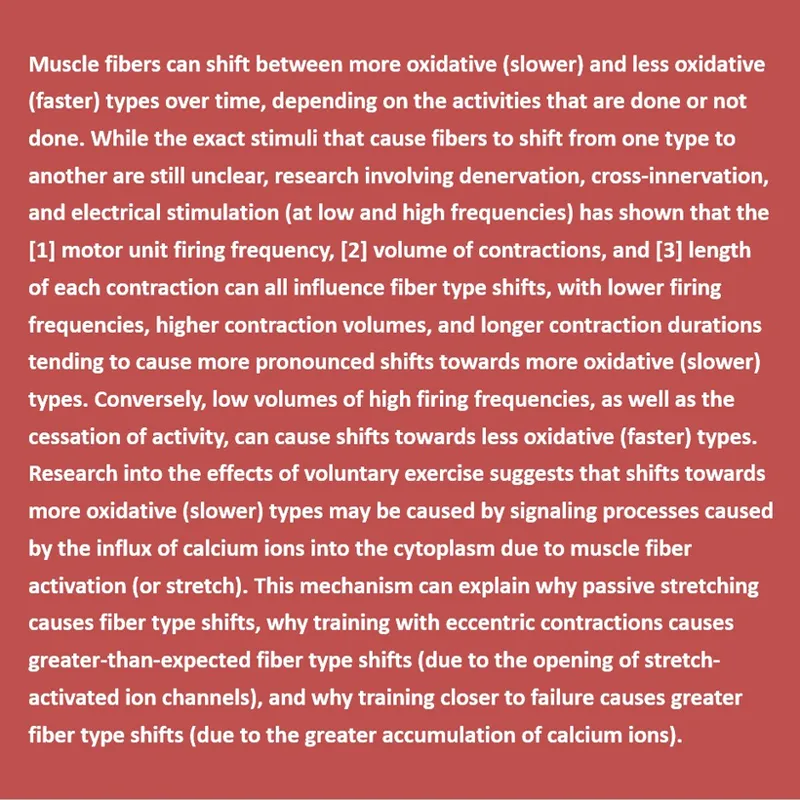
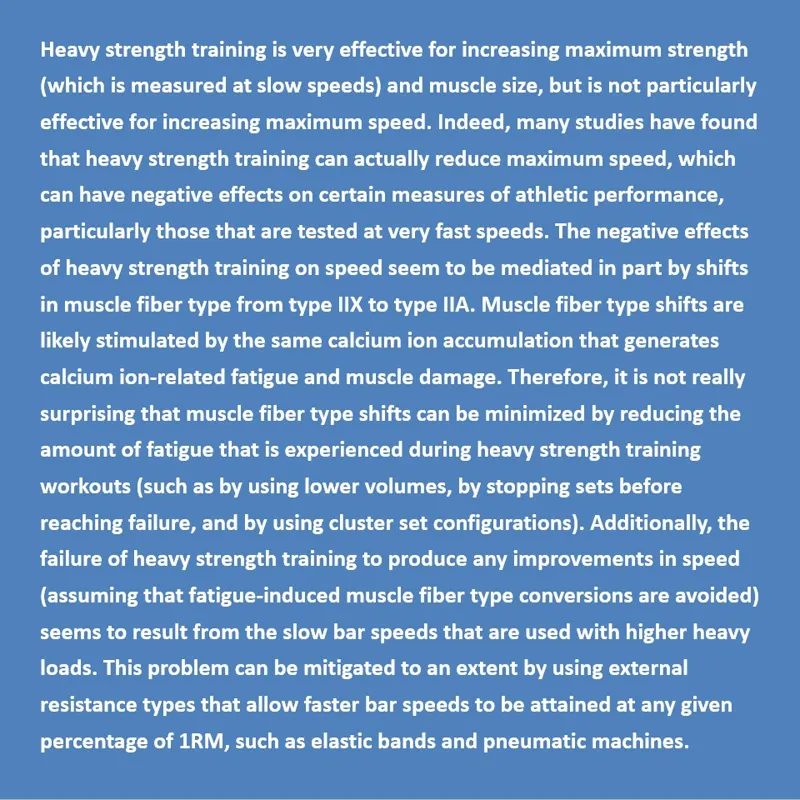
Muscle fiber type is a key determinant of maximum theoretical velocity, rate of force development and high-velocity force production. Type IIX muscle fibers are the fastest muscle fibers and therefore any conversion of these muscle fibers into the slightly slower, type IIA muscle fibers causes reductions in maximum theoretical velocity, rate of force development and high-velocity strength (read more).
.
Experiencing more calcium ion-related fatigue during exercise seems to be the factor that causes very fast, type IIX muscle fibers to convert into slightly slower, type IIA muscle fibers (read more).
.
Calcium ion-related fatigue can be avoided by stopping sets before reaching muscular failure (as is the case during velocity-based training) or by implementing cluster set configurations (read more).
.
Conclusions
Cluster sets are different from conventional strength training sets because they involve intra-set rest periods. Such intra-set rest periods create clusters (or subsets) within a single set. Any number of intra-set rest periods can be used, from taking only a single intra-set rest period (to divide the set into two halves) to taking an intra-set rest period after each individual rep. By taking intra-set rest periods, the amount of fatigue that is accumulated at any given point within the set is reduced. Cluster set configurations are most commonly used to allow a fixed workload (a number of reps with a given weight) to be done with less fatigue at the end of a set (this is also the way in which cluster sets are usually studied by researchers). When cluster sets are programmed in this way, they produce superior changes in [1] maximum theoretical velocity, [2] rate of force development, and [3] high-velocity strength. In this way, cluster set configurations produce similar outcomes to velocity-based training in which sets are stopped far from failure. It seems likely that both training techniques permit the retention of more type IIX muscle fibers in comparison with conventional strength training, which involves more fatigue during each set and therefore a greater stimulus for muscle fibers to convert from type IIX to type IIA, thereby causing a reduction in whole muscle shortening velocity.


Comments (4)
Hi Chris, I was wondering if you know whether the dose response in stimulus from a stimulating rep is linear throughout the stimulating reps, or whether its stimulus depends on its proximity to failure (so whether two singles performed at a 5RM give the same hypertrophy stimulus as a double at a 5RM, or 5 singles at 5RM compared to a 5RM taken to failure). I expect long term growth to be better with singles/doubles/triples over the set taken to failure due to lower calcium ion related fatigue mechanisms, but I am trying to figure out the effects of a single bout to get a better understanding about programming clusters. This question has been bugging me for a while, I hope you can help me out. Thanks in advance, - Ties
I've been playing some with clusters anecdotally. Some initial fails and then some success with better understanding of what they offer. In a nutshell I've had to drop percentages (set of 8X3 at 80% in cluster form goes to 8X3 at 67% 30-60 sec rest to keep fatigue back). However for the time allotment the real key event I'm finding is I'm able to add 60% more tonnage or volume back into the routine with shorter rest. More key is what you do with that extra tonnage so say for ex. squats I may run 2x8x3 clusters and one cluster is standard and the other I add chains or may widen stance or both but each cluster a slightly different formation of the main lift. I imagine you could do this with speed/weight also. Ultimately I'm hearing on what you're preaching on atrophy happening fairly rapidly so this additional conjugate to the routine I've seen some plateaus break more rapidly and I'm assuming it prevents atrophy from progressing in certain fibers that may get hit one week but not the next (ex front squat one week, back squat the next). I also tend to find I can only run cluster sets on the first main lift as they can still be too taxing. Accessory lifts I keep to traditional 2-3 min rest to maintain stamina at the end of the lift. High risk lifts with more stabilizer muscles like in deadlifts I've also left off the table. I've tried them and then get lower back tightening and have decided risk/reward is not there. Rest I tend to be flexible. Larger muscle compounds also seem to require closer to 60 sec where OHP shoulders I can go on the 30 every time. I think a better method vs seconds may be pulse watch for clusters. If your advanced in lifting enough you can tell when fatigue is building too much and then and simply adjust rest or weight as your moving thru it. Appreciate any thoughts or comments. These are notes that may help another so thought I'd leave them. Very much enjoy your forum and podcast.
Thanks Chris - great article - if I lift a weight 10 times to muscular failure the last 2 seem to be a negative according to your writings. In this case the biological adaptation is a fiber shift that makes me slower. If my goal is a high level of motor unit recruitment in conjunction with a high level of crossbridge formation to produce progressive mechanical tension overload on the muscle fibers then the last 2 repetitions interfere there as well. The afferent feedback producing CNS fatigue reduces the fiber recruitment and the peripheral fatigue/ECCF due to metabolite accumulation reduces crossbridge formation. So there is no reason to lift beyond perhaps repetition number 8 out of the possible 10. You did mention a sort of nebulous fatigue resistance adaptation unless I'm mistaken. However how does that help me in terms of strength, size, or speed? Would it just help me say if I wanted to run long distances? Thanks!
The last couple of reps of a set performed to muscular failure seem to have two potentially negative effects, yes. [1] they produce more long-lasting fatigue due to calcium ion-related mechanisms, including ECCF, and [2] they probably contribute the most to fiber type shifts, again most likely due to calcium ion-related mechanisms, although that is much less clear.