




Improving speed with heavy strength training
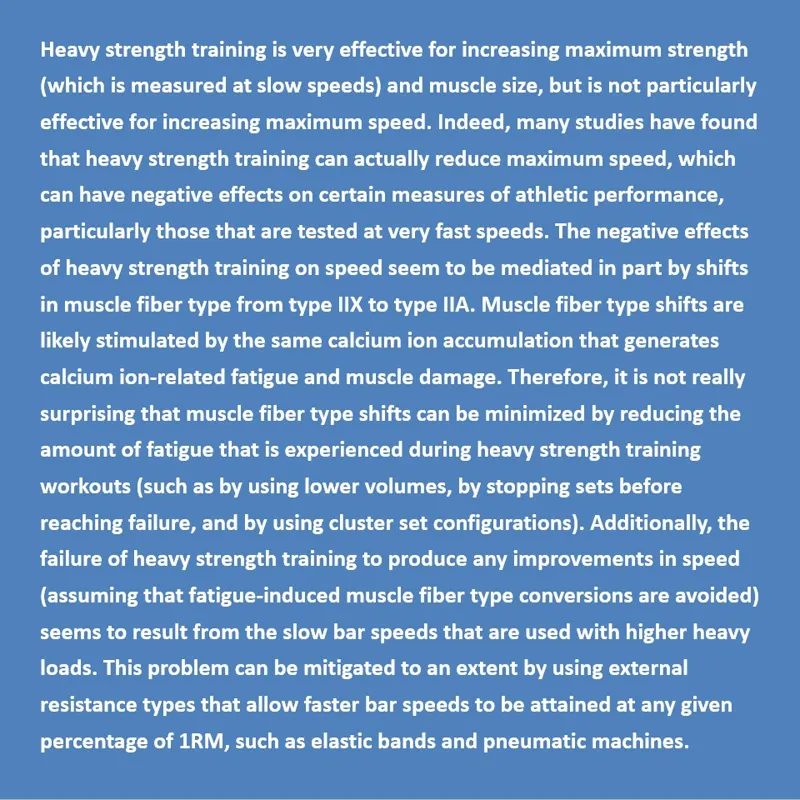
Heavy strength training is very effective for increasing maximum strength (which is measured at slow speeds) and muscle size, but is not particularly effective for increasing maximum speed. Indeed, many studies have found that heavy strength training can actually reduce maximum speed, which can have negative effects on certain measures of athletic performance, particularly those that are tested at very fast speeds.
.
#1. Heavy strength training often reduces maximum speed
While it is often assumed that an increase in maximum strength will necessarily also improve maximum speed, this is not the case. In fact, maximum speed is a totally different quality from maximum strength, and it often decreases when maximum strength increases. Therefore, when maximum speed is a key characteristic for athletes, great care needs to be taken when performing heavy strength training, such that the improvements in maximum strength do not impair athletic performance.
.
#2. Heavy strength training often causes adverse muscle fiber type shifts
Heavy strength training seems to produce reductions in maximum strength primarily due to shifts in muscle fiber type from the fastest type IIX to the moderately-fast type IIA fibers. This fiber type shift can occur very rapidly, and can dramatically impair the maximum shortening speed that the whole muscle can achieve, regardless of its ability to produce force. Fiber type shifts from type IIX to type IIA are accelerated by training closer to failure.
.
Similarly, training with high volumes also causes a greater shift from type IIX to type IIA fibers, and thereby impairs improvements in the ability to produce force at high speeds. It is likely that training closer to failure and training with high volumes cause greater muscle fiber type shifts through the same mechanism, which is by causing more fatigue.
.
Indeed, when fatigue is deliberately avoided (as in the case of velocity-based training and stopping before reaching failure as described above), this can allow improvements in maximum speed even when using heavy strength training. In fact, improvements in maximum theoretical velocity after heavy strength training have been observed after using cluster set configurations.
.
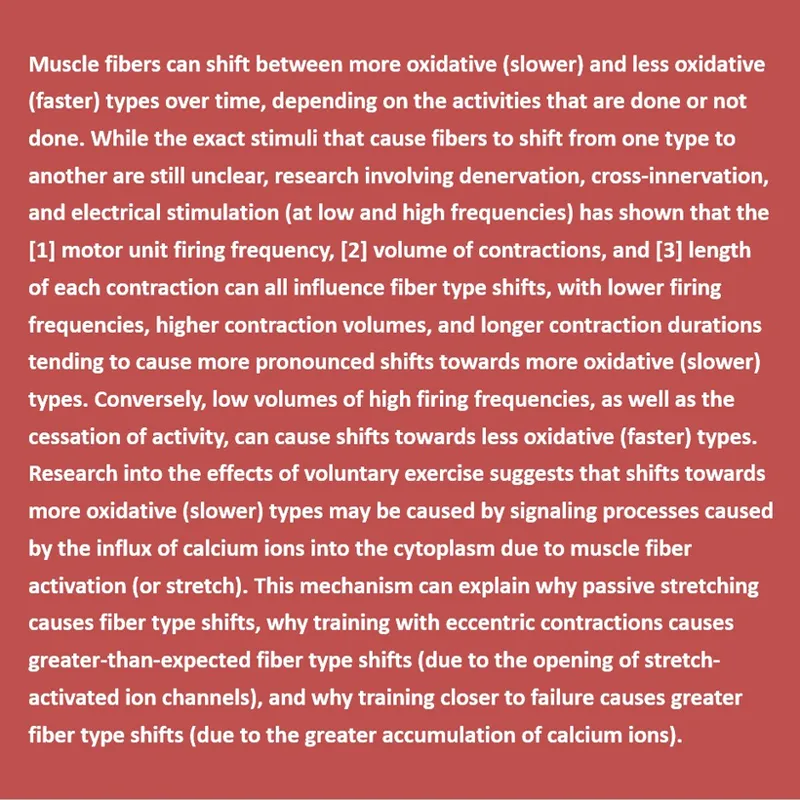
Indeed, from a mechanistic point of view, it is likely that muscle fiber type shifts are stimulated by the same calcium ions that produce calcium ion-related fatigue mechanisms towards the end of a set that is performed to muscular failure (read more).
.
#3. Certain external resistance types allow faster movement speeds
Heavy strength training is normally performed with free weights (or machines) that involve mass. Mass produces resistance by virtue of the effects of gravity and inertia. While gravity exerts the same force on the mass through the whole of an exercise range of motion, inertia is only relevant at the start of the lift when the mass is being accelerated. For this reason, the strength curve of an exercise that is performed with a free weight typically involves a higher force at the start of the concentric phase, and this means that the acceleration is relatively small at this point. In contrast, the strength curve of an exercise that is performed with external resistance types that involve less mass (such as elastic bands or pneumatic machines) typically involves a lower force at the start of the concentric phase, which allows them to accelerate more rapidly, and thereby attain a faster bar speed.
.
Fast movement training (like plyometrics) produces neural and peripheral adaptations that enhance maximum speed. These adaptations seem to be stimulated by the achievement of a fast movement velocity. Indeed, the performance of a fast movement requires a high motor unit firing rate, and this seems to stimulate increases in the ability to achieve higher motor unit firing rates in the future. Similarly, the performance of a fast movement also requires a fast muscle fiber shortening velocity, and this seems to stimulate alterations in contractile properties that improve muscle fiber shortening velocity in the future. While heavy strength training cannot attain the speeds that are attained during fast movement training, certain external resistances (such as pneumatic machines or elastic bands) can be used that allow faster speeds to be attained, and this can make heavy strength training more suitable for improving maximum speed.
.
Conclusions
Heavy strength training is very effective for increasing maximum strength (which is measured at slow speeds) and muscle size, but is not particularly effective for increasing maximum speed. Indeed, many studies have found that heavy strength training can actually reduce maximum speed, which can have negative effects on certain measures of athletic performance, particularly those that are tested at very fast speeds. The negative effects of heavy strength training on speed seem to be mediated in part by shifts in muscle fiber type from type IIX to type IIA. Muscle fiber type shifts are likely stimulated by the same calcium ion accumulation that generates calcium ion-related fatigue and muscle damage. Therefore, it is not really surprising that muscle fiber type shifts can be minimized by reducing the amount of fatigue that is experienced during heavy strength training workouts (such as by using lower volumes, by stopping sets before reaching failure, and by using cluster set configurations). Additionally, the failure of heavy strength training to produce any improvements in speed (assuming that fatigue-induced muscle fiber type conversions are avoided) seems to result from the slow bar speeds that are used with higher heavy loads. This problem can be mitigated to an extent by using external resistance types that allow faster bar speeds to be attained at any given percentage of 1RM, such as elastic bands and pneumatic machines.

Comments (8)
Hi Chris. Have this view changed the latest years? Listening to you podcast High Performance physiology episode 3- Maximum Speed, you discussed how heavy strength training could improve speed. Or did I misunderstand? Thanks for you contribution on free podcasts!
Chris, very important work here. I am somewhat dismayed for lack of a better term, at the Colyer study’s results with loaded (and unloaded, non-sport specific [“blocks” 2 and 6]) strength training effects. I’ll read the paper ASAP to try to glean their training design for those phases. Do you suppose they used high volumes/high fatigue without consideration of velocity loss? Do you believe that if they implemented VBT and a minimal velocity loss along with cluster sets during those phases there would be an end result for improvement in the F-V characteristics? Does SAID totally uproot the AA->MxS->speed-strength Periodization scheme (SPP)?
Yes, I agree that this is a really important area for athletic training. I think it helps to think in terms of the stimuli that produce adaptations (I did a separate Patreon post on this idea, I will link it below). Fast movements stimulate increases in speed (maximum theoretical velocity on a force-velocity profile test) primarily by muscle fibers achieving extremely fast movement velocities (since this is linked to motor unit firing frequency as well as local fiber adaptations). Thus, it is difficult for any external resistance to assist with the process of speed-related adaptations, because all it really does is slow down the muscle fiber shortening speed (and therefore also the motor unit firing frequency).
This is how I approach training golfers who want to swing faster. Heavy strength training to make them bigger and stronger, light med ball throws and slams, jumps, and swinging clubs as fast as they can to improve high velocity strength.
Hi Chris - great article - I have heard the argument that maximum strength training increases muscle size and strength. Then be explosive with sport training, So a basketball player lifts heavy and then performs jumps. That would be like the study on athletes above with the blocks producing more or less force or velocity. Does that make sense or will there be a permanent negative fiber shift from the heavy lifts> Thanks!
It really depends upon the sport and the athlete. If the sport requires a high movement velocity (like sprinting) and the athlete already has a force-dominant force-velocity profile, then doing heavy strength training probably isn't going to be a helpful approach. Ultimately, the optimal approach would be to test the force-velocity profile in the movement most important for the sport (jumping, sprinting or throwing) and then plan the contents of the program from there.
Interesting stuff. An argument by someone that I found the most difficult to understand in this regard is that as type IIX fibers are usually associated with low levels of muscle quality, Heavy strength training is preferred as it will cause conversion of the non functional type IIX fibers into the functional type IIA fibers. I would have thought there's enough evidence there that type IIX fibers can become functional once motor unit recruitment levels have increased with training. One question that I have is that to compare two different circuit training methods - if you compare a boxer doing rounds on a heavy bag to a crossfit competitor doing burpee press ups or another type of circuit. I would think in that context the boxer's training would mimic some of the characteristics of high velocity strength training in the sense of fast muscle fiber shortening velocity with low levels of mechanical tension whereas the crossfit competitor's circuit would involve slower muscle fiber shortening velocity with higher levels of mechanical tension albeit both would involve sub maximal levels of motor unit recruitment. I wonder if in that context the boxer's circuit would lead to a more fast twitch fiber profile over time.
I would also disagree with the suggestion that type IIX muscle fibers are non-functional. Certainly, sedentary individuals have higher proportions of type IIX fibers than most people who are more physically active, and this is probably because they don't regularly recruit the motor units that control those muscle fibers. Yet, the muscle fibers are almost certainly perfectly functional, IMO. Moreover, we can see that some sprint athletes have very high proportions of type IIX fibers, and those are certainly very functional for producing force at high speeds. For example: https://www.instagram.com/p/B8Jce3wAoEX/