







Strength
Heavy strength training is often used by athletes to improve athletic performance. Importantly, heavy strength training produces specific adaptations that increase maximum strength to a greater extent than maximum speed, and this alters the force-velocity profile.
.
#1. Improvements in coordination
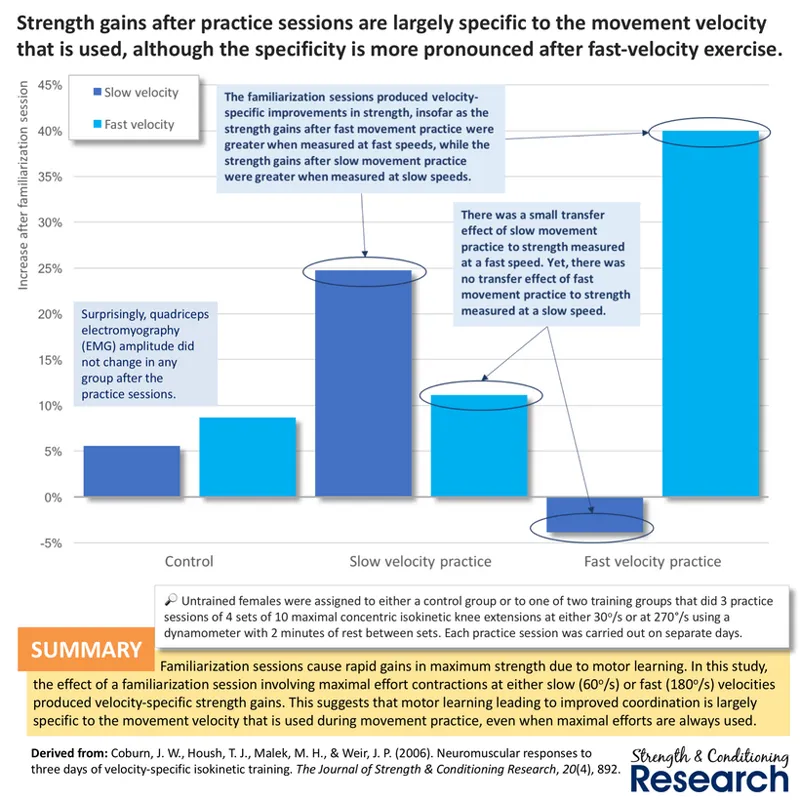
Improvements in coordination obviously contribute to strength gains and are velocity-specific. For this reason, coordination changes after strength training with a heavy load (and hence a slow bar speed) will produce greater improvements in strength than in speed.
.
#2. Increases in the ability to recruit high-threshold motor units of the agonist muscle
Improvements in the ability to recruit high-threshold motor units of the prime mover contribute to increases in strength, because they lead to new high-threshold motor units being recruited. Yet, this adaptation also causes an increase in speed, because the newly-recruited high-threshold motor units will necessarily mainly control muscle fibers of the fastest fiber type (type IIX).
.
Heavy strength training can increase the ability to recruit high-threshold motor units of the prime mover muscle. Exactly what triggers this adaptation is unclear. Yet, the adaptation tends to occur to a greater extent after using heavier loads (to failure) than after using lighter loads (to failure). Since training with heavier and lighter loads involve similar levels of effort at task failure, it is unlikely that the perception of effort itself is responsible for the adaptation. Rather, since training with heavier loads involves slightly higher levels of central motor command (leading to motor unit recruitment) than lighter loads at task failure, it is likely that the attainment of a high level of motor unit recruitment during exercise is what triggers an improvement in the ability to recruit high-threshold motor units in the next workout.
.
#3. Reductions in antagonist muscle activation
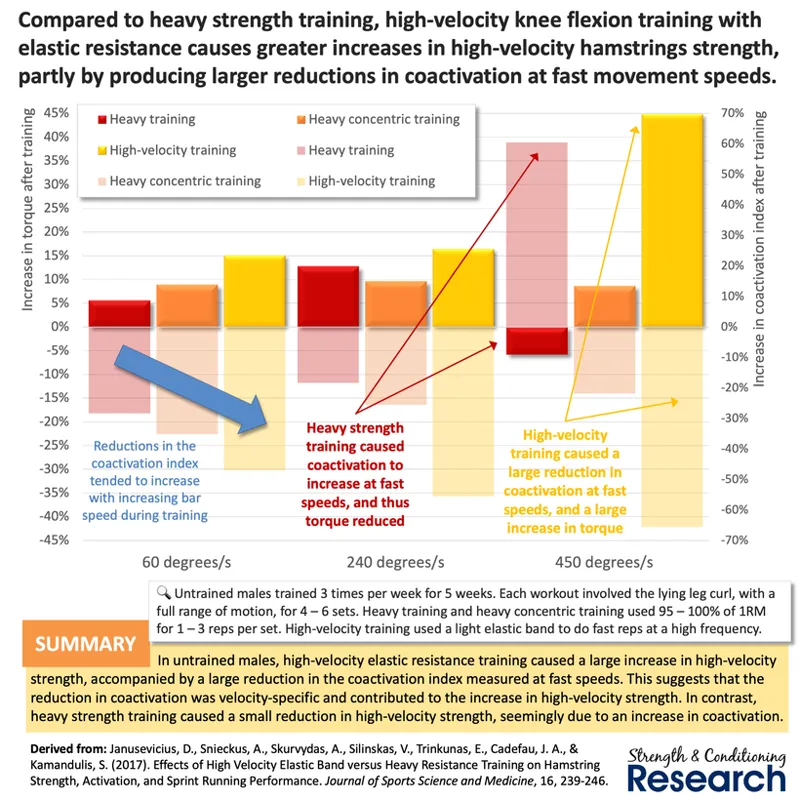
A reduction in the force produced by the antagonist muscle during an exercise reduces the braking force at the joint, and thereby increases the external force that is exerted during an exercise, even without the force of the agonist muscle itself increasing. Although other research indicates that antagonist coactivation does not reduce over short periods of time spent performing heavy strength training, cross-sectional studies have revealed that very well-trained lifters do display lower levels of antagonist coactivation than less well-trained individuals. This suggests that reductions in antagonist coactivation do occur after heavy strength training, and that they take a longer amount of time to become apparent in comparison with other neural adaptations.
.
Nevertheless, changes in antagonist coactivation are quite velocity-specific. Short-term training studies have shown that heavy strength training only reduces antagonist coactivation measured in slow movements. In this respect, it is very different from fast movement training, which reduces antagonist coactivation predominantly at fast movement speeds. In fact, some studies have shown that heavy strength training might even increase antagonist coactivation measured in fast movements, which would produce a negative effect on speed. Whether this effect is sustained after longer periods of training, however, is unclear.
.
#4. Hypertrophy
Increases in muscle fiber size increase the ability to produce force because they increase the number of myofibrils, which in turn increases the number of actin-myosin crossbridges that can form inside the muscle fiber. Each actin-myosin crossbridge contributes a tiny amount of force to the overall muscle fiber force. Therefore, increasing muscle fiber size must necessarily increase strength. Nevertheless, when muscle fiber size increases, this also increases the internal moment arm length of the muscle, which increases the distance that each muscle fiber must shorten during a joint angular rotation, and thereby increases the muscle fiber shortening velocity for a given joint angular velocity. For this reason, hypertrophy after heavy strength training increases strength but actually decreases speed.
.
#5. Increases in myofibrillar density
When muscle fibers increase in size, this occurs by means of an increase in both the number of myofibrils and an increase in the surrounding sarcoplasm. However, some recent research suggests that muscle fibers can also increase the number of myofibrils that they contain without any change occurring in the size of the fiber. This change is called an increase in the "myofibrillar density" of the muscle fiber. Like hypertrophy, increases in myofibrillar density increase the ability of a muscle fiber to produce force because they increase the number of myofibrils, which in turn increases the number of actin-myosin crossbridges that can form inside the muscle fiber. Each actin-myosin crossbridge contributes a tiny amount of force to the overall muscle fiber force. Therefore, increasing myofibrillar density must necessarily increase strength. Yet, unlike hypertrophy, changes in myofibrillar density do not affect the internal moment arm length of the muscle, and therefore probably do not reduce speed.
.
#6. Increases in lateral force transmission
Although it is often assumed that the sarcomeres inside muscle fibers transmit force from one sarcomere to the next, and eventually down to the tendon, this is probably not the case. Most of the force that is produced by each sarcomere probably travels laterally first, to the surrounding collagen layer, and then travels longitudinally to the tendon from there. Nevertheless, not all sarcomeres are effectively attached to the tendon in this way, and an increase in the number of costameric proteins after heavy strength training can cause an increase in the amount of lateral force transmission that occurs. The effect of increasing the number of sarcomeres that transmit their force laterally (instead of longitudinally) is to increase strength, but to reduce speed.
.
#7. Muscle fiber type shifts from type IIX to type IIA (velocity-specific)
Maximum muscle fiber shortening speed is closely related to the proportion of type IIX fibers, and athletes with very high proportions of type IIX fibers tend to be very successful at sports that require fast movement speeds, such as sprinting.
.
Unfortunately, heavy strength training typically causes muscle fiber type shifts from type IIX to type IIA. Exactly what causes this to occur is unclear, but it is a very rapid adaptation that can even be noted after single workouts.
.
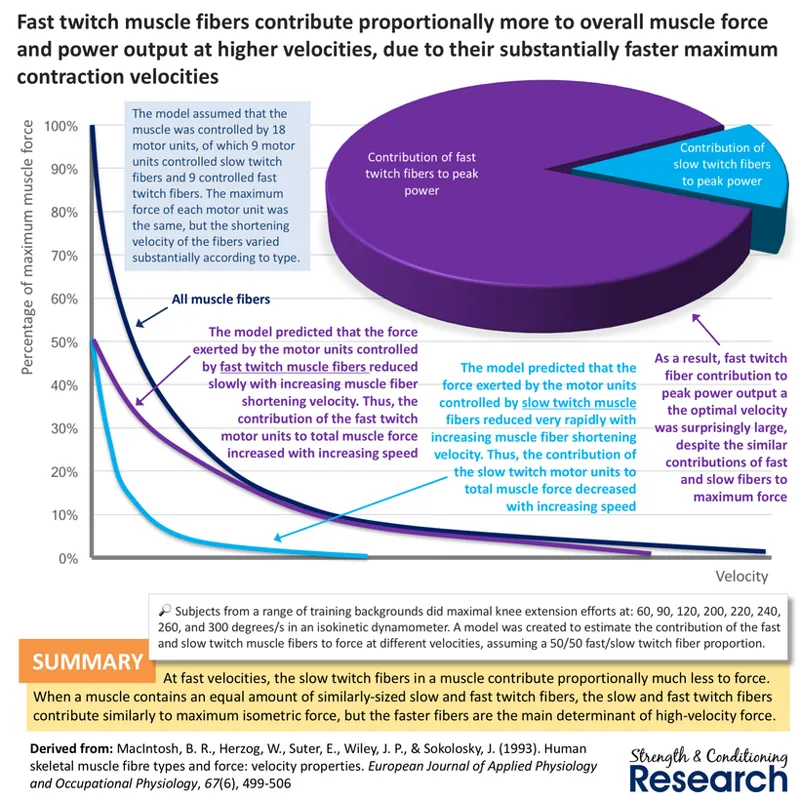
Although the number of muscle fibers that convert from type IIX to type IIA might seem relatively small in the context of the whole muscle, they actually exert a very large effect on speed. This is because only the fastest muscle fibers within a muscle contribute to force production at very fast movement speeds. Muscle fibers stop producing force once the whole muscle shortens faster than their maximum muscle fiber shortening velocity. Slow twitch (type I) muscle fibers have a maximum muscle fiber shortening velocity of approximately 1 fiber length per second. Once the muscle shortens faster than this, they cease producing force even though they are activated. Moderately-fast twitch (type IIA) muscle fibers have a maximum muscle fiber shortening velocity of approximately 3 or 4 fiber lengths per second. Once the muscle shortens faster than this, they cease producing force even though they are activated. Fast (type IIX) muscle fibers have a maximum muscle fiber shortening velocity of approximately 5 or 6 fiber lengths per second. Thus, when we test maximum speed, it is only some of the type IIA and all of the type IIX fibers that are contributing force. For this reason, losses in type IIX muscle fibers have a large impact on speed.
.
In contrast to the large effect of fiber type on maximum strength, the relative proportions of type IIX and type IIA muscle fibers have no effect on strength. This is because muscle fiber force per unit cross-sectional area does not vary very much between muscle fibers of different types, in contrast to maximum muscle fiber shortening speeds, which do vary greatly.
.
#8. Summary of effects on the force-velocity profile
Heavy strength training causes improvements in coordination and reductions in antagonist coactivation, both of which cause increases in strength but no changes in speed (although it could be argued that heavy strength training does increase antagonist coactivation at fast speeds, which would reduce speed). It causes increases in the ability to recruit high-threshold motor units and (possibly) increased myofibrillar density, which cause increases in both strength and speed. It causes hypertrophy and increases in lateral force transmission, which likely increase strength while reducing speed. And it causes muscle fibers to shift from the very fast type IIX to the moderately-fast type IIA, which has no effect on strength but reduces speed.
.
Conclusions
Heavy strength training is used by athletes to improve athletic performance. Heavy strength training produces specific adaptations that increase strength but which have either minimal or negative effects on speed, and this alters the force-velocity profile. Yet, heavy strength training also causes an adaptation that increases both strength and speed, such that it can produce a transfer effect on fast movement performance. Heavy strength training causes five velocity-specific adaptations: [1] improvements in coordination, [2] reductions in antagonist coactivation, [3] hypertrophy, [4] increases in myofibril density, and [5] increases in lateral force transmission. All five of these adaptations cause large increases in strength and either no changes in speed or reductions in speed. Also, heavy strength training often produces muscle fiber type shifts that have no effect on strength but which reduce speed. Together, these adaptations contribute greatly to the velocity-specificity of strength gains after heavy strength training and alter the force-velocity profile to become more force-dominant. Heavy strength training also causes one adaptation that is not velocity-specific, which is an increase in the ability to recruit high-threshold motor units. This adaptation causes an increase in both strength and speed. The exact effects of heavy strength training on any given athletic performance outcome will vary depending on the individual training status for each of these adaptations, and the extent to which the program is optimized to produce each adaptation (according to its own unique stimulus).
Comments (7)
Hi! What's the deal with detraining/tappering and the 'overshot phenomen'. The conversion into even more type 2X fibres. Are there any research how long training and detraing periods should be for maxing this out? Is it possible to repeat this process to increase type2X even more? I read the Jonathan Edwards may profit from this prior to his best season.
Chris, does myofibrillar density really increase force at all velocities equally? orange graph in the last one
No it doesn't. Not sure why I included it in that category
Hi chris, what about tendon stiffness and the underlying mechanism that should improve strenght training?
Suppose an athlete has very heavy powerlifting experience (thus increases in lateral force transmission) but wants to move into a sport requiring high veocity movement speeds (and therefore no longer wants to train heavy). Do the costameres developed from the past powerlifting experience ever go away once formed? If they do how quickly does this occur? Is it most comparable to the rate muscle mass decreases, tendon adaptations decrease, etc.?
There is evidence that aspects of costamere formation are indeed reversible through deloading, so I would expect that it is possible to reduce the extent of lateral force transmission within a muscle. My best guess is that the effect would be comparable to muscle and tendon changes, so a couple of months would produce meaningful changes.
Great article