




Lifting (concentric) phase tempo
The word "tempo" refers to the implementation of a deliberately slower bar speed than would otherwise be achievable on the early reps of a strength training set, when fatigue is not present. Tempo guidance is usually given as the durations of the concentric and eccentric phases (in seconds).
.
#1. What effect does tempo have on hypertrophy when training to failure?
Overall, it seems like there is minimal effect of lifting (concentric) phase tempo on hypertrophy when looking at strength training programs that involve performing sets to muscular failure.
.
#2. What effect does tempo have on time under tension when training to failure?
Even though there is no effect of lifting (concentric) phase tempo on hypertrophy when training to failure, there is a very marked impact of lifting (concentric) phase tempo on total time under tension when measured across the entire set to failure (including the reps that are not stimulating).
.
#3. What does tempo achieve, when there is no fatigue present?
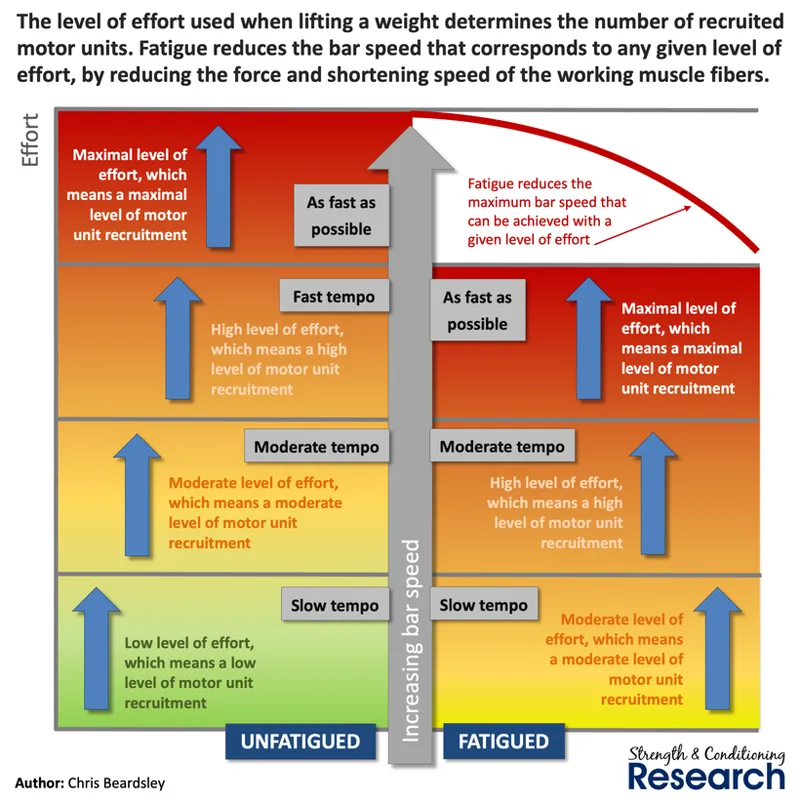
Since tempo has no effect on hypertrophy, it is worth considering why this happens. To do that, let us consider how tempo affects the stimulus produced by [1] reps before fatigue occurs, [2] reps while fatigue is present, and [3] reps at the very end of the set. In the early reps of a strength training set, when there is no fatigue present, the tempo that is used to lift the weight is closely related to the amount of effort applied to the bar, and therefore the level of motor unit recruitment that is attained. Using a low level of effort (and therefore a low level of motor unit recruitment) is necessary to create a slow tempo, while higher levels of effort (and therefore higher levels of motor unit recruitment) are required to produce faster tempos. A maximal level of effort (and therefore a maximal level of motor unit recruitment) causes the bar to move at the fastest possible speed.
.
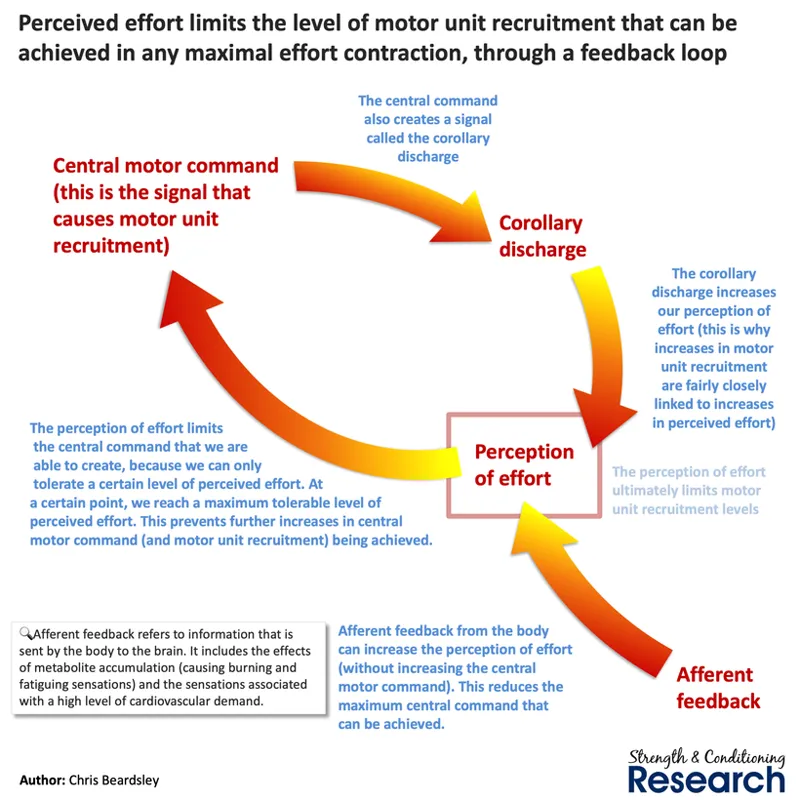
The effort we employ during a rep (and therefore the perception of effort that we experience during that rep) is a good indicator of the level of motor unit recruitment that is achieved on that rep. This is because the perception of effort is largely created by a signal (called the "corollary discharge") that is itself produced by the central motor command that is sent to the muscle to recruit motor units. This is called the "sensation of innervation."
.
#4. What does tempo achieve, when there is some fatigue present?
In the later reps of a strength training set, when there is some fatigue present, the tempo that is used to lift the weight is still related to the amount of effort applied to the bar, and therefore the level of motor unit recruitment that is attained. Yet, the presence of fatigue changes the level of effort (and the level of motor unit recruitment) that corresponds to any given tempo. With fatigue present, a slow tempo now requires a moderate level of effort (and a moderate level of motor unit recruitment). This is because fatigue has caused some of the working muscle fibers to be unable to function at the same force and velocity as in an unfatigued state, such that additional motor units must be recruited to compensate for them, if the same tempo is to be maintained.
.
#5. Is tempo even possible to choose on the final rep of a set performed to failure?
On the final rep of a strength training set, when fatigue is maximal, it is debatable whether tempo is even possible to implement. The final rep is impossible to complete without using a maximal effort (and a nearly maximal level of motor unit recruitment). Consequently, the ability to moderate force levels and create a tempo has essentially disappeared (since the only way that a tempo can be produced is by altering motor unit recruitment). Therefore, the final rep of a set involves a bar speed that is largely involuntary.
.
It is worth noting that while the level of effort will be maximal on the final rep of a set performed to failure (because without maximal effort, the set was not really performed to failure), this does not mean that the level of motor unit recruitment reached a maximal level. This is because failure occurs when a maximal level of perceived effort is attained, and not when a maximal level of motor unit recruitment is achieved. Since other factors can increase the level of perceived effort (as well as the corollary discharge produced by central motor command), this allows effort to reach a maximal level slightly ahead of motor unit recruitment in certain circumstances.
.
#6. Why does tempo not affect hypertrophy when training to failure?
Tempo does not affect the hypertrophy produced by a strength training set because it can only be altered when motor unit recruitment is not maximal, in those reps before the stimulating reps are performed. Only stimulating reps can achieve meaningful hypertrophy (read more).
.
Conclusions
The word "tempo" refers to the implementation of a deliberately slower bar speed than would otherwise be achievable on the early reps of a strength training set, when fatigue is not present. This deliberately slower bar speed is obtained by reducing effort, which means that motor unit recruitment is reduced. The reduction in motor unit recruitment leads to a lower external force production and therefore reduced acceleration of the barbell, leading to a slower movement velocity. Importantly, meta-analyses have shown that lifting (concentric) phase tempo has minimal impact on hypertrophy during strength training programs that involve performing sets to muscular failure, even though a slow lifting (concentric) phase tempo does also greatly increases the total time under tension of each set to failure. It seems likely that lifting (concentric) phase tempo does not affect the hypertrophy produced by a strength training set because tempo can only be altered when motor unit recruitment is not maximal, which means only during non-stimulating reps before the stimulating reps are performed. Since only stimulating reps can achieve meaningful hypertrophy, this explain why altering the lifting (concentric) phase tempo does not affect the amount of muscle growth that is achieved. During the earlier, non-stimulating reps of the set, lifting (concentric) phase tempo can be maximal (such that bar speed is very fast). In this case, motor unit recruitment will be maximal, but single muscle fiber tension will be too low to stimulate hypertrophy in the working muscle fibers. Alternatively, lifting (concentric) phase tempo can be very slow. In this case, single muscle fiber tension will be maximal but motor unit recruitment will be too low to stimulate much hypertrophy across the whole muscle.
