





Power
Power is a very misunderstood concept in the fitness industry, since it is not often appreciated that maximum power cannot be improved without changes in either maximum strength or maximum speed. This lack of understanding often leads to sub-optimal programming decisions when working with athletes.
.
#1. What is power?
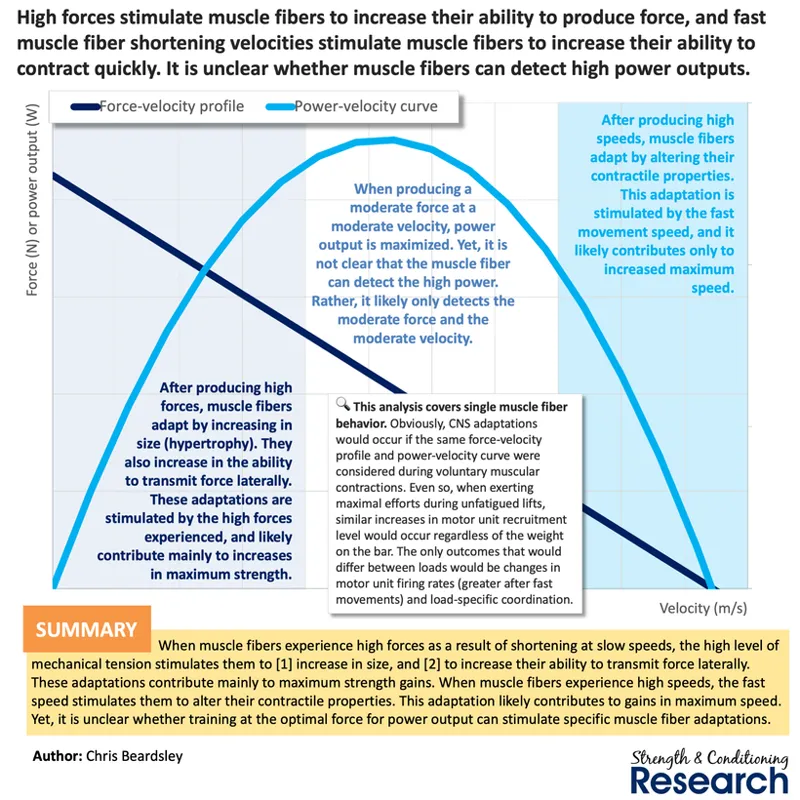
Power is the rate of work done and can be calculated as force multiplied by velocity at any point on the force-velocity (FV) profile. This generates a power-velocity curve that is zero when the FV profile meets the x axis (at zero force and maximum velocity) and is also zero where the FV profile meets the y axis (at zero velocity and maximum force). Exactly halfway between these two extremes is the velocity at which maximum power is produced. For this reason, assessing maximum power needs testing with a range of different loads (and hence velocities) because the load (and hence velocity) that corresponds to maximum power will differ between individuals. This can be seen by viewing the FV profiles of different athletes.
.
#2. What determines maximum power?
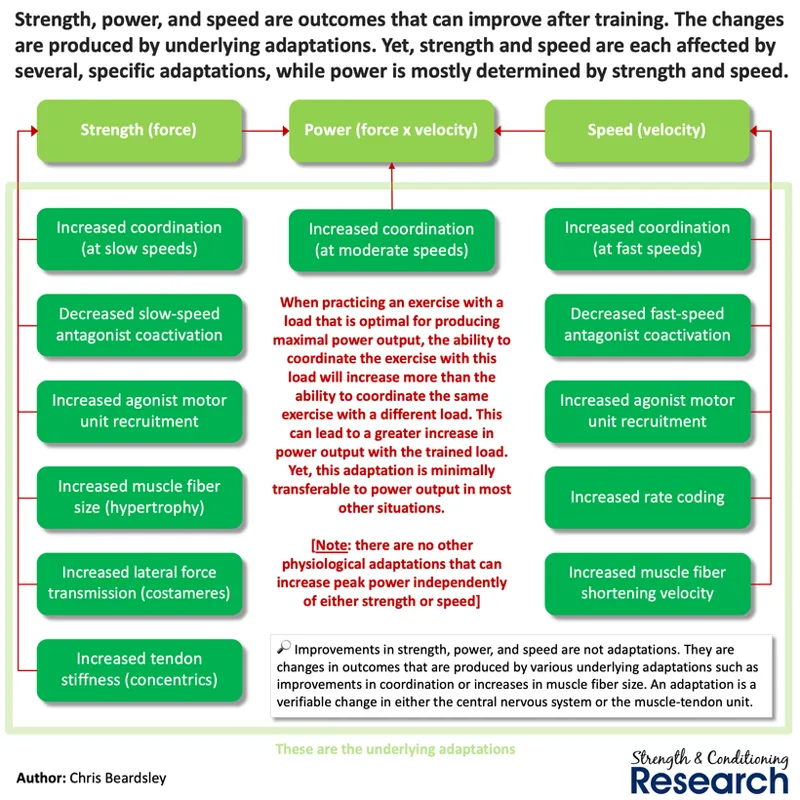
Maximum power (when determined across a range of loads) is determined by the force produced at the velocity that is halfway between maximum force and maximum velocity. For this reason, maximum power is solely dependent upon [1] maximum strength, and [2] maximum speed. Importantly, this means that the only way in which maximum power can be increased is by increasing strength or speed. In other words, it is completely impossible to increase maximum power without increasing either strength or speed.
.
Consequently, when we increase maximum power through training, we are actually causing this improvement either by [1] an increase in maximum strength, or by [2] an increase in maximum speed. Such increases in strength and speed must occur due to strength-related or speed-related adaptations. Research has identified a number of strength-related adaptations, which are (for the most part) achieved most successfully through heavy strength training. Often, it is the very high muscle (or muscle fiber) forces during the lifting of heavy loads that causes the adaptation.
.
Similarly, research has also identified a number of speed-related adaptations, which are (again, for the most part) achieved most successfully by means of fast movement training. And since it is the achievement of a very high velocity that seems to trigger most of these adaptations, training with a moderately-fast velocity (as is common during traditional power training) usually is not sufficient to bring them about.
.
#3. What determines maximum power with a specific load?
Maximum power can be determined by assessing the maximum power produced across a range of loads. Yet, it is more common to assess power outputs in specific exercises with specific loads (such as in the unloaded vertical jump). In this situation, maximum power can also be affected by the velocity of the test, for two reasons. Firstly, this can occur due to changes in load-specific coordination.
.
And secondly, it can happen because of changes in the gradient of the FV profile such that the load (and hence the velocity) at which maximum power is produced. From the perspective of the exercise in question, this is described as moving between actual and optimal FV profiles and can be achieved by training with either a greater quantity of heavy strength training (to increase strength more than speed) or by training with either a greater quantity of fast movement training (to increase speed more than strength). Indeed, it is the relative changes in strength and speed that produce the change in the gradient and not the absolute changes in each.
.
Conclusions
Power can be calculated as force multiplied by velocity at any point on the force-velocity (FV) profile. This generates a power-velocity curve that is zero when the FV profile meets each of the x and y axes. Maximum power is produced at the velocity halfway between these two extremes and is therefore solely dependent upon [1] maximum strength, and [2] maximum speed. Indeed, the only means by which maximum power can be increased is by increasing either strength or speed (although power at a specific load can also be altered by [1] altering the velocity at which maximum power is achieved, and by [2] changes in load-specific coordination). Strength can only be increased by strength-related adaptations, which are best achieved by heavy strength training. Similarly, speed can only be increased by speed-related adaptations, which are best achieved by fast movement training. Consequently, if transferable increases in maximum power are required (and not simply increases in power with a certain load in a specific exercise), it seems likely that these are best achieved by a combination of heavy strength training and fast movement training, and not by moderate load, power training.
Comments (4)
Hi Chris! Where can I read and understand about “lateral force transmission”? Thanks
The FAQ has links to all topics: https://www.patreon.com/posts/frequently-asked-43097481
I remember you saying over a year ago now that the mechanical tension stimulus for lateral force transmission MIGHT be higher then hypertrophy, meaning we might need to go slightly closer to failure for this adaptation. I’m not sure if you still believe this now but if so could this possibly be the part of the reason why sets taken closer to failure reduce higher velocity strength more (on top of fiber type shifts)? From what I understand, in terms of maximizing power, strength gains from hypertrophy would be more beneficial than strength gains from lateral force transmission because the latter directly decreases maximum shortening velocity?
Yes, that's exactly why I speculated this in the first place. Although hypertrophy can effectively decrease shortening velocity too (to a certain extent) by increasing [1] inertia due to mass, and [2] effective distance traveled by the muscle fiber for a given amount of muscle shortening due to a longer internal moment arm.