



Negative effects of fatigue mechanisms
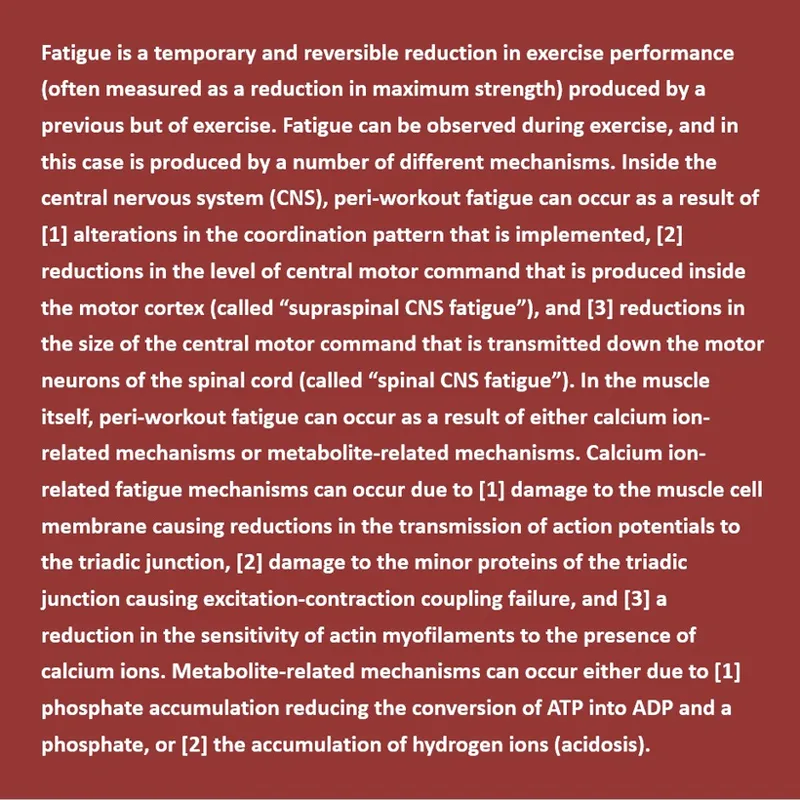
Fatigue is a temporary, reversible reduction in exercise performance (often measured as a reduction in maximum strength) observed both during and after exercise. While fatigue is frequently believed to be a key stimulus for producing adaptations, it actually typically reduces the adaptations experienced after exercise.
.
FATIGUE MECHANISMS SUMMARY
While this article deals with the impact of fatigue mechanisms on adaptations, the previous article in this series addresses the fatigue mechanisms themselves (read more).
.
CENTRAL NERVOUS SYSTEM FATIGUE MECHANISMS
#1. Fatigue prevents adaptations in coordination
When we experience fatigue, this reduces our ability to coordinate movements. Since it is a high quality movement during the workout that stimulates an improvement in coordination after the workout, fatigue stops an adaptation in coordination from happening.
.
#2. Fatigue reduces improvements in central motor command (and therefore the ability to recruit high-threshold motor units)
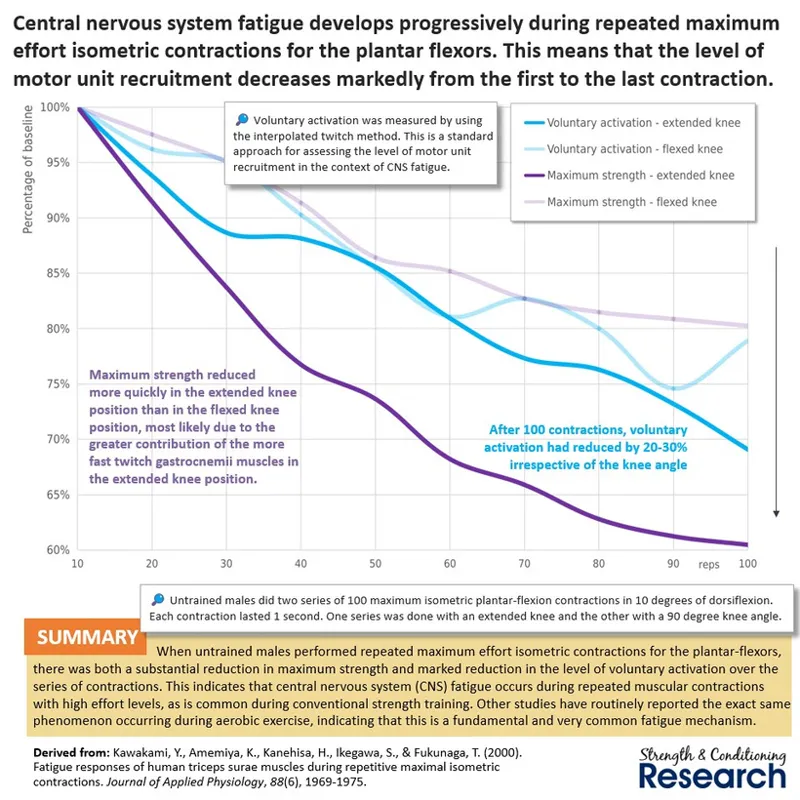
During exercise, the central motor command produced by the motor cortex causes motor unit recruitment. We need a high level of central motor command to recruit high-threshold motor units. However, when supraspinal central nervous system (CNS) fatigue is present due to perceived effort being increased by factors other than the corollary discharge from the central motor command, we cannot reach maximum levels of central motor command. This CNS fatigue develops gradually over the course of a series of sets, most likely due to the production of inflammatory mediators.
.
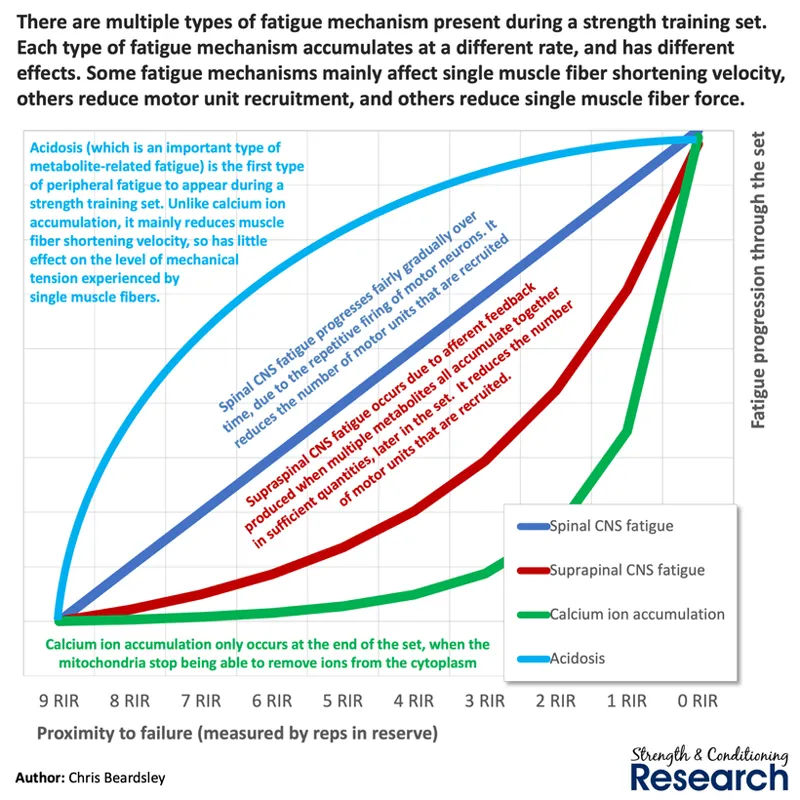
CNS fatigue also develops during single sets of light load strength training to failure by means of afferent feedback from metabolite accumulation and/or in response to the sensations associated with higher levels of cardiorespiratory activity.
.
Since achieving a high level of central motor command in a workout is the stimulus for increasing the ability to produce even higher levels of central motor command in the subsequent workout, reducing central motor command during the workout reduces the adaptation. This is exactly what happens during light load strength training to failure. The improvement in central motor command (and hence in motor unit recruitment) is substantially smaller compared to after heavier load strength training.
.
PERIPHERAL FATIGUE MECHANISMS
#1. Fatigue reduces muscle fiber mechanical tension by means of excitation-contraction coupling failure (ECCF)
ECCF reduces the ability of the voltage sensor on one side of the triadic junction to interact with the calcium ion store on the other side. This stops the calcium ions from entering the cytoplasm in response to the presence of the action potentials. Consequently, this then prevents crossbridge formation from happening despite muscle fiber activation occurring. The reduction in crossbridge formation reduces muscle fiber force (and hence the mechanical tension stimulus). Indeed, several studies have shown that muscle fiber activation alone is not sufficient to stimulate muscle fiber hypertrophy, even when calcium ions are present.
.
Similarly, research has shown that when muscle fiber mechanical tension is reduced but muscle activation is maintained at constant, maximal levels (by manipulating the point at which muscle fibers produce force on the force-velocity relationship), the resulting hypertrophy is also much reduced.
.
#2. Acidosis
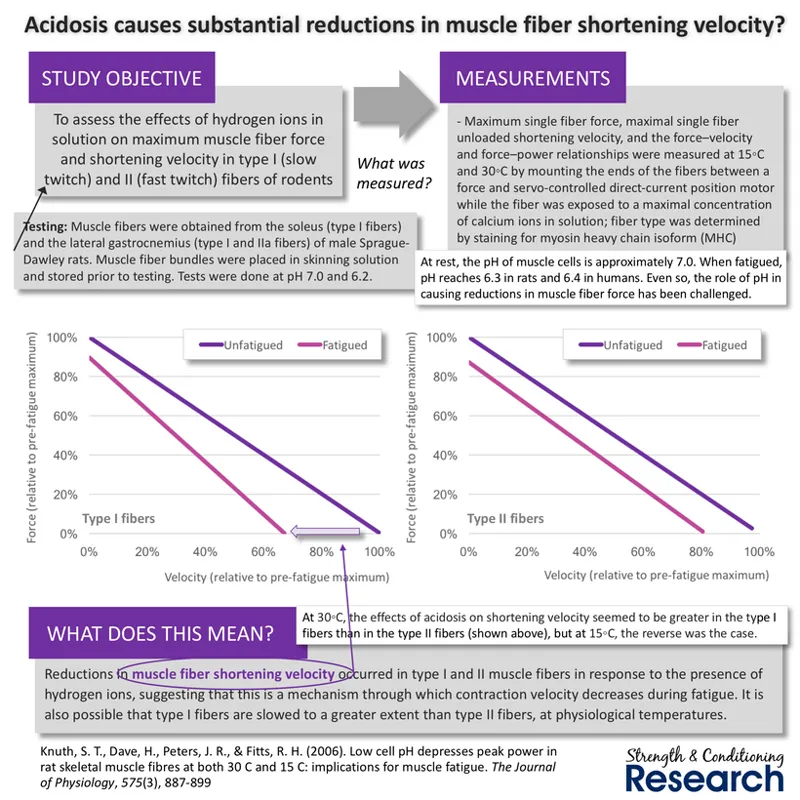
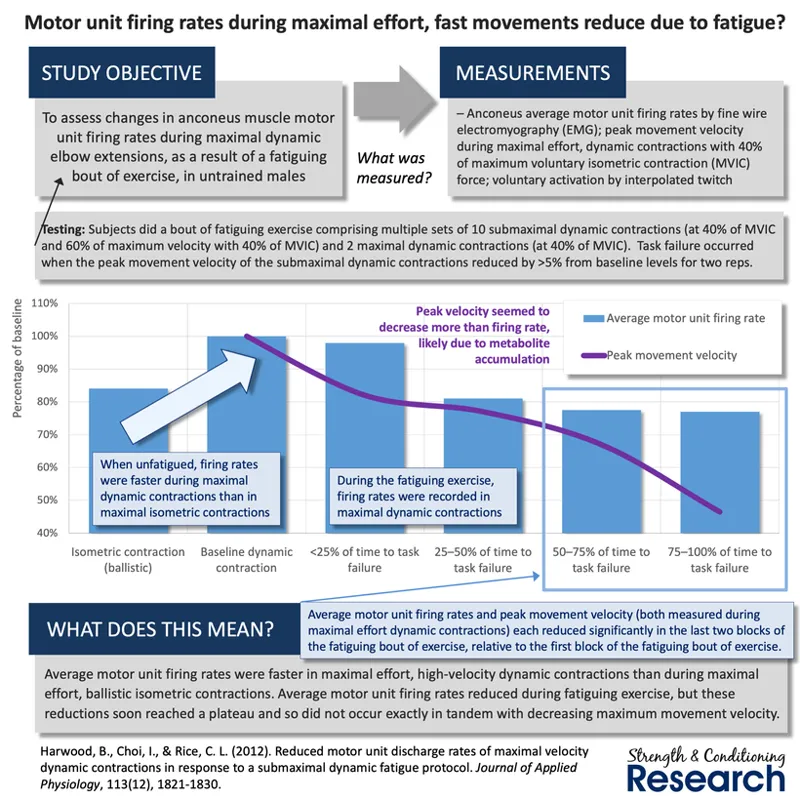
Maximum speed increases after fast movement training due to a range of mechanisms. Two very important mechanisms are [1] an increase in motor unit firing rate (MUFR), and [2] an increase in muscle fiber shortening velocity. Adaptations in MUFR are stimulated when a high MUFR is achieved during exercise. Similarly, adaptations in muscle fiber shortening velocity are stimulated when a very fast muscle fiber shortening velocity is achieved during exercise. Acidosis acts to reduce muscle fiber shortening velocity and clearly therefore reduces the stimulus for increasing muscle fiber shortening velocity.
.
Additionally, since MUFR is closely linked to muscle fiber shortening velocity, a reduction in muscle fiber shortening velocity because of acidosis also causes a concomitant reduction in MUFR. In this way, acidosis prevents adaptations in MUFR from happening.
.
Since acidosis occurs more rapidly during a strength training set than any other type of fatigue, we experience very rapid losses in muscle fiber shortening velocity as soon as we start exercising. This then reduces our stimulus for producing adaptations in both MUFR and in muscle fiber shortening velocity. However, since acidosis does not affect mechanical tension, the same negative effect is not observed for increases in maximum strength. Ultimately, this is why power training is conducted much further from muscular failure than training for maximum strength.
.
Conclusions
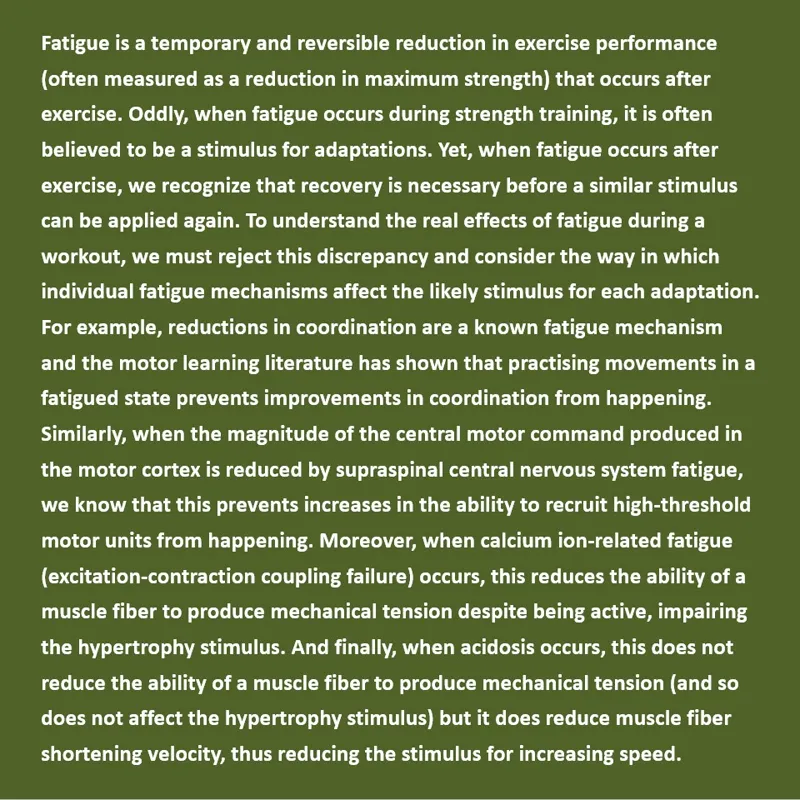
Fatigue is a temporary, reversible reduction in exercise performance (often measured as a reduction in maximum strength) observed both during and after exercise. Curiously, when fatigue occurs during strength training, it is often believed to be a stimulus for adaptations. Yet, when fatigue occurs after exercise, we customarily recognize that recovery is necessary before a similar stimulus can be applied again. To understand the real effects of fatigue during a workout, we must reject this discrepancy and consider the way in which individual fatigue mechanisms affect the likely stimulus for each adaptation. For example, reductions in coordination are a known fatigue mechanism and the motor learning literature has shown that practising movements in a fatigued state prevents improvements in coordination from happening. Similarly, when the magnitude of the central motor command produced in the motor cortex is reduced by supraspinal central nervous system (CNS) fatigue, we can see that this prevents increases in the ability to recruit high-threshold motor units from happening. When calcium ion-related fatigue (excitation-contraction coupling failure) occurs, this reduces the ability of a muscle fiber to produce mechanical tension despite being active, impairing the hypertrophy stimulus. Finally, when acidosis occurs, this does not reduce the ability of a muscle fiber to produce mechanical tension (and so does not affect the hypertrophy stimulus) but it does reduce muscle fiber shortening velocity, thus reducing the stimulus for increasing speed.
