




Delayed onset muscle soreness (fascia)
Despite a great deal of research being performed into the nature of the delayed onset muscle soreness (DOMS) that occurs in the days after strength training workouts, we still do not know exactly what causes it.
.
#1. Why is DOMS not caused by muscle damage?
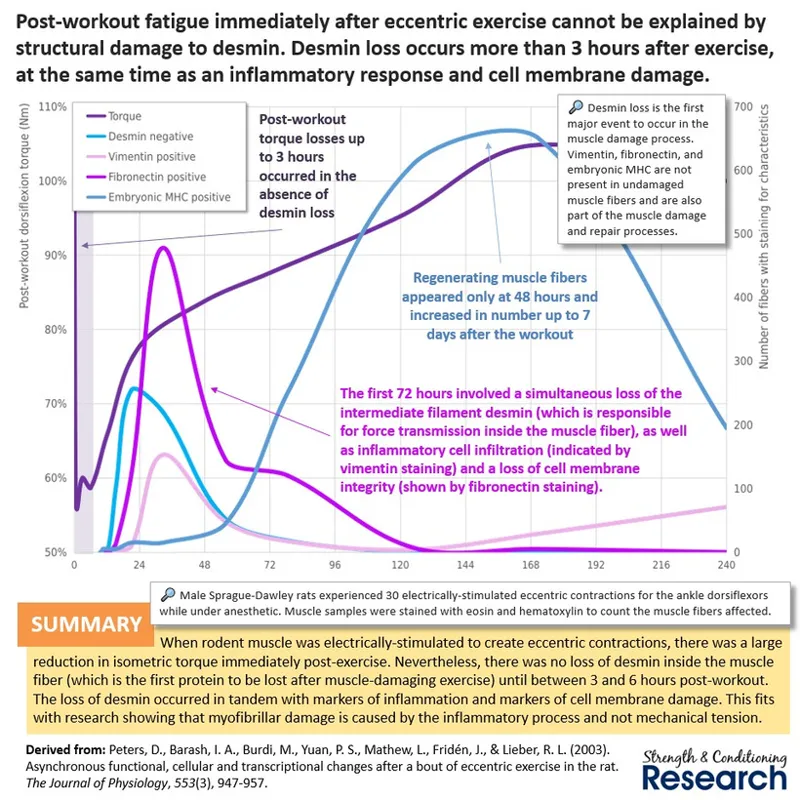
We are fairly certain that DOMS is not caused by muscle damage for several reasons. Firstly, there is a weak relationship between post-workout fatigue and DOMS. For example, although workouts involving higher volumes typically always cause more fatigue, they do not always cause more DOMS.
.
Secondly, the repeated bout effect works differently for DOMS than for fatigue. DOMS experiences a repeated bout effect from the first workout to the second workout, but does not experience any further repeated bout effects from the second workout onwards. In contrast, fatigue seems to experience repeated bout effects (that are smaller in size) across all subsequent workouts.
.
Thirdly, the time course of fatigue, muscle swelling, and muscle damage are very different from the time course of DOMS. DOMS follows a characteristic time course, rising to a peak at between 24-72 hours post-workout, depending on the characteristics of the study. In contrast, fatigue usually always peaks between 0 and 24 hours post-workout.
.
Moreover, the durations of the DOMS, post-workout fatigue, and swelling can vary greatly compared to one another. Often, post-workout fatigue outlasts the other two phenomena quite substantially.
.
The exact time course of muscle damage is difficult to describe because various events take place and each of them have a different timeline.
.
#2. How might DOMS be caused by fascial inflammation?
Early studies showed that (muscle) collagen breakdown occurs after eccentric training workouts. Markers of collagen breakdown were detected in urine and in blood samples that were taken during the post-workout recovery period.
.
Later research clarified that the collagen surrounding the muscle fiber (the endomysium) is likely broken down and remodeled as a result of eccentric training workouts. Indeed, there is an early increase in the levels of agents of collagen breakdown (such as matrix metalloproteinases) followed by a subsequent increase in the quantity of type III and IV collagen types in the endomysium.
.
Recently, researchers have shown that the fascia surrounding muscles is sensitized to pain caused by electrical stimulation in the post-workout recovery period, in much the same way as muscle tissue. Nevertheless, the increases in fascial sensitivity are more closely related to DOMS than the increases in muscle sensitivity. This suggests that it is changes in the fascia that are instrumental in producing DOMS after the workout, and not changes in the muscle.
.
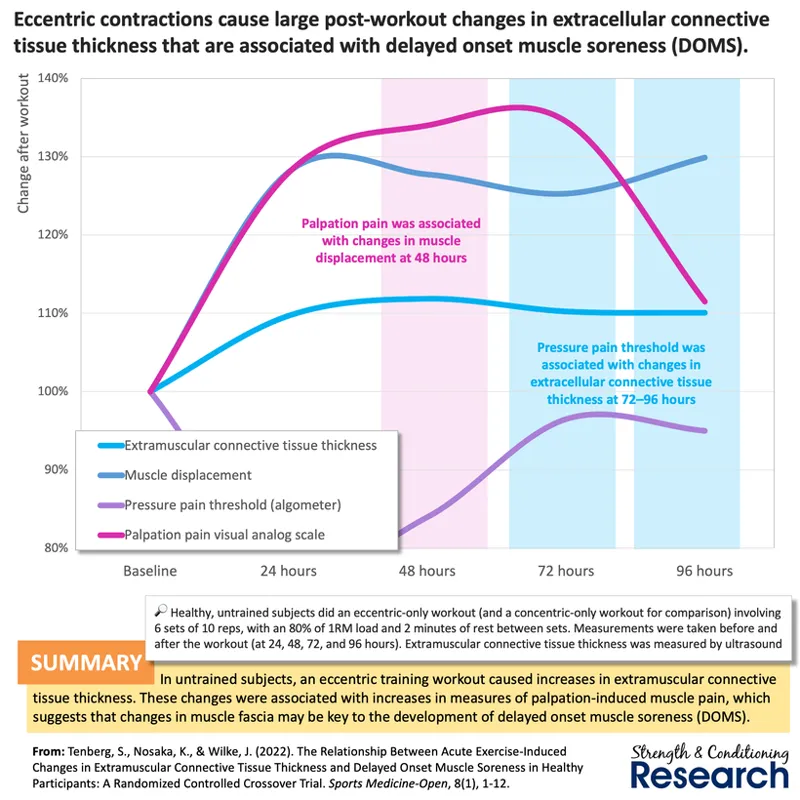
Additionally, recent research has shown that the fascia surrounding muscles increases in thickness in the post-workout recovery period, and that this change in extracellular connective tissue thickness is related to DOMS for part of the time. This also suggests that it is changes in the fascia that cause DOMS after the workout.
.
Conclusions
Despite a lot of research being done into delayed onset muscle soreness (DOMS), we still do not know exactly what causes it. Indeed, research shows that DOMS is likely not caused by muscle damage for at least three reasons: [1] higher volume workouts that cause more fatigue do not necessarily cause more DOMS, [2] the repeated bout effect occurs only after the first workout for DOMS but occurs both after the first workout and also after successive workouts for post-workout fatigue, and [3] the time course of DOMS after a workout is very different from the time courses of post-workout fatigue and the development of myofibrillar damage (since DOMS peaks at approximately 48 hours after the workout, while fatigue peaks immediately post-workout, and muscle damage develops progressively over several days afterwards and involves multiple stages). For this reason, researchers have considered whether DOMS could be caused by damage to the extracellular connective tissue (fascia) of the muscle and its subsequent inflammation. Indeed, research has shown that the connective tissue is damaged and remodeled after eccentric contractions, that it increases in thickness during the post-workout recovery period (and that this is related to DOMS), and that increases in the electrical pain threshold of the fascia in the post-workout recovery period are related to DOMS.
Comments (5)
Chris, I am a pretty advanced lifter, I train a lot, but recently even with low volume of chest or back workout, I get really high levels of DOMS. I can do like 2-3 sets of bench press, and my chest will sore for few days like never before. My two questions from this are: 1. Are advance lifters get more DOMS? 2. Can DOMS be indicator of optimal volume? For example - no DOMS - good recovery, good volume, a little DOMS - maybe two much volume, high levels of DOMS - volume is too high? As always, Chris, thank you
Once the repeated bout effect has happened, the general tendency is for increasing training status to cause increasing muscle damage and soreness because of the increases in motor unit recruitment capacity leading to more fast twitch fibers being activated during exercise. So yes, advanced lifters can find that they develop worse DOMS than beginners and intermediates. Also, some muscles will experience more problems than others. Typically, in the upper body, the pecs, biceps, and triceps are the most severely affected by virtue of their fast twitch fiber type.
Would it be recommended to pause in the stretched position for 1-2 seconds for exercises that benefit from SMH or should this be done for every exercise? I know all exercises should have a controlled 2-4 second eccentric.
It depends upon the muscle and the lifter. If either the muscle or the lifter are very susceptible to muscle damage and/or DOMS then it might be better to avoid stretched position exercises and/or stretched position pauses. In contrast, if the muscle and the lifter are not very susceptible to muscle damage and/or DOMS then it could enhance hypertrophy.
Great article Chris, I have one question. Why most people have more DOMS after chest, hamstring training then other muscle groups?