

Eccentric tempo (athletes)
Supramaximal eccentric-only training has often been recommended for athletes since it can increase energy absorption ability during the sprinting gait cycle, and during deccelerations, landings, and changes of direction. However, this type of strength training is difficult to implement without special equipment, and therefore many strength coaches have attempted to replicate the effects using slow lowering (eccentric) phase tempos during normal strength training. Sadly, this is not only impossible, but it is also counterproductive, because the two types of strength training are totally different in their effects.
.
#1. Slow lowering (eccentric) tempos cause more hypertrophy
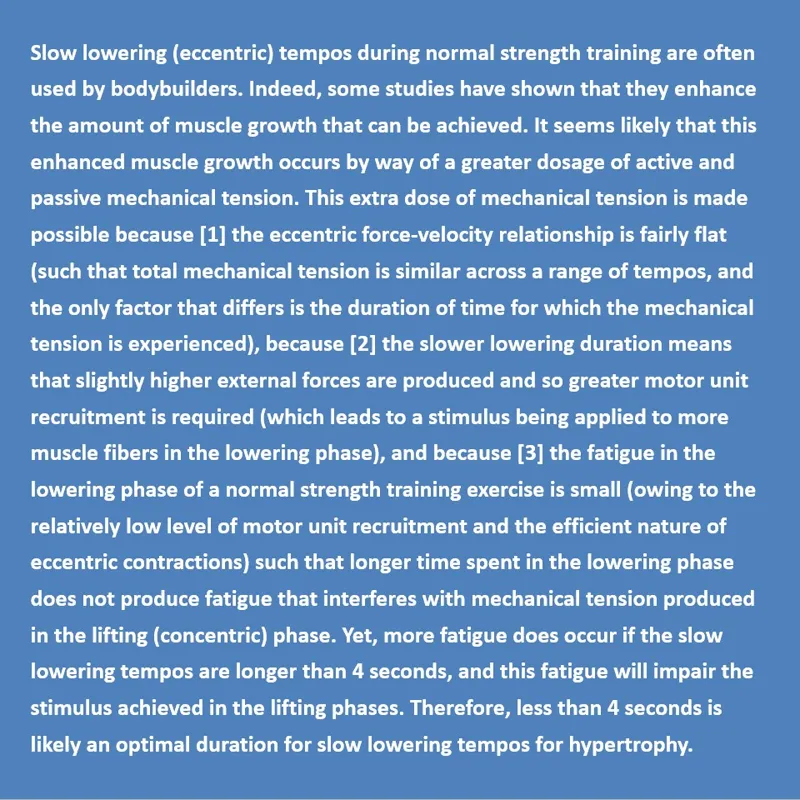
Research has shown very clearly that slow lowering (eccentric) tempos during normal strength training cause more muscle growth (read more). This has made them attractive for strength coaches who want to increase the muscle mass that their athletes carry.
.
#2. The greater hypertrophy is solely due to increases in slow twitch fiber size
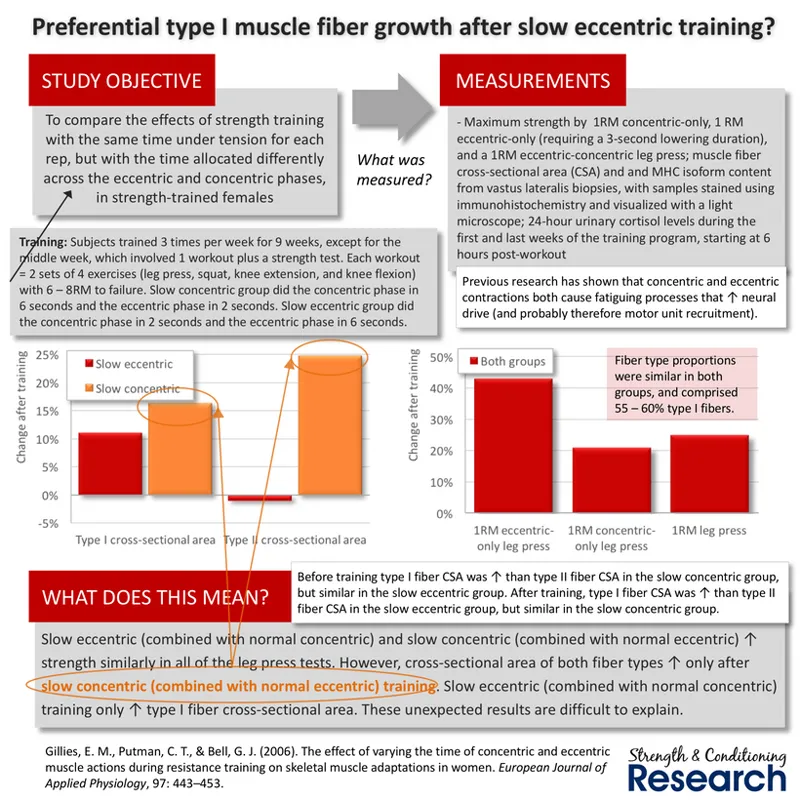
Sadly, however, the greater hypertrophy that is stimulated by slow lowering (eccentric) phases does not occur due to overall greater muscle fiber size. In fact, the greater hypertrophy is solely caused by slow twitch muscle fiber growth.
.
This is because the level of muscle activation is much lower during lowering (eccentric) phases. Therefore, only the slow twitch muscle fibers are actually activated and therefore stimulated to grow.
.
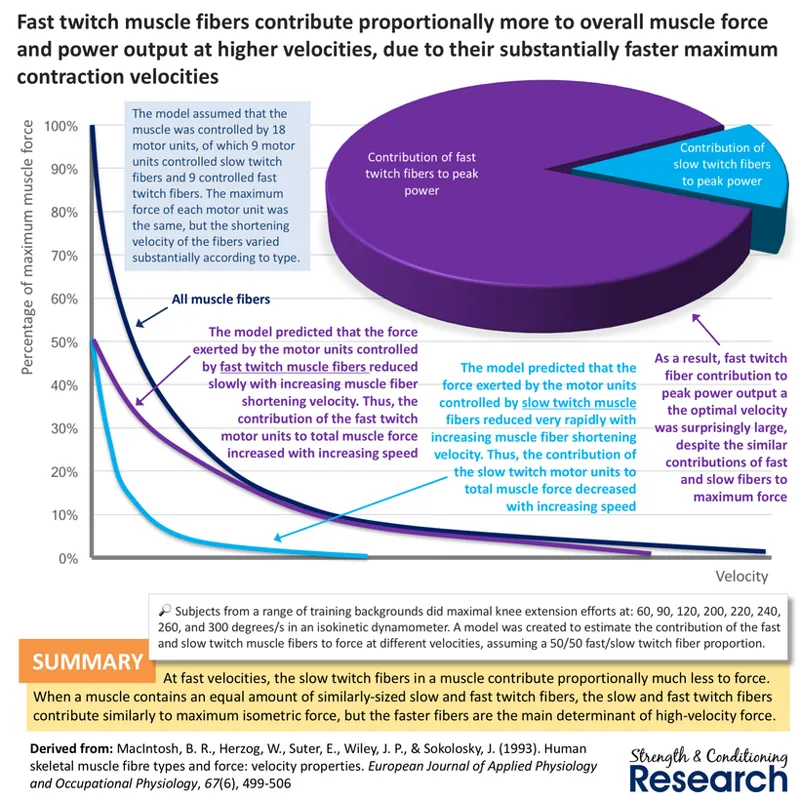
This has incredibly important practical implications, since muscle fibers can only shorten at speeds equal to or less than their maximal shortening velocity. Therefore, during fast, athletic movements, only the fast twitch muscle fibers can contribute to force production (even though all muscle fibers are activated). This means that when we increase the size (and mass) of slow twitch muscle fibers, we are increasing bodyweight without increasing our ability to move that bodyweight at a high speed, thereby reducing athletic performance!
.
#3. Slow lowering (eccentric) phase durations also reduce concentric phase bar speed, likely reducing their stimulus
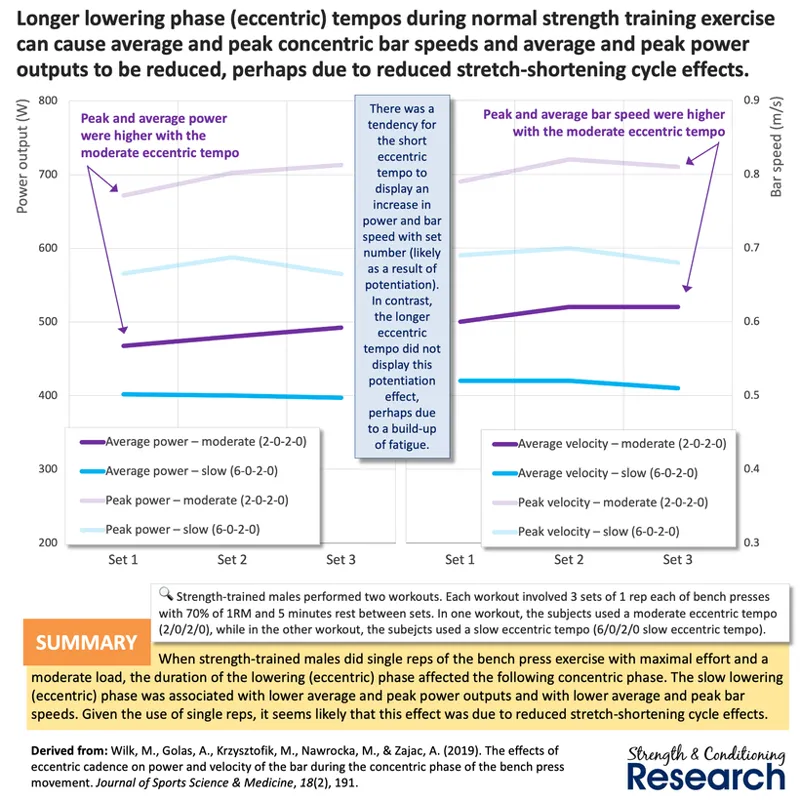
When using slow lowering (eccentric) phase durations, the bar speed of the lifting (concentric) phase is generally reduced. This could occur either due to fatigue mechanisms from the eccentric phase interfering with the concentric phase, or because of some interference with the stretch-shortening cycle. Either way, the slow lowering (eccentric) phase could reduce adaptations achieved in the lifting (concentric) phase.
.
#4. Slow lowering (eccentric) phase durations are less effective for improving high-velocity athletic performance
When athletes train with slow lowering (eccentric) phase durations, we might expect this to produce better gains in maximum strength due to the greater (slow twitch muscle fiber) hypertrophy. However, we might expect it to cause worse gains in high-velocity strength measures (such as vertical jumping and sprinting) because of [1] the increase in the mass of the slow twitch muscle fibers that does not benefit high-velocity force production, and because of [2] the reduced stimulus in the lifting (concentric) phase either because of fatigue or interference with the stretch-shortening cycle. Indeed, this is exactly what happens.
.
Conclusions
Slow lowering (eccentric) tempos during normal strength training are often used by bodybuilders to enhance hypertrophy. However, they are almost certainly not valuable for athletes, for two key reasons. Firstly, the extra hypertrophy that they produce occurs only in the slow twitch muscle fibers, since these are the only muscle fibers that can be activated (and therefore stimulated to grow) during the lowering (eccentric) phase of a normal strength training rep. Importantly, slow twitch muscle fibers are not able to contribute to force production during high-speed movements like jumping, throwing, and sprinting because they can only produce force in concentric contractions up to and including their maximal shortening velocity, which is typically slower than the speed used in such movements. Thus, even though they are activated in such movements, they do not contribute. Consequently, causing growth of such fibers is counterproductive for athletes, since it adds bodyweight with no benefit to high-velocity force production. Secondly, slow lowering (eccentric) tempos during normal strength training appear to reduce performance in the associated lifting (concentric) phase (either because of fatigue or because of interference with the stretch-shortening cycle), which may in turn reduce the adaptations produced by this more important phase.