



Time under tension
Time under tension (TUT) is a popular concept in bodybuilding that unfortunately is poorly understood. Theoretically, we can relate TUT to the stimulus for hypertrophy but not as is currently measured.
.
#1. How can we assess the stimulus for hypertrophy?
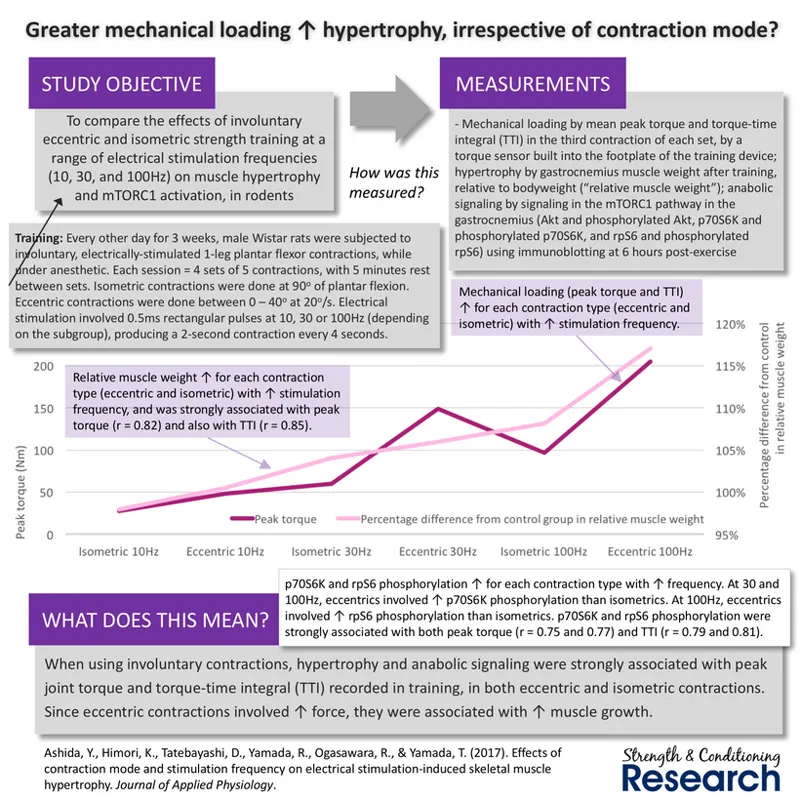
Some research studies in animals have found a way of quantifying the dose of mechanical tension stimulus that causes hypertrophy. They have shown that the force-time integral experienced by the muscle in maximally electrically-stimulated isometric, eccentric or slow-velocity concentric contractions can predict the resulting muscle growth. The force-time integral is simply the average level of mechanical tension produced (and hence experienced) by the muscle fiber multiplied by the time for which that average level of mechanical tension is experienced. In other words, this type of TUT measurement is a very accurate way of assessing the dosage of mechanical tension and hence of the stimulus for hypertrophy.
.
#2. How is TUT currently measured?
In contrast to during animal studies (where TUT is measured only during maximal contractions with slow movement velocities), TUT during strength training in humans is typically calculated as the duration of time that it takes for a set to be performed to failure, where this set includes reps that either [1] do not involve high levels of motor unit recruitment, or [2] do not involve high levels of mechanical tension. For this reason, this measurement of TUT is not closely related to the resulting hypertrophy. Indeed, it is not greater when training with higher repetition ranges than when training with lower repetition ranges, despite hypertrophy being identical.
.
Similarly, TUT is greater when training with slower lifting phase tempos than when training with faster lifting phase tempos, and yet the resulting hypertrophy is identical.
.
#3. How should TUT be measured in order to connect it with hypertrophy?
So how can we change the definition of TUT during normal strength training so that it becomes useful to predict the amount of muscle growth that will occur? Essentially, we need to only calculate the TUT in which responsive muscle fibers are exposed to a sufficient mechanical tension stimulus. Counting time when non-responsive muscle fibers are activated is not particularly useful, since these muscle fibers will not grow after training anyway.
.
Conclusions
Time under tension (TUT) is a popular concept in bodybuilding, and greater TUT is often believed to lead to greater hypertrophy. Indeed, when looking at animal models, the force-time integral (in maximally-stimulated contractions at a slow movement speed) is closely associated with muscle growth achieved. This suggests that the duration of time for which a muscle fiber is exposed to a pulling force (above a certain threshold) is a useful way of quantifying the dosage of the mechanical tension that stimulates hypertrophy. However, TUT during strength training sets is not related to muscle growth, because training with the same number of sets of light and moderate loads causes the same hypertrophy, and yet light loads involve much longer TUT than moderate loads. Similarly, training with slow and fast lifting (concentric) phase tempos cause the same hypertrophy, and yet slow lifting (concentric) phase tempos involve much more total TUT than fast lifting (concentric) phase tempos. Fortunately, this problem can be solved by only counting TUT for those reps in which [1] motor unit recruitment is maximal, and [2] bar speed is slow. Practically speaking, this probably corresponds to the final five or so reps of a set performed to failure.
Comments (4)
We have to consider which muscle fibers are experiencing TUT. When effort levels are submaximal, TUT may not produce a stimulating effect. Lowering (eccentric) phases during normal strength training are always going to be submaximal and therefore we don't really know whether the muscle fibers will experience hypertrophy.
Thank you Chris - I believe you have proposed a 4 second eccentric as being the optimal hypertrophy stimulus - so regardless of the concentric tempo utilized why would that not allow us to calculate a length of mechanical tension stimulus that is optimal? In other words is TUT just another way of saying don't drop the weight?
Glad you posted this. "TUT" IMO is a term that is thrown around but means little. TUT implies causality when it is simply correlated with results, in other words "TUT has no virtue of it's own". In addition to the above studies-if TUT were "king", then constant tension exercises (e.g. cammed machines, single joint cable exercises, etc.) would be the better for hypertrophy than compound free weight exercises due to the TUT on target muscles during each repetition. TUT seems to be a vague expression of volume.
Yes, TUT as it is defined in the fitness industry is pretty much useless, and TUT as defined properly is the same thing as the number of stimulating reps.