




Carbohydrate mouth rinsing
The effect of carbohydrate mouth rinsing is a very interesting phenomenon, because it produces an improvement in exercise performance that cannot be attributed to the traditional energy crisis model of fatigue. Rather, it must be interpreted within the new, psychobiological model of fatigue. Moreover, in the last few years, research has tested the effects of carbohydrate mouth rinsing on strength training performance.
.
#1. Effects of carbohydrate mouth rinsing on strength training performance
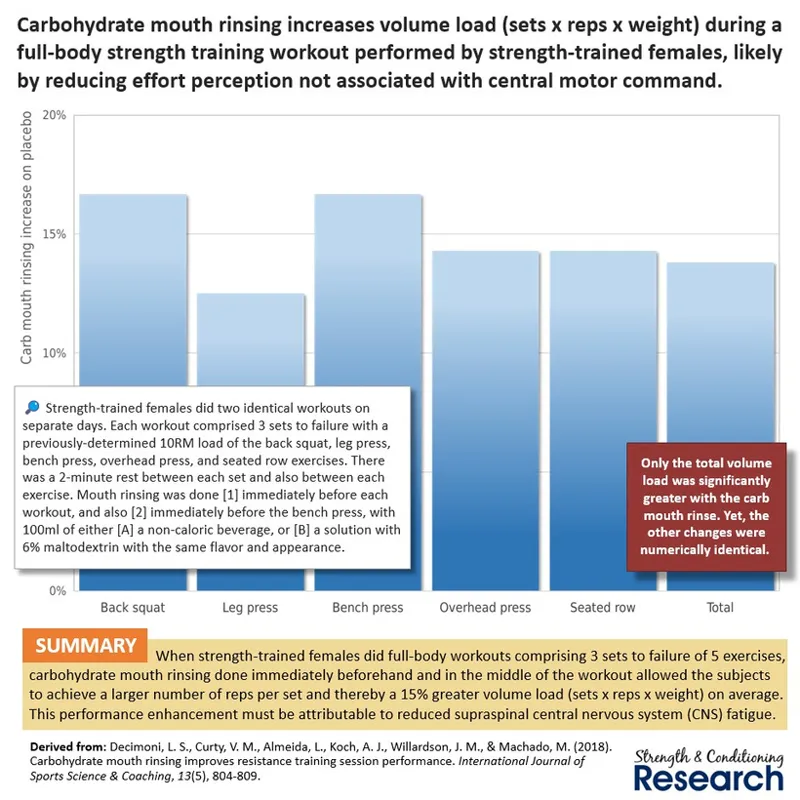
Recent research has shown that the number of reps performed to failure during a strength training workout with a fixed number of sets can be increased by carbohydrate mouth rinsing in strength-trained lifters. Since no carbohydrate is consumed in such situations, the only mechanism that can explain the phenomenon is one inside the central nervous system (CNS).
.
While some researchers have suggested that the effect is only observable in long-durations of strength training exercise comprising many sets of moderate or high reps, more recent work has shown that even heavy load performance is affected.
.
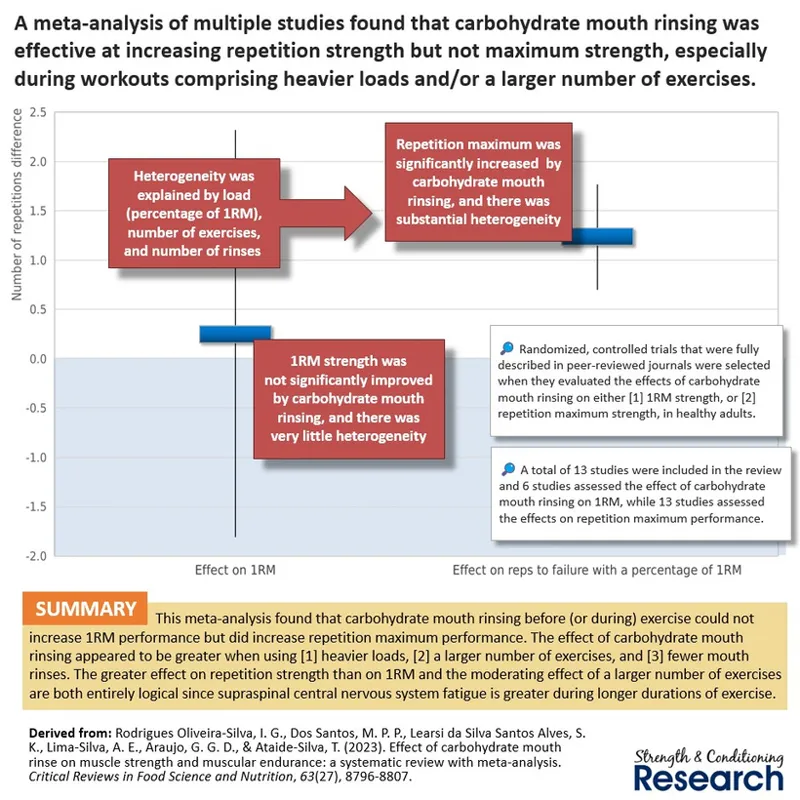
Across the whole available literature, there is no noticeable effect on maximum strength, but there is a very clear effect on repetition strength, whether this is performed as a single set or across multiple sets of a workout.
.
#2. Effects of low carbohydrate availability on supraspinal central nervous system fatigue
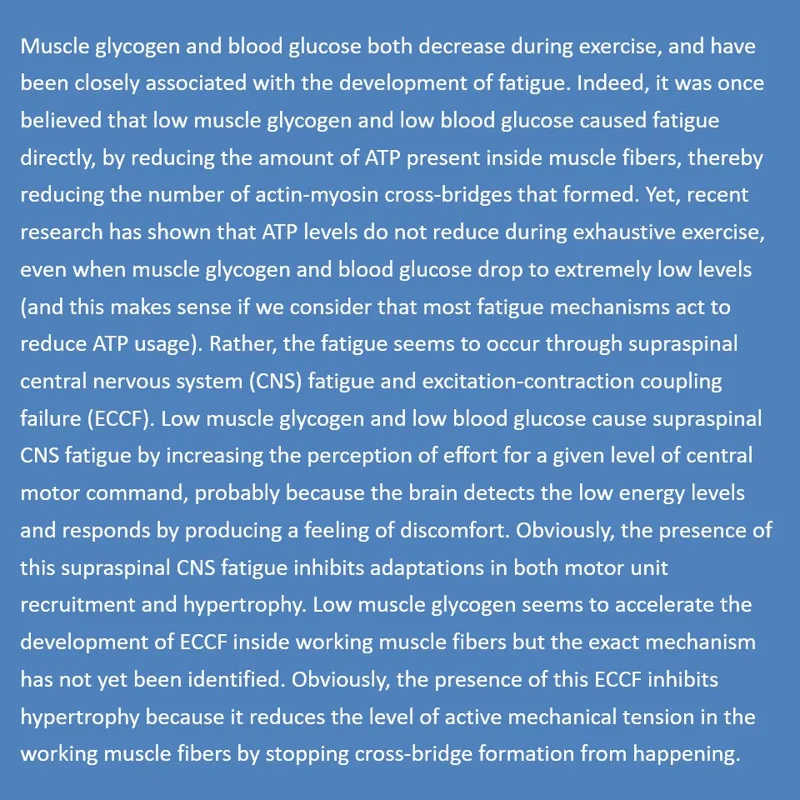
How does carbohydrate mouth rinsing affect strength training performance? To understand that, we must first look at how low glycogen or low blood glucose cause fatigue. Indeed, there is a large amount of data showing that a reduction in body carbohydrate stores is quickly noticed by the brain, which then produces discomforting feelings of tiredness and fatigue. These feelings produce a reduction in motor unit recruitment at maximal levels of effort, which we call supraspinal CNS fatigue (read more).
.
#3. The psychobiological model of supraspinal central nervous system fatigue
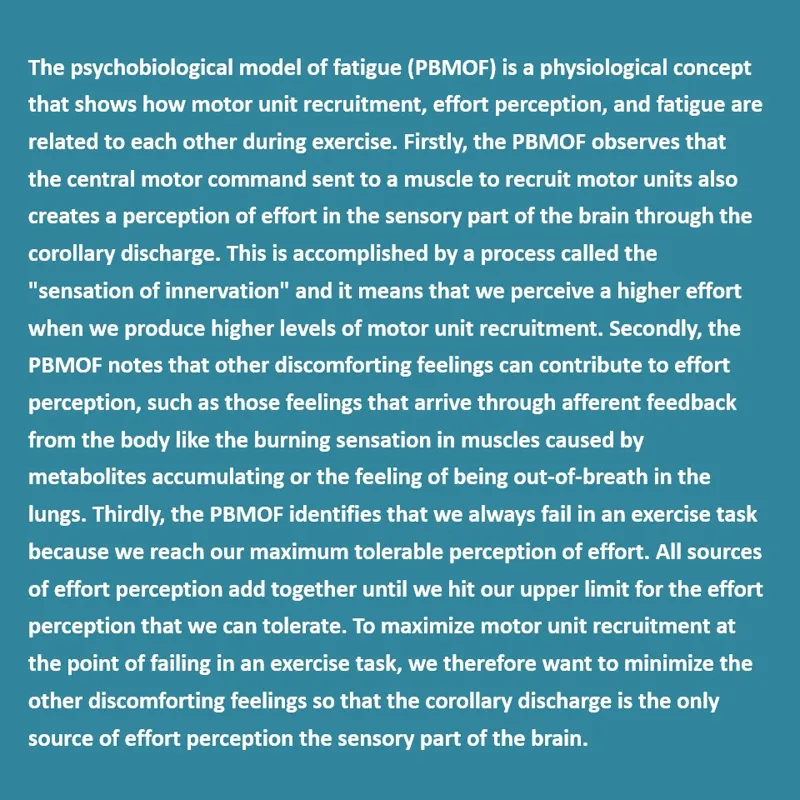
The way in which discomforting feelings produce a reduction in motor unit recruitment at maximal levels of effort is explained by the psychobiological model of fatigue (read more).
.
Conclusions
Recent studies have shown that [1] the total number of reps to failure in a strength training workout with a fixed number of sets, and [2] peak power outputs during heavy load strength training sets, can both be increased by pre-workout and/or peri-workout carbohydrate mouth rinsing in strength-trained lifters. Earlier research had focused on the effects of carbohydrate mouth rinsing in endurance activities and it had previously been suggested that the benefits of this practice during strength training would be minor owing to the much smaller impact of supraspinal central nervous system (CNS) fatigue on short-duration, high-intensity exercise in comparison with long-duration, endurance exercise. Indeed, carbohydrate mouth rinsing works by reducing the supraspinal CNS fatigue that is triggered when the brain detects low levels of carbohydrate (either as blood glucose or muscle glycogen). Evidently, the positive effects of carbohydrate mouth rinsing on strength training performance tell us that [A] supraspinal CNS fatigue is a standard feature of strength training workouts, even those that are of relatively short duration and which involve heavy loads, and also that [B] pre-workout and/or peri-workout carbohydrate mouth rinsing or carbohydrate consumption are viable strategies for reducing this effect.
Comments (1)
Is there a minimum concentration of carbohydrates for the effect to take place?