




Muscle glycogen
Muscle glycogen and blood glucose both decrease during exercise. Traditionally, low muscle glycogen and blood glucose were thought to cause fatigue directly, by reducing the amount of ATP present inside muscle fibers. This is now known as the "energy crisis hypothesis" and has been discarded in favour of other explanations.
.
#1. Muscle glycogen is indeed reduced by exhaustive exercise
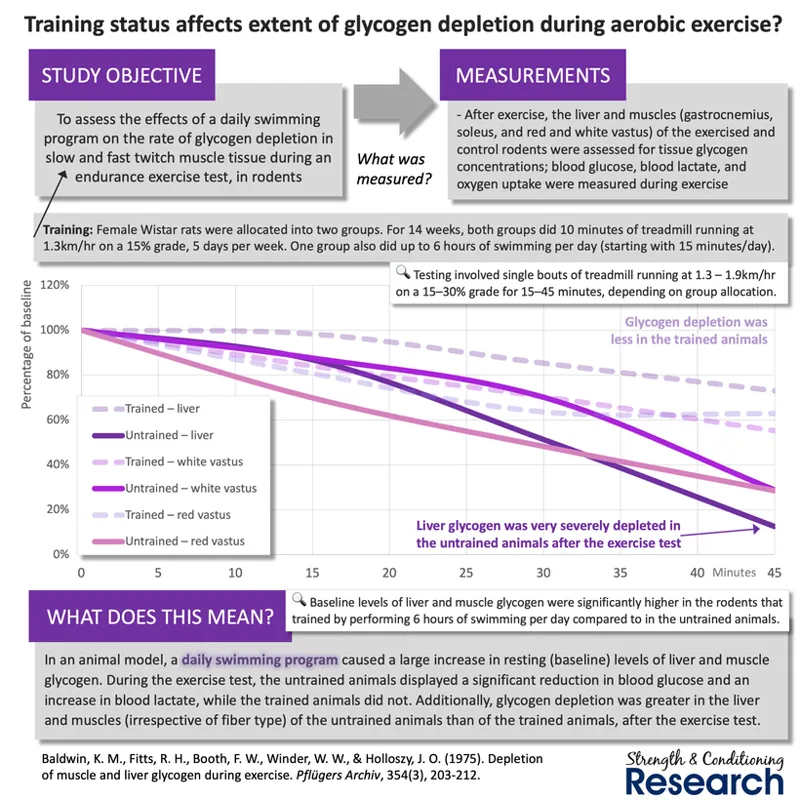
Muscle glycogen is reduced by exhaustive exercise (but it is never completely depleted). The extent to which glycogen is depleted by exercise depends on its relative intensity. When exercise is more intense, more muscle glycogen is used. This is probably because higher intensities of exercise involve a higher proportion of glycolysis but a lower contribution from fat oxidation. While liver glycogen can provide extra fuel to working muscles, glycogen stored in other muscles cannot.
.
#2. Low glycogen causes supraspinal central nervous system (CNS) fatigue
Important research has shown that low muscle glycogen during exercise does not reduce ATP inside the working muscle fibers, which has allowed us to discard the energy crisis hypothesis. In addition, it has shown that maximum involuntary force is not greatly affected by the presence of low muscle glycogen even though the maximum voluntary exercise performance is substantially reduced. This suggests that the source of the fatigue caused by low muscle glycogen is at the CNS level.
.
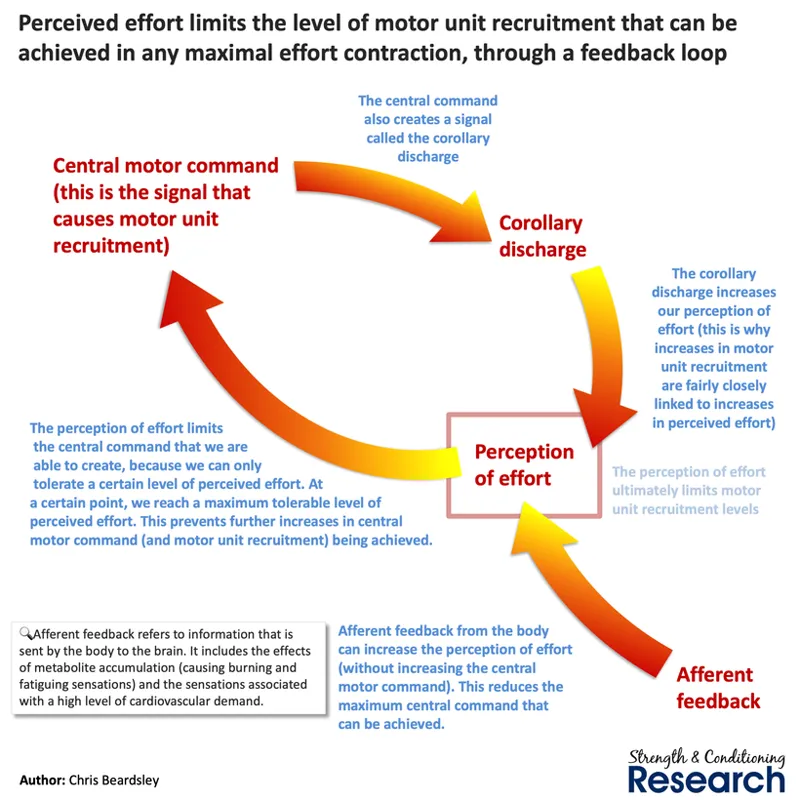
Indeed, when voluntary activation reductions are measured in humans during voluntary exercise, it is clear that low muscle glycogen (and low blood glucose) cause fatigue by reducing the central motor command that can be generated, thereby reducing motor unit recruitment levels. The obvious explanation for this observation is that the brain creates a feeling that increases our perception of effort in response to low muscle glycogen (and low blood glucose) levels.
.
When our perceived effort is increased by other factors (and not by the corollary discharge from the central motor command), then we reach a maximum tolerable perception of effort at a lower level of central motor command and therefore also a lower level of motor unit recruitment. This reduces our ability to achieve gains in motor unit recruitment and our ability to activate the most responsive muscle fibers of the highest high-threshold motor units, thereby reducing hypertrophy.
.
#3. Low glycogen causes excitation-contraction coupling failure
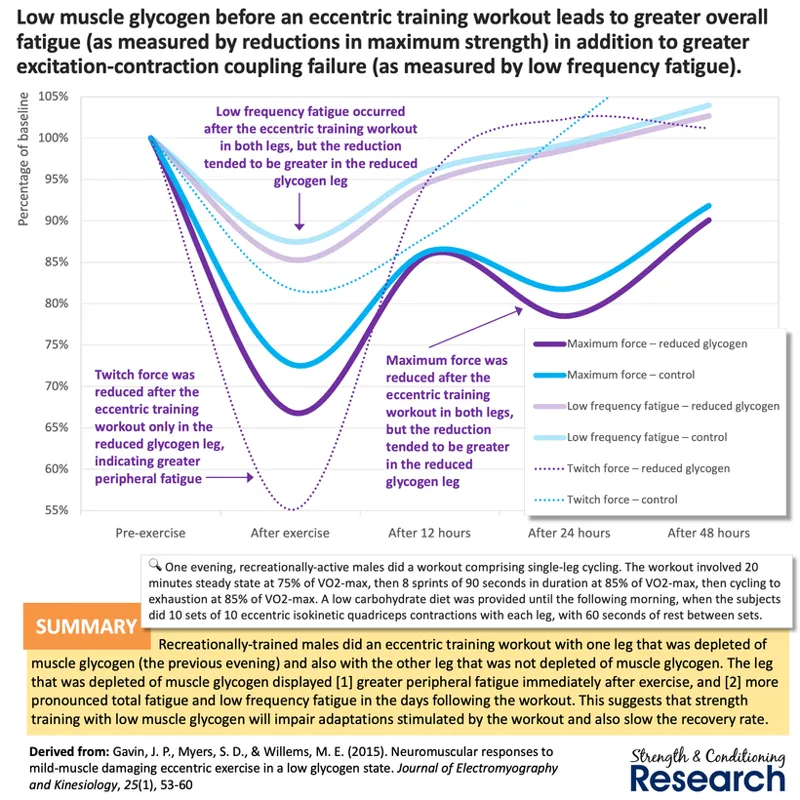
Yet, low muscle glycogen does also appear to contribute to local muscle fatigue as well as supraspinal CNS fatigue. When eccentric training workouts are performed in a low glycogen state, calcium ion-related fatigue develops far more rapidly (as measured by the presence of low-frequency fatigue).
.
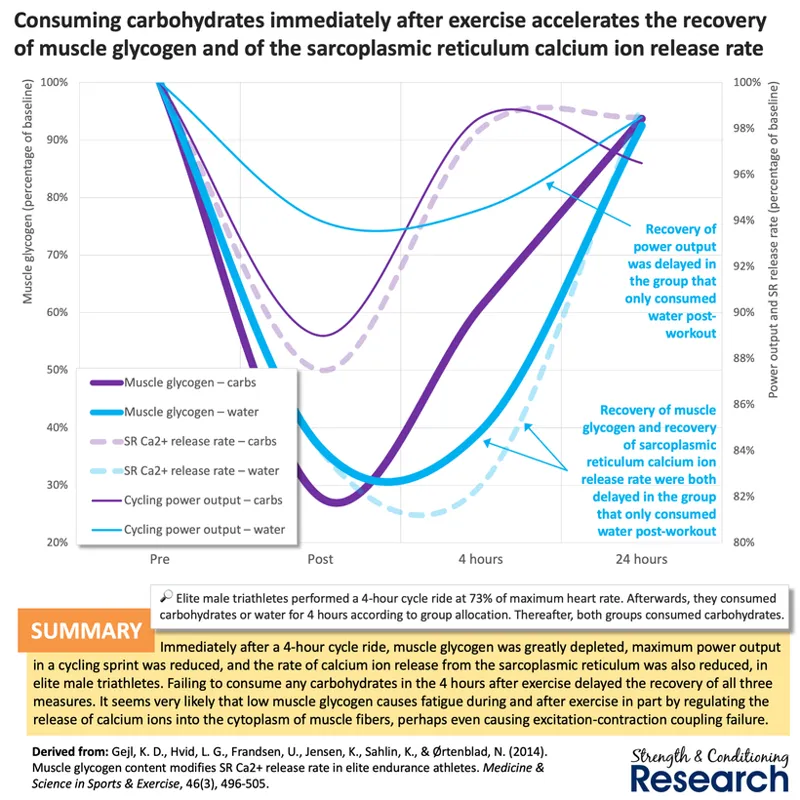
Also, we can see that the rate of release of calcium ions from the sarcoplasmic reticulum is reduced when muscle glycogen is depleted. This also indicates that low muscle glycogen exacerbates excitation-contraction coupling failure.
.
Indeed, the fact that the calcium ion-related fatigue mechanism is excitation-contraction coupling failure (and not a loss of myofibrillar sensitivity) has been confirmed in animal models.
.
Importantly, once excitation-contraction coupling failure has occurred, it is not easily reversed. Thus, when glycogen depletion causes excitation-contraction coupling failure, we might expect delayed recovery from exercise despite glycogen recovery occurring. Indeed, this is exactly what happens. If glycogen depletion were causing fatigue by a lack of fuel for the metabolic processes, recovery would occur perfectly in tandem with the recovery of glycogen reserves.
.
Conclusions
Muscle glycogen and blood glucose both decrease during exercise, and have been closely associated with the development of fatigue. Indeed, it was once believed that low muscle glycogen and low blood glucose caused fatigue directly, by reducing the amount of ATP present inside muscle fibers, thereby reducing the number of actin-myosin cross-bridges that formed. Yet, recent research has shown that ATP levels do not reduce during exhaustive exercise, even when muscle glycogen and blood glucose drop to extremely low levels (and this makes sense if we consider that most fatigue mechanisms act to reduce ATP usage). Rather, the fatigue seems to occur through supraspinal central nervous system (CNS) fatigue and excitation-contraction coupling failure (ECCF). Low muscle glycogen and low blood glucose cause supraspinal CNS fatigue by increasing the perception of effort for a given level of central motor command, probably because the brain detects the low energy levels and responds by producing a feeling of discomfort. Obviously, the presence of this supraspinal CNS fatigue inhibits adaptations in both motor unit recruitment and hypertrophy. Low muscle glycogen seems to accelerate the development of ECCF inside working muscle fibers but the exact mechanism has not yet been identified. Obviously, the presence of this ECCF inhibits hypertrophy because it reduces the level of active mechanical tension in the working muscle fibers by stopping cross-bridge formation from happening.
Comments (6)
Loud and clear that training effectiveness is limited by glycogen reserves. Are you considering a look into glycogen recovery optimization?
I suspect that the main factor in glycogen recovery is the amount of muscle damage sustained. So it is likely that we cannot really accelerate the process that easily. This article explains: https://www.patreon.com/posts/84147366?utm_campaign=postshare_creator
Back to empty glycogen depot training: I’ve found some information that this protocol helps to activate mTORC1 pathways and this helps to gain hypertrophy.. But it sounds little bit fantastic
Hi Chris, thanks for the article! What do you think about strength/endurance training after lowering muscle glycogen? Does this give any benefit for the athletic performance?
I can't see an advantage to strength training after lowering muscle glycogen for any of the common strength training goals. Ultimately, it's just going to accelerate the development of excitation-contraction coupling failure and thereby increase the amount of sustained fatigue present in the days after the workout. As far as endurance training is concerned, that's not really my area of expertise.
Great article Chris - so muscle damage also has negative health implications for me. It's equivalent to being insulin resistant and inflammation breeds disease. I cannot be a better athlete with that pathway. Thanks!