



Hypertrophy and strength gains
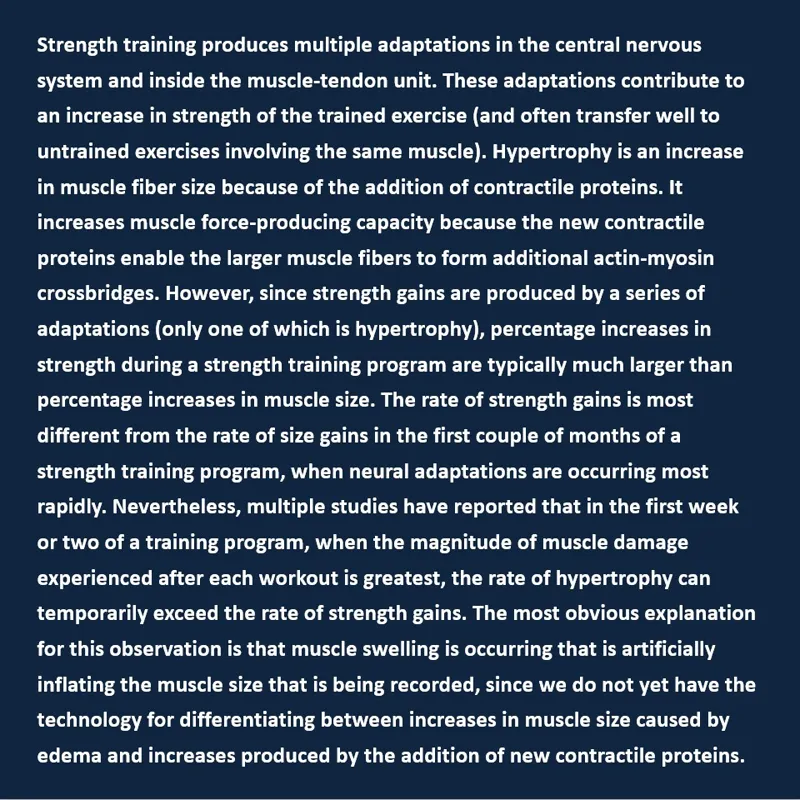
Hypertrophy is just one adaptation that contributes to an increase in strength of the trained exercise. It contributes to strength gains by increasing the capacity of the muscle to produce force by adding new contractile proteins. Since other adaptations also contribute to strength gains, however, the size of the increase in maximum strength after a training program is usually much larger than the magnitude of the increase in muscle mass.
.
#1. Strength gains are associated with hypertrophy
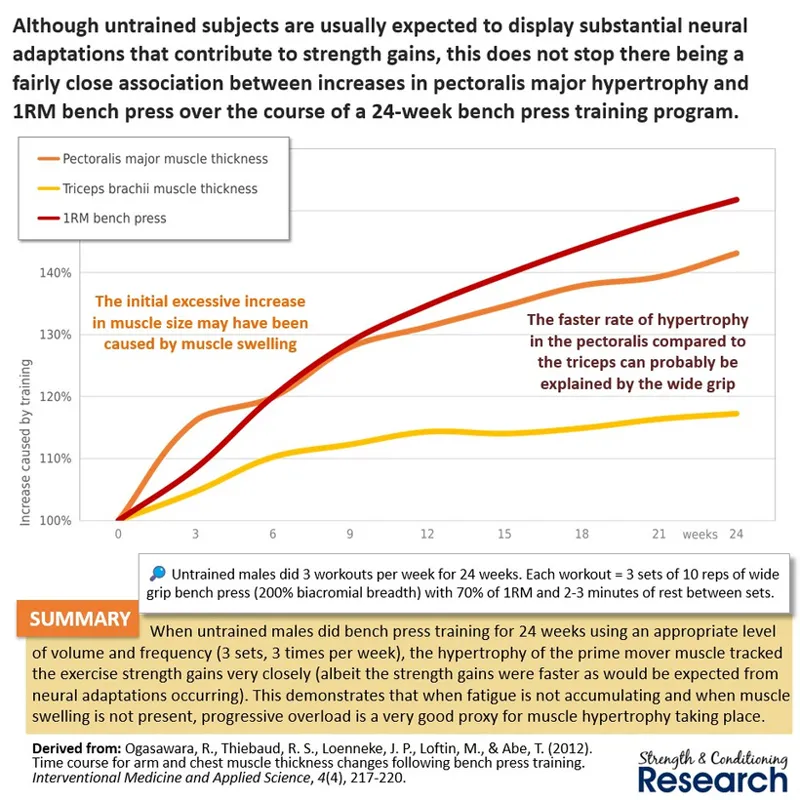
Although some fitness influencers like to present contrarian viewpoints suggesting that increases in muscle size are unrelated to increases in maximum strength, there are actually good data showing that this is untrue. Increases in maximum strength are closely associated with increases in muscle size during conventional strength training programs.
.
#2. Strength gains are frequently faster than the rate of increase in muscle size
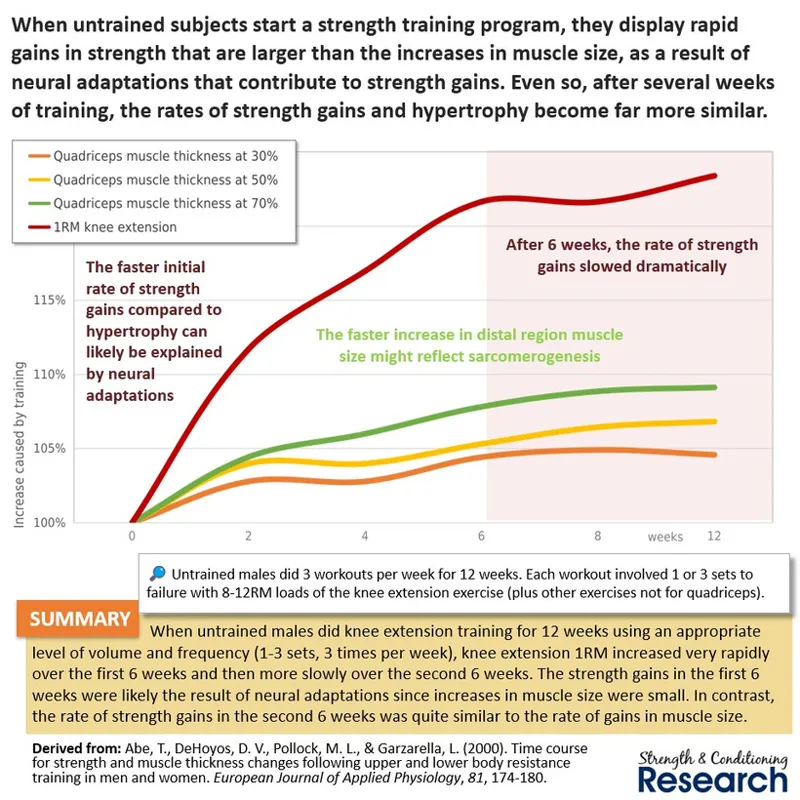
While strength gains are associated with increases in muscle size, there are nevertheless some discrepancies. When we look at time-course studies that have compared the rate at which muscle size increases with the rate at which maximum strength in the trained exercise increases, we can see that the strength gain is typically several times faster than the size increase. This is most obvious at the beginning of a training program when neural adaptations such as coordination improvements are happening most rapidly.
.
This observation is a very common one in time-course studies of hypertrophy and is not affected by the subject population, since both younger and older subjects display the exact same phenomenon. Also, the relationship between size gains and strength gains is fairly weak because strength gains are influenced by multiple underlying adaptations, including several within the central nervous system.
.
#3. When the rate of hypertrophy exceeds the rate of strength gains, that is probably muscle swelling
When studies have recorded brief periods of time in which the rate of increase in muscle size is greater than the rate of increase in maximum strength, this is likely the result of muscle swelling. Indeed, in this study, there was an initial excessive increase in muscle size than quickly plateaued off and settled into a much slower rate of hypertrophy.
.
Similarly, the same observation was recorded in this relatively long-duration study that reported increases in bench press strength and muscle size.
.
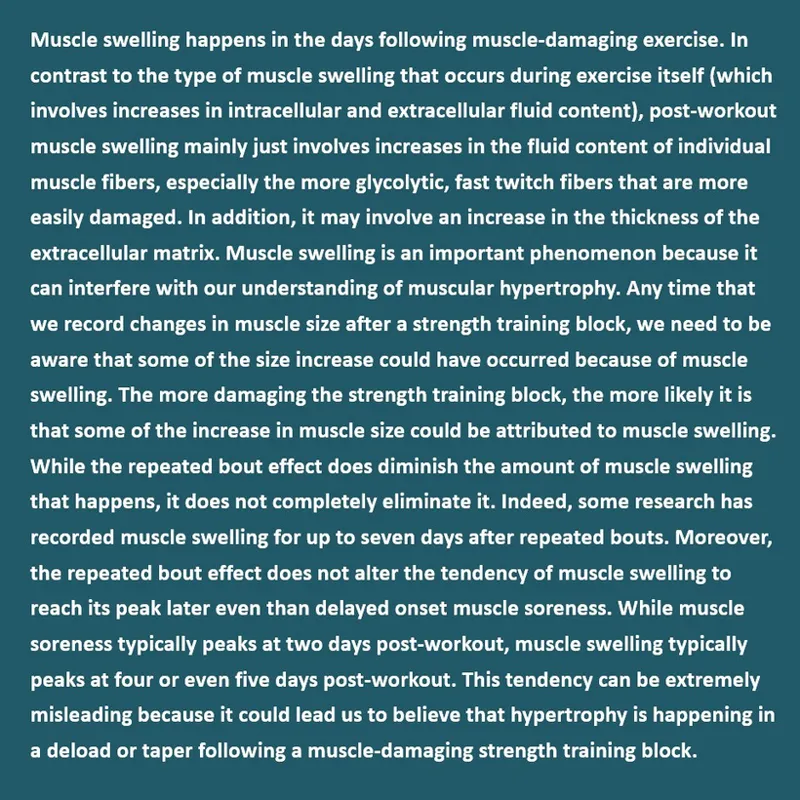
Muscle swelling is frequently minimized by hypertrophy researchers and commentators because they do not like the fact that our current measurement methods are unable to differentiate between edema and the addition of contractile proteins. Also, they like to forget that many studies have shown that muscle swelling can last for several days after a muscle-damaging workout and that the tendency is for the swelling to peak at around four days post-workout (which is typically when hypertrophy measurements are recorded) (read more).
Conclusions
Strength training produces multiple adaptations in the central nervous system and inside the muscle-tendon unit. These adaptations contribute to an increase in strength of the trained exercise (and often transfer to untrained exercises involving the same muscle). Hypertrophy is an increase in muscle fiber size because of the addition of contractile proteins. It increases muscle force-producing capacity because the new contractile proteins enable the larger muscle fibers to form additional actin-myosin crossbridges. However, since strength gains are produced by a series of adaptations (only one of which is hypertrophy), percentage increases in strength during a strength training program are typically much larger than percentage increases in muscle size. The rate of strength gains is most different from the rate of size gains in the first couple of months of a strength training program, when neural adaptations are occurring most rapidly. Nevertheless, multiple studies have reported that in the first week or two of a training program, when the amount of muscle damage experienced after each workout is greatest, the rate of hypertrophy can temporarily exceed the rate of strength gains. The most obvious explanation for this observation is that muscle swelling is occurring that is artificially inflating the muscle size that is being recorded, since we do not yet have the technology for differentiating between increases in muscle size caused by edema and increases produced by the addition of new contractile proteins.
