



Overreaching = accumulated damage?
What is overreaching and what causes it to happen? While many myths exist regarding the underlying causes of overreaching during strength training, we can easily derive the truth of the matter from the basic physiology.
.
#1. Overreaching defined
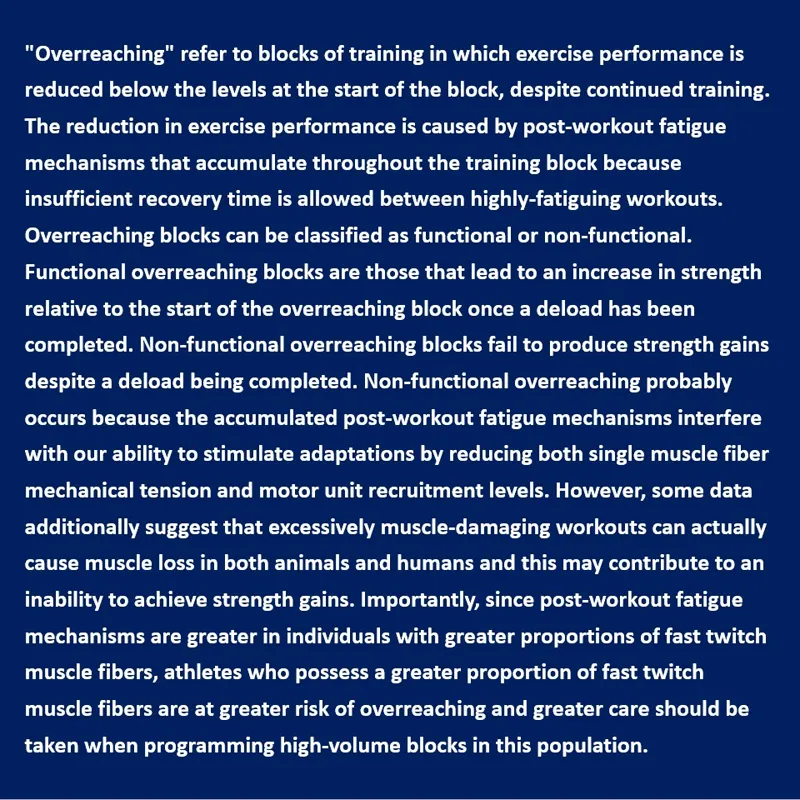
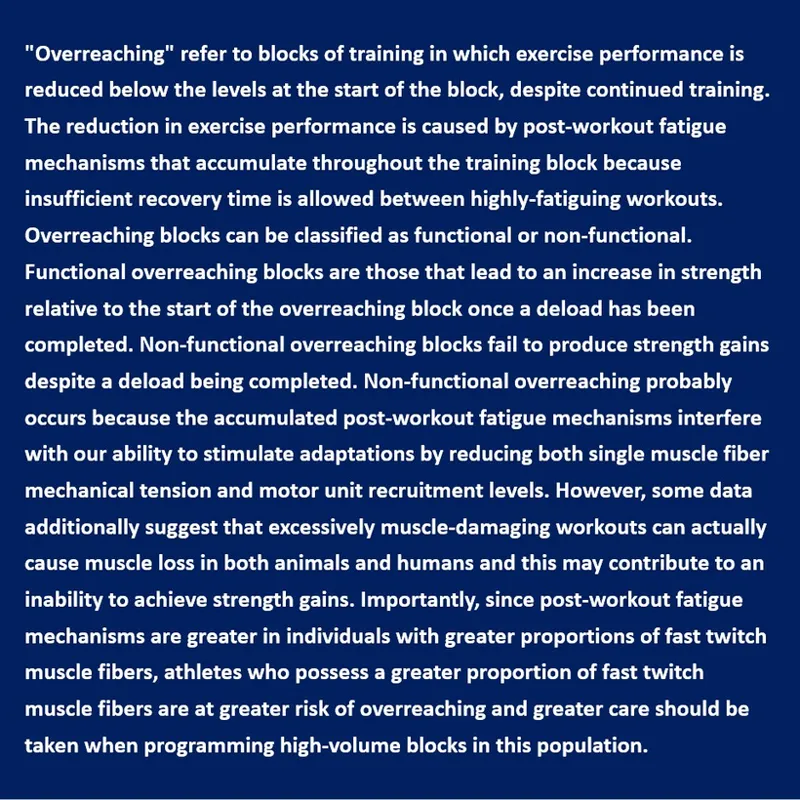
Overreaching refers to blocks of time in which exercise performance is reduced despite the expectation of adaptations producing improvements. This reduced exercise performance is caused by post-workout fatigue (read more).
.
#2. Overreaching is post-workout fatigue accumulation
Indeed, overreaching is clearly just the accumulation of post-workout fatigue. Although the accumulation of post-workout fatigue was once contentious, we now have several studies showing that even short periods of high volume, high frequency, conventional strength training cause post-workout fatigue to accumulate (read more).
.
#3. Post-workout fatigue mechanisms
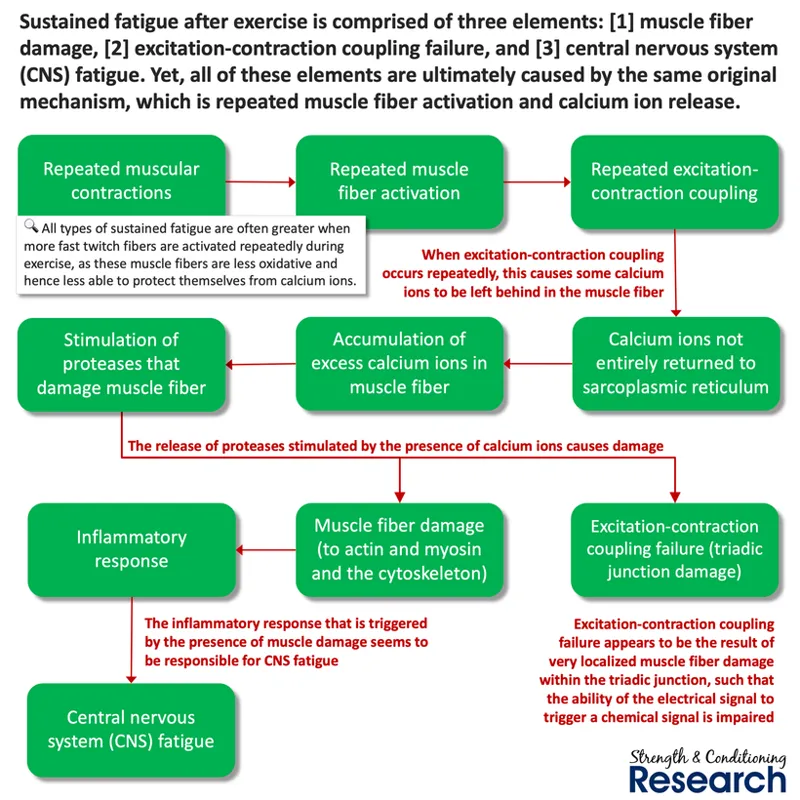
There are three main post-workout fatigue mechanisms that could accumulate over time. The way in which they work suggests that they should all be present together if any of them are present (read more).
.
The way in which these three fatigue mechanisms work means they are all present together immediately post-workout.
.
#4. Overreaching and calcium ion-related fatigue
So do all of the main post-workout fatigue mechanisms contribute equally to the overreaching effect? Not necessarily. Recently, animal models have reported evidence showing that it is the accumulation of muscle damage that mainly causes overreaching.
.
That is not to say that excitation-contraction coupling failure does not also contribute to the ongoing fatigue after each bout of exercise. But it looks like the "accumulation effect" during overreaching is mainly myofibrillar damage rather than further damage to the triadic junction that causes excitation-contraction coupling failure.
.
Conclusions
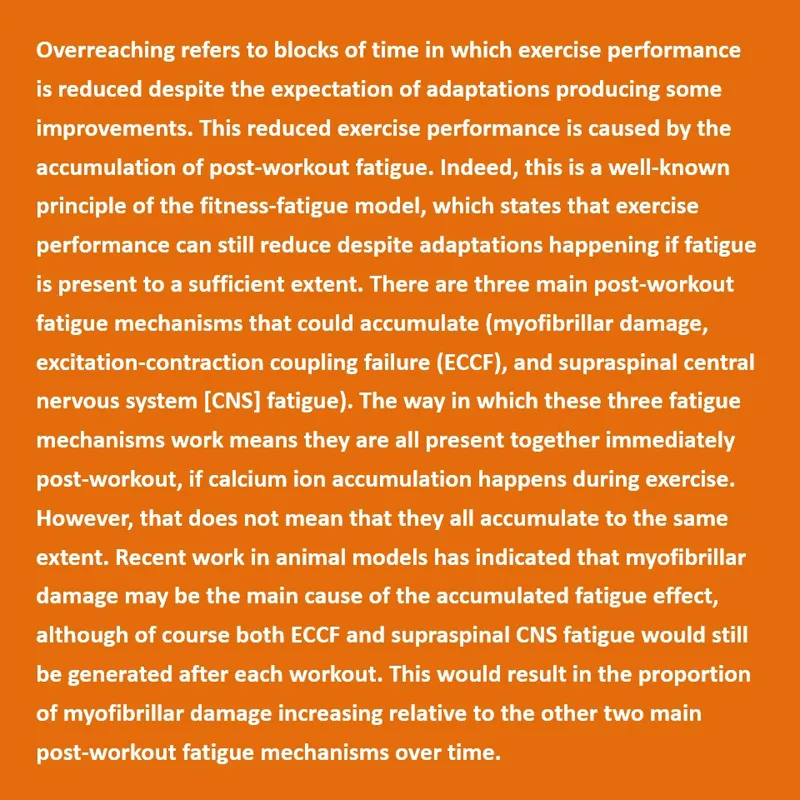
Overreaching refers to blocks of time in which exercise performance is reduced despite the expectation of adaptations producing improvements. This reduced exercise performance is caused by the accumulation of post-workout fatigue. Indeed, this is a well-known principle of the fitness-fatigue model, which states that exercise performance can still reduce despite adaptations happening if fatigue is present to a sufficient extent. There are three main post-workout fatigue mechanisms that could accumulate (myofibrillar damage, excitation-contraction coupling failure (ECCF), and supraspinal central nervous system [CNS] fatigue). The way in which these three mechanisms work means they are all present together immediately post-workout, if calcium ion accumulation happens during exercise. However, that does not mean that they all accumulate to the same extent. Recent work in animal models has indicated that myofibrillar damage may be the main cause of the accumulated fatigue effect, although of course both ECCF and supraspinal CNS fatigue would still be generated after each workout. This would result in the proportion of myofibrillar damage increasing relative to the other two main post-workout fatigue mechanisms over time.