


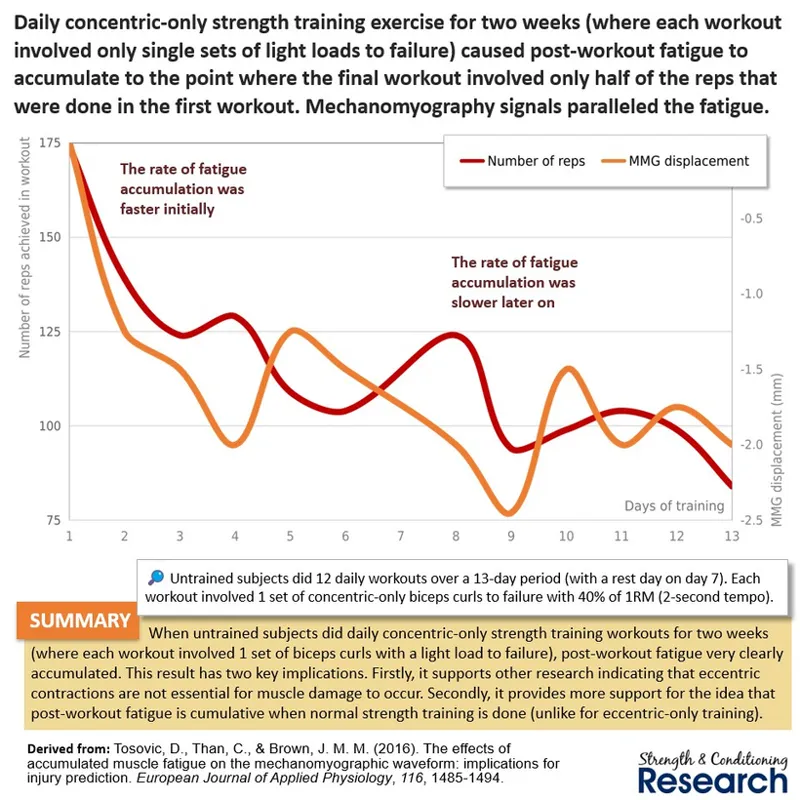


Post-workout fatigue accumulates
Whether post-workout fatigue can accumulate over time has been contentious among researchers for some time (even though it is tacitly assumed to occur by strength coaches and underpins periodization concepts like overreaching). The reason for the contention is that early studies into eccentric-only workouts reported minimal post-workout fatigue accumulation over the course of a series of muscle-damaging workouts.
.
#1. Does post-workout fatigue during eccentric-only training?
Several studies have reported that post-workout fatigue does not accumulate when a series of eccentric-only strength training workouts are performed. It seems likely that the post-workout fatigue caused by the very first workout is temporarily protective against further muscle damage.
.
Indeed, when muscle damage is excessive, this produces a large supraspinal central nervous system (CNS) fatigue response that stops high-threshold motor units from being recruited. Since this then stops the muscle fibers that belong to those motor units from being recruited, they cannot be damaged in subsequent workouts. Of course, that also stops them from experiencing any hypertrophy stimulus (read more).
.
#2. Does post-workout fatigue during conventional strength training?
In contrast to eccentric-only strength training, post-workout fatigue definitely does accumulate workout-to-workout during conventional strength training (or concentric-only strength training) and can reach quite impressive reductions in exercise performance. The rate of post-workout fatigue accumulation is fairly rapid to begin with and slows over time. This suggests that the accumulation of fatigue mechanisms is somewhat protective against further muscle damage in later workouts.
.
Not only does the accumulated post-workout fatigue reach impressive levels, but it also occurs repeatedly. While some fitness influencers believe that the repeated bout effect completely stops muscle damage from being a problem, research has shown that sequential high-volume blocks of strength training cause post-workout fatigue to accumulate regardless of whether prior training has been performed or not.
.
Workout volume is a key determinant of recovery time. Four sets probably requires 72 hours for recovery to occur. The above study found that 7 workouts of 4 sets per workout over 5 days needed 12 days for full recovery to occur (or more correctly, 17 days when counting from the first day of the training block). We would expect 7 workouts of 4 sets per workout to require a total of 21 days of recovery (3 days per workout). So there is a close correspondence between the expected accumulated fatigue and the measured accumulated fatigue. It looks like we can count the number of days we need for recovery to occur in order to calculate the outstanding fatigue "debt" that we are carrying.
.
Conclusions
During eccentric-only training, post-workout fatigue does not appear to accumulate. Many studies have shown that performing a second eccentric-only training workout soon after a first, similar workout does not extend the duration of the post-workout recovery process. It seems likely that the post-workout fatigue mechanisms generated by the first eccentric-only workout exert a temporary, protective effect in the second workout (in addition to the semi-permanent repeated bout effect). Indeed, the supraspinal central nervous system (CNS) fatigue that occurs subsequent to the inflammatory response to muscle damage stops high-threshold motor units from being recruited, and this stops fast twitch muscle fibers from being activated and damaged. Even so, post-workout fatigue DOES accumulate during conventional strength training. The amount of accumulated fatigue can be calculated approximately as the expected time required for full recovery to occur for each and every workout in the training block less the total time elapsed. However, it does appear to accumulate faster earlier in the training block, when total post-workout fatigue is less. Finally, it is not obviously affected by any repeated bout effect, since it happens similarly in sequential blocks of high-volume, high-frequency training.

Comments (2)
Chris. Can you explain why HTMU fatigue more with moderate or light loads taken to failure than with heavy loads taken to failure? In all cases is it not the case that only the last five reps activate the HTMU? How is the extra CI fatigue being generated? Thank you
He has a post on that, I believe it's called "heavy loads cause less CNS fatigue"