




Fatigue prevents gains in speed
We know that the presence of certain fatigue mechanisms can negatively affect our ability to stimulate some of the adaptations that contribute to maximum strength. So how do fatigue mechanisms affect our ability to create the adaptations that contribute to maximum speed?
.
#1. What are the adaptations contributing to gains in speed?
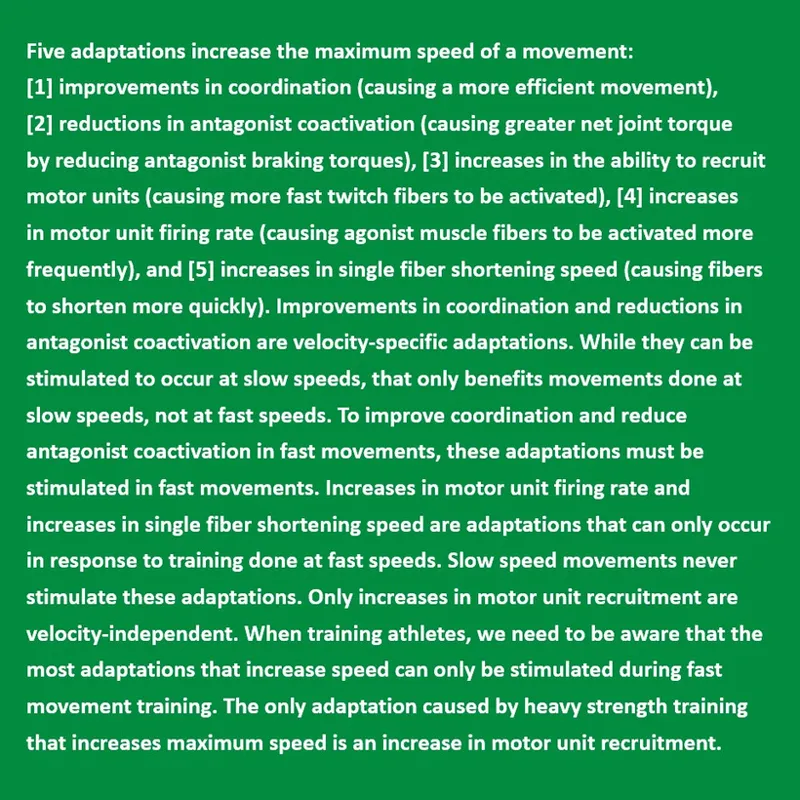
In a previous article, I detailed the five adaptations contributing to gains in speed (read more).
.
The individual, unique stimuli that produce each of these adaptations can be readily identified, as shown in the table below. We can now look at how the presence of various fatigue mechanisms might interfere with each stimulus and prevent the adaptation from happening during a training session.
.
#2. How does fatigue impair improvements in coordination?
Fatigue mechanisms of any kind impair gains in coordination because fatigue reduces the efficiency of our movement patterns. We need to produce a highly efficient movement pattern in order to stimulate any improvements in our motor programs (read more).
.
#3. How does fatigue impair reductions in antagonist coactivation?
Fatigue mechanisms likely impair reductions in antagonist coactivation in much the same way as fatigue stops improvements in coordination since the stimulus for that adaptation is probably achieving very low levels of antagonist coactivation during the target movement and the presence of fatigue increases antagonist coactivation.
.
#4. How does fatigue impair increases in the ability to recruit high-threshold motor units?
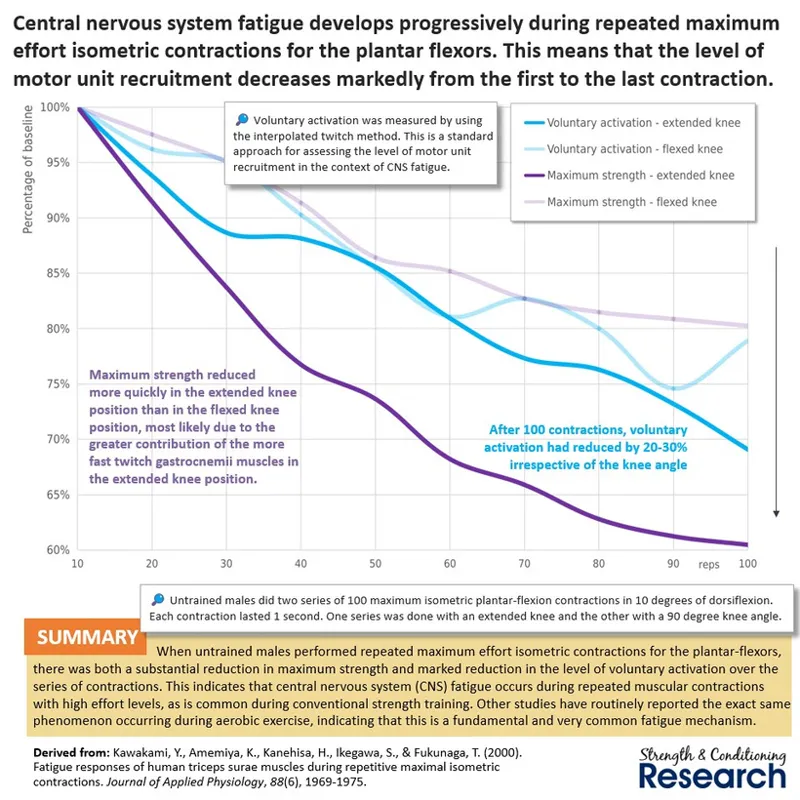
Supraspinal central nervous system (CNS) fatigue likely impairs our ability to stimulate increases in the ability to recruit high-threshold motor units because the stimulus for that adaptation is probably achieving very high levels of motor unit recruitment in the target muscle. During exercise, supraspinal CNS fatigue develops whenever perceived effort is produced by factors other than the corollary discharge from the central motor command, and this stops us from reaching maximum levels of motor unit recruitment.
.
Indeed, this is the reason why training to failure with light loads fails to stimulate gains in the ability to recruit high-threshold motor units after training, while training to failure with heavy or moderate loads does produce that adaptation. The light load sets involve supraspinal CNS fatigue because of the afferent feedback causing burning sensations in the muscles, leading us to reach muscular failure (at maximum tolerable perception of effort) at a lower level of motor unit recruitment.
.
#5. How does fatigue impair increases in the ability to reach fast motor unit firing frequencies?
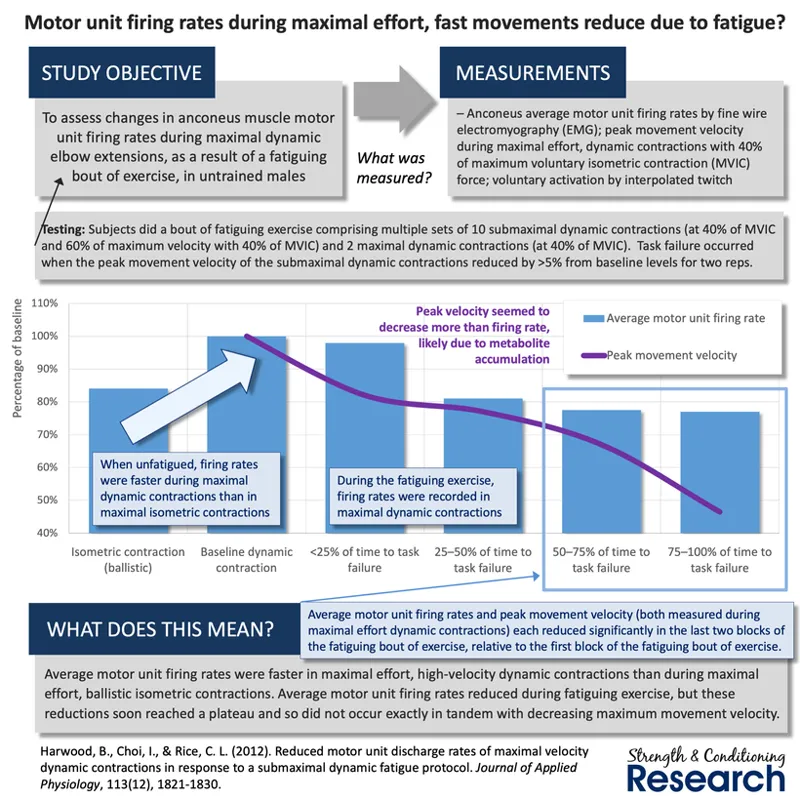
Fatigue impairs our ability to stimulate increases in the ability to reach fast motor unit firing rates for two reasons because the stimulus for that adaptation requires both [1] very high levels of motor unit recruitment in the target muscle, and [2] a very fast movement speed. This is the combination of factors that permits reaching the maximum possible motor unit firing rate, which is the underlying stimulus. Supraspinal CNS fatigue reduces the levels of motor unit recruitment in the target muscle and metabolite-related fatigue reduces the shortening speed of the muscle fibers.
.
#6. How does fatigue stop increases in muscle fiber shortening speed?
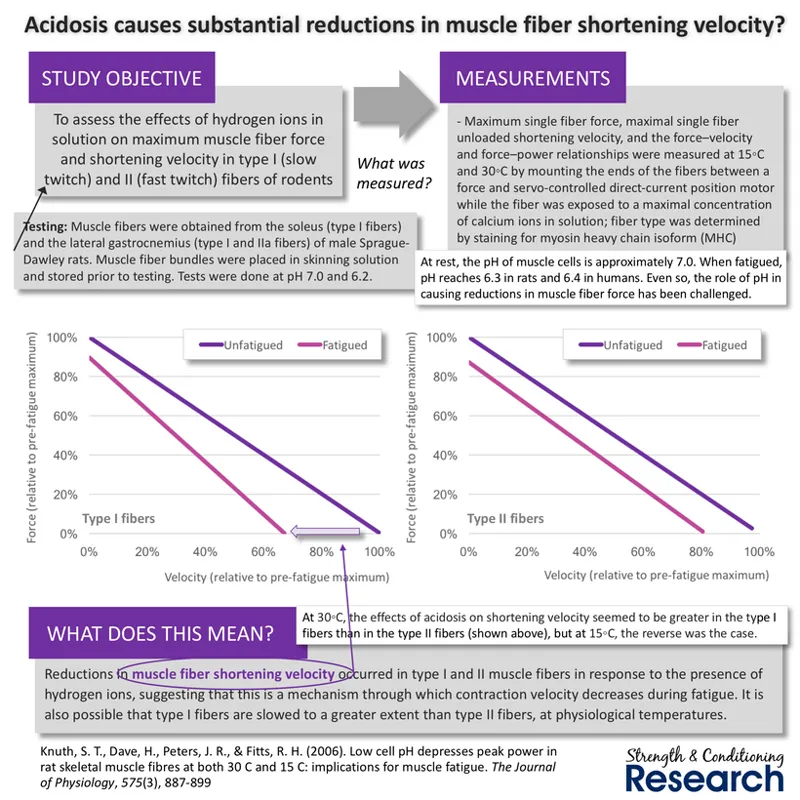
Fatigue impairs our ability to stimulate increases in the muscle fiber shortening speed because the stimulus for that adaptation requires a very fast movement speed. Indeed, it is well-known that metabolite-related fatigue reduces the shortening speed of muscle fibers.
.
Conclusions
Fatigue mechanisms can reduce our ability to create the adaptations that contribute to maximum speed. Fatigue reduces the efficiency of movement patterns. Since we need to produce a highly-efficient movement pattern to stimulate positive changes in our motor programs, fatigue prevents changes in coordination. Similarly, fatigue increases antagonist coactivation. Since we need to produce very low levels of antagonist coactivation to stimulate reductions in antagonist coactivation, fatigue prevents this adaptation too. Supraspinal central nervous system (CNS) fatigue reduces the central motor command in the brain. Since we need to produce very high levels of central motor command to stimulate increases in the ability to recruit high-threshold motor units, supraspinal CNS fatigue prevents this adaptation. Together with metabolite-related fatigue mechanisms, supraspinal CNS fatigue also limits motor unit firing rates. Since we need to produce very high motor unit firing rates to stimulate increases in the ability to produce high motor unit firing rates, these fatigue mechanisms stop this adaptation happening. Finally, metabolite-related fatigue mechanisms reduce muscle fiber shortening speeds. Since we need to produce fast muscle fiber shortening speeds to increase the ability of muscle fibers to shorten quickly, metabolite-related fatigue stops this adaptation. The presence of fatigue mechanisms is clearly very problematic for adaptations that contribute to speed improvements.

