








Increasing speed
Speed is the ability to move at a very fast velocity. Speed is not the same thing as strength. Strength allows us to accelerate but it does not guarantee that we can actually move at a certain velocity. Having a lot of strength (the ability to produce a large force) without also having a high maximum speed (the ability to move very quickly) means that you accelerate rapidly up to a certain speed but then stop accelerating once you hit your limit. So how can we generate increases in speed through training?
.
#0. Introduction to strength and speed
There is a widely-held view that increases in maximum strength will automatically increase the maximum speed that we can move. This is not correct. When coaches argue that more muscle force means more acceleration (F = ma) and more acceleration means a higher top speed, they forget that force changes with movement velocity. As the body accelerates and the muscle fibers start to shorten more quickly, the amount of force they can produce starts to drop. If their maximum shortening speed is slow, they quickly stop producing force and the acceleration disappears.
.
#1. What are the mechanisms of increasing speed?
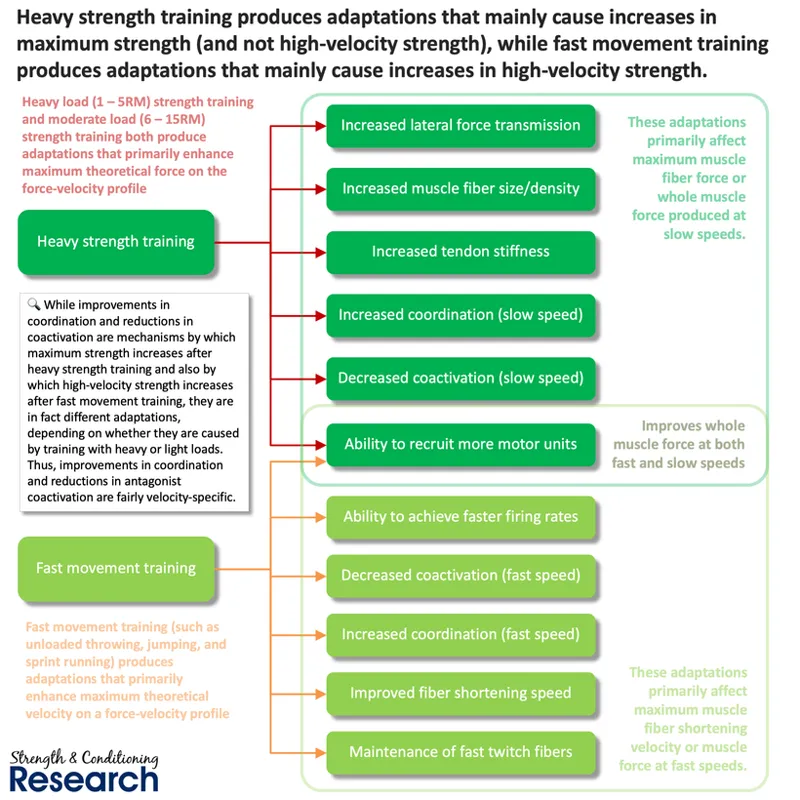
There are five physiological determinants of speed that can be affected by training: [1] improvements in coordination, [2] increases in motor unit firing rate, [3] increases in motor unit recruitment, [4] reductions in antagonist coactivation, and [5] increases in maximum muscle fiber shortening speed. As shown in the chart below, these determinants are largely very different from the determinants of maximum strength.
.
#2. Improvements in coordination
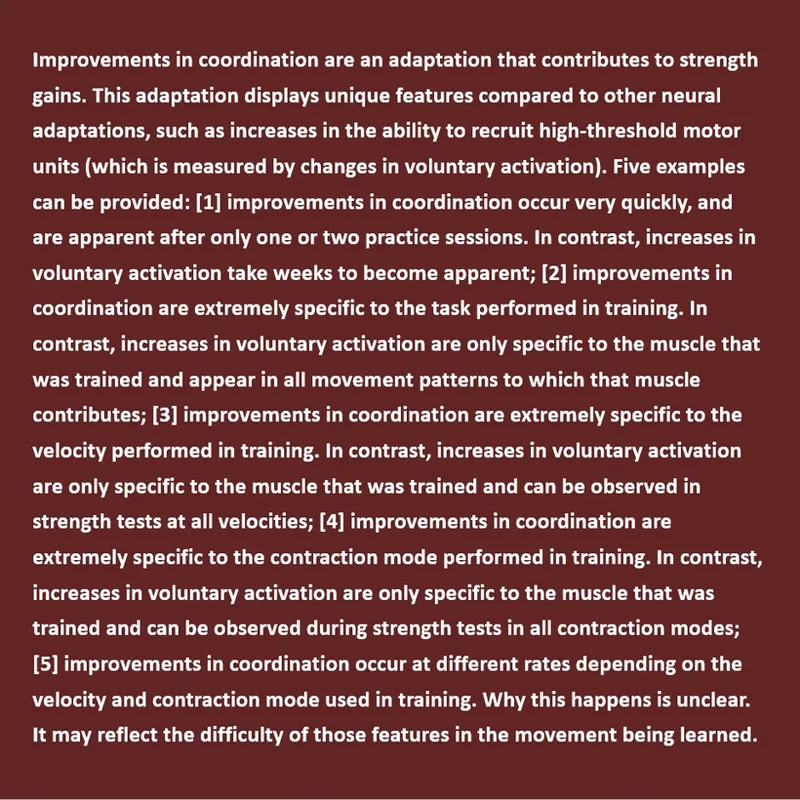
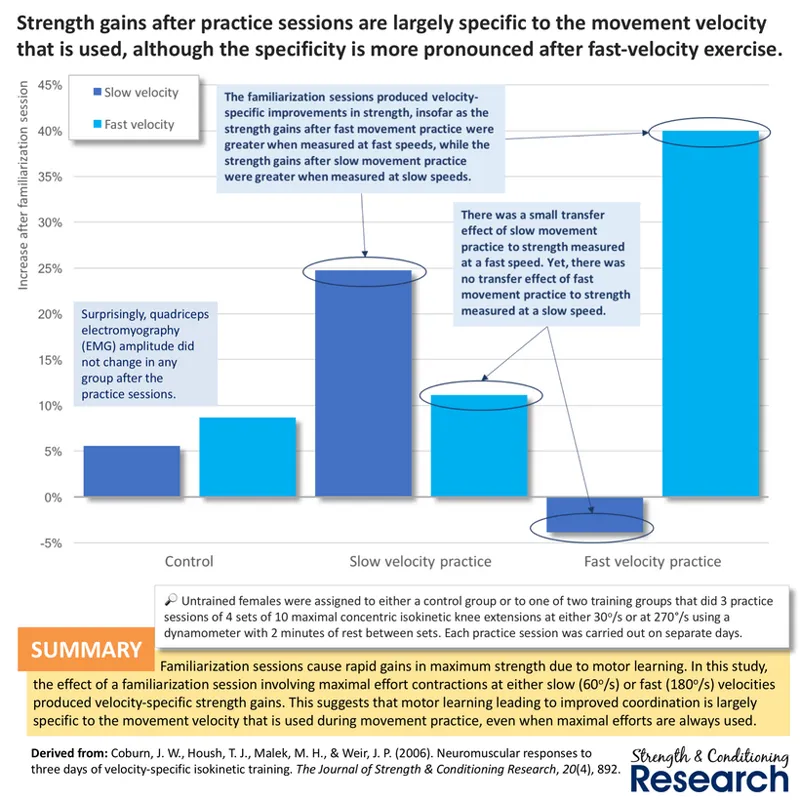
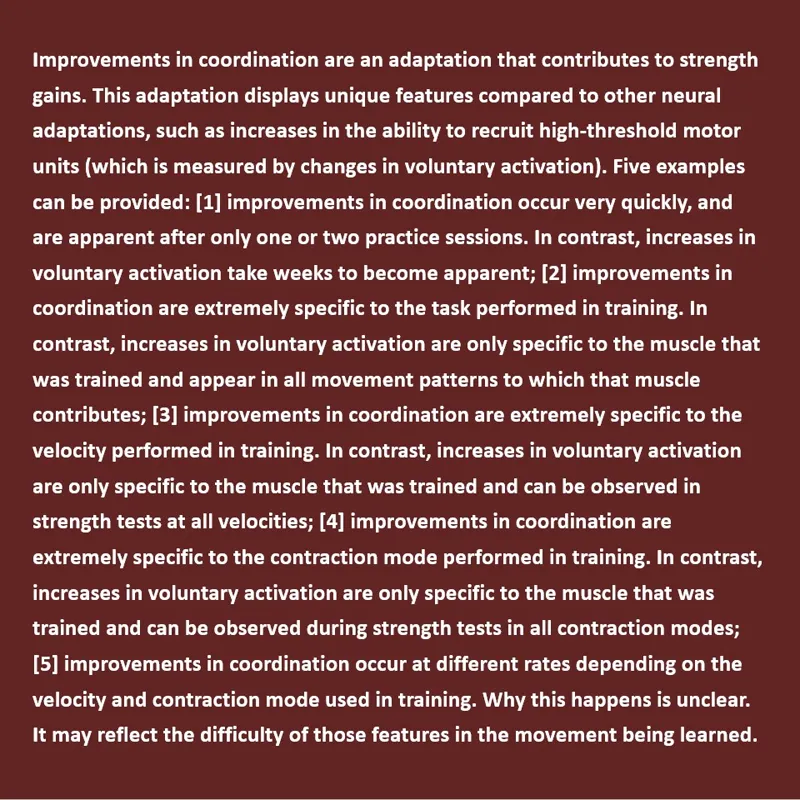
Improvements in coordination contribute to increases in speed because they increase the efficiency of the movement being done. We improve coordination by performing a specific movement in a more well-coordinated way than the motor program that the brain has in place. The brain notices that the movement was more efficient and updates its pattern for future use. Improvements in coordination are extremely specific to the activity that is being practised. This specificity includes the velocity of movement. So, if we want to increase speed by increasing coordination, we must practice the exercise as fast as possible (read more).
.
Indeed, research into coordination improvements by testing the effects of familiarization sessions has confirmed that they are indeed extremely velocity-specific.
.
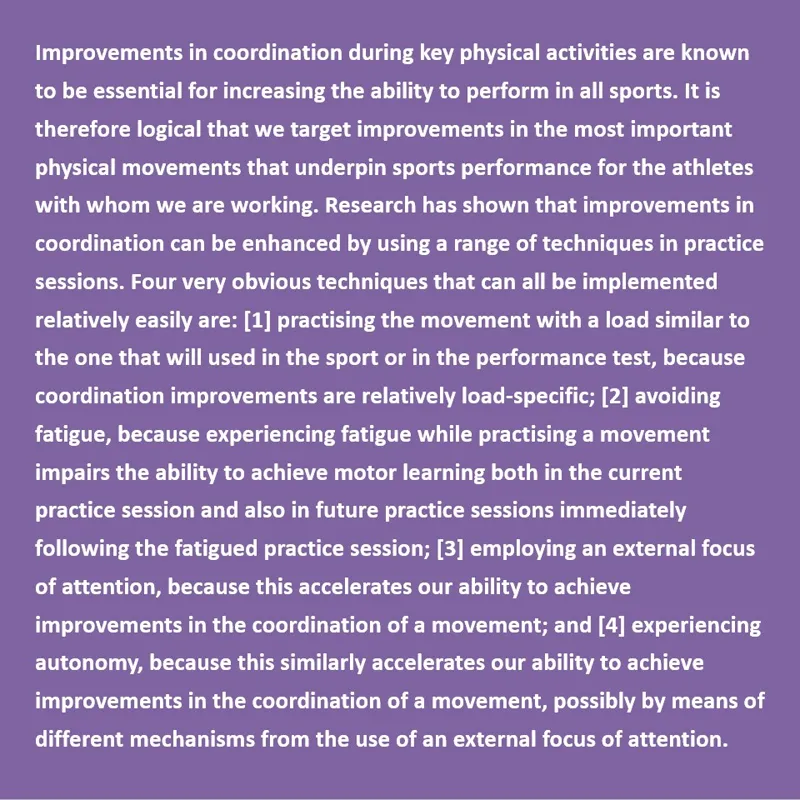
In practice, we can maximize the improvements in coordination that are stimulated by a practice session by maximizing the efficiency of the exercise we are doing. This presents the brain with the best possible motor program to copy. Various techniques are available to help us maximize coordination during exercise (read more).
.
#3. Increases in the ability to recruit high-threshold motor units of the agonist muscle
Improvements in the ability to recruit high-threshold motor units of a muscle contribute to increases in speed, because newly-recruited high-threshold motor units will necessarily mainly control muscle fibers of the fastest fiber type (type IIX). Thus, increasing the ability to access high-threshold motor units increases the average muscle fiber shortening velocity of the muscle fibers in a muscle.
.
Fast movement training with light loads increases the ability to recruit high-threshold motor units in any movement involving the same muscle group, including isometric contractions.
.
The stimulus that causes increases in the ability to access high-threshold motor units is just reaching a very high central motor command and thereby reaching a very high level of motor unit recruitment for the muscle in question. In practice, this means [1] producing a maximum effort and [2] devoting all of that effort perception to the central motor command, without losing any of it to the management of discomforting sensations like cardiovascular activity or metabolite-related burning sensations. Even so, there are a variety of techniques available for maximizing this stimulus (read more).
.
#4. Increases in agonist motor unit firing rate
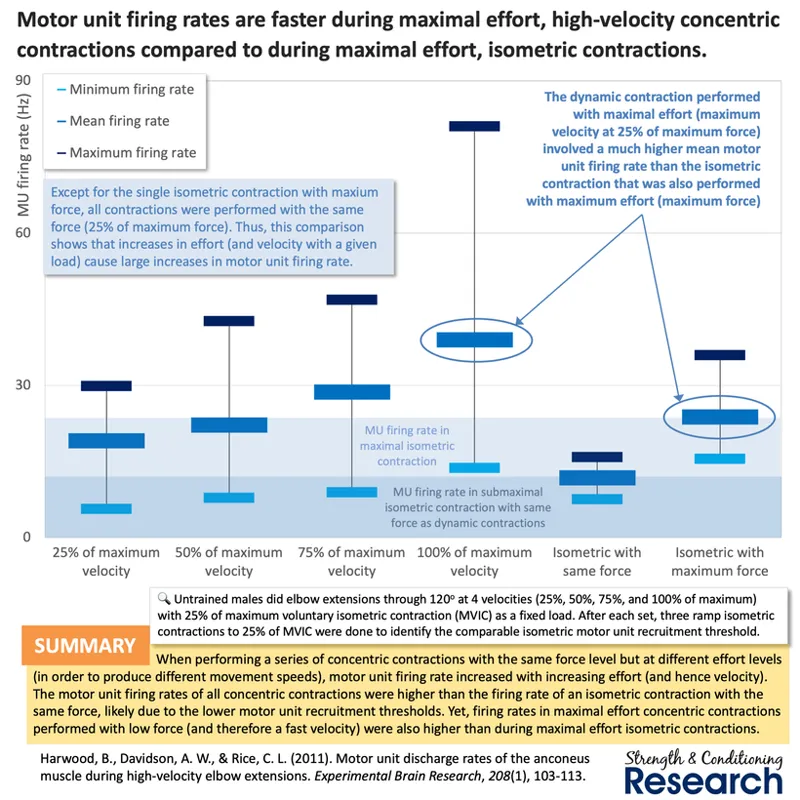
Central motor command signals are sent repeatedly to a muscle in muscular contractions, many times per second. The rate at which signals are sent is called the motor unit firing rate, the motor unit firing frequency, or rate coding. In slow movements (even with maximal efforts), the number of signals per second is relatively low. In contrast, during fast movements, the number of signals per second is comparatively high.
.
Studies have shown that fast, dynamic movement training is able to increase motor unit firing rates as a long-term adaptation.
.
In contrast, heavy strength training is unable to produce the same adaptation. This suggests that the stimulus for increasing the motor unit firing rates is achieving high motor unit firing rates during the exercise training sessions.
.
#5. Reductions in antagonist muscle activation
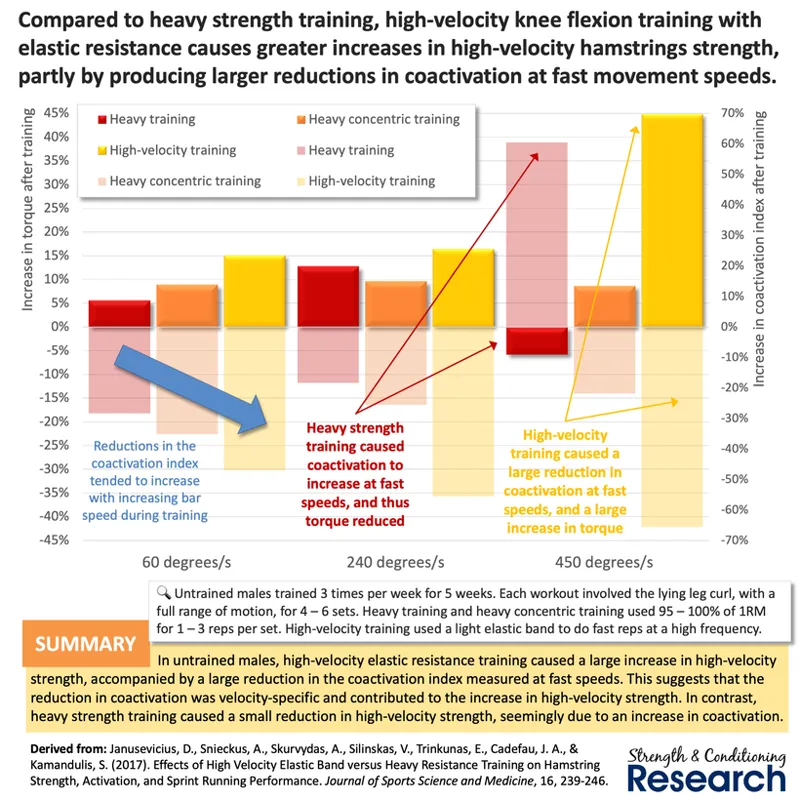
A reduction in the force produced by the antagonist muscle during an exercise reduces the braking force at the joint, and thereby increases the external force that is exerted during an exercise, even without the force of the agonist muscle itself increasing. In other words, the adaptation involves an increase in efficiency, much like an improvement in coordination. Training studies have shown that fast movement training causes much larger reductions in antagonist coactivation when strength is measured at fast speeds than when strength is measured at slow speeds. This suggests that reductions in antagonist coactivation are velocity-specific and are probably stimulated by practice at the velocity required for the test.
.
In practice, this means that we must perform the desired movement very quickly in order to achieve this particular adaptation. In this way, it is very much like coordination improvements.
.
Antagonist coactivation does reduce after other types of training but the time-course over which it happens is slightly different. Moreover, research has shown that there are some ways in which we might maximize reductions in antagonist coactivation by training (read more).
.
#6. Increases in muscle fiber contractile velocity
Muscle fibers have a maximum shortening velocity that they cannot exceed, no matter how little external resistance they are working against. Muscle fiber type is a key determinant of this maximum velocity, but even within muscle fiber types, the actual maximum shortening speed can vary between muscles and also individuals. For example, elite sprinters tend to have extremely fast muscle fiber shortening velocities.
.
Maximum muscle fiber shortening velocity can be increased by fast movement training (even without changes in muscle fiber type). This is an incredibly important adaptation that is rarely considered by strength and conditioning coaches.
.
In contrast, heavy strength training is unable to produce the same adaptation. This suggests that the stimulus for increasing the maximum muscle fiber shortening velocity is achieving high muscle fiber shortening velocities during the exercise training sessions.
.
#7. Muscle fiber type shifts
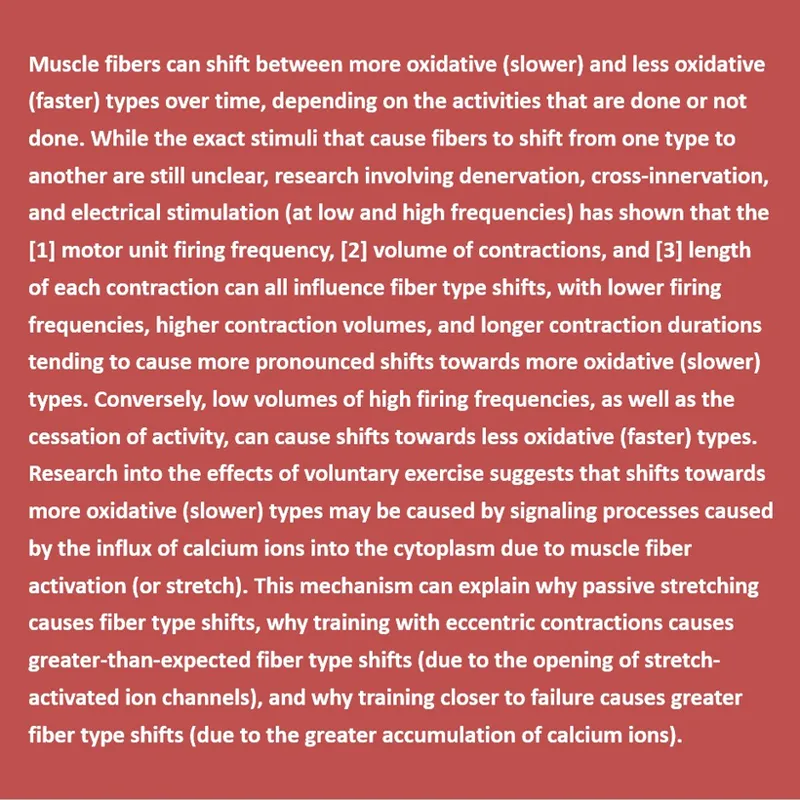
Naturally, it is worth noting that since muscle fiber type is a key determinant of muscle fiber maximum shortening velocity, we do want to avoid muscle fiber type shifts towards slower, more oxidative types if our goal is to increase maximum speed. Muscle fiber type shifts are caused by the same calcium ion accumulation that causes calcium ion-related fatigue, so this is relatively straightforward to manage (read more).
.
#8. Summary of effects
Speed can be increased by multiple adaptations. With the exception of increases in the ability to recruit high-threshold motor units, all of these adaptations require a fast movement speed during the exercise session in order to be stimulated.
.
Conclusions
Speed is the ability to move at a very fast velocity. Speed is not the same thing as strength. Strength allows us to accelerate but does not guarantee that we can reach a certain velocity. Velocity is limited by the maximum shortening velocity of the fibers in the muscle. Having a lot of strength (the ability to produce a large force) without also having a high maximum speed (the ability to move very quickly) means that you accelerate rapidly up to a certain speed but then stop accelerating once you hit your limit. So how can we generate increases in speed through training? Speed can be increased by five separate adaptations. Two involve improved efficiency (increases in coordination and decreases in antagonist coactivation). While not uniquely speed-related adaptations, they are velocity-specific and require practice at a fast speed to be stimulated. Two permit muscle fibers to shorten faster (increases in motor unit firing rate and increases in muscle fiber shortening velocity). These are stimulated by reaching fast speeds during a workout (making them similarly velocity-specific adaptations). Finally, increasing motor unit recruitment increases speed because any newly-accessed motor unit has fast, glycolytic muscle fibers, which increases average maximum shortening velocity of the accessible fibers in the muscle. This adaptation is not velocity-specific. It is stimulated by any high-effort movement that does not involve strong negative sensations as well as the corollary discharge.

Comments (1)
Has your perspective on strength training for sprinting speed changed? I thought that you used to recommend specific strength at high velocity (jump squats high and speed hip flexor exercises, supplemented with Nordic curls for eccentric strength). I've greatly enjoyed your High Performance Physiology podcast, which now seems to emphasize sprinting (for speed gains) + strength work for hips (hip thrusts, hip flexors, Nordic curls), that don't have to be as fast to improve the proximal force creation in the hips.