




Detraining of speed
Some strength and conditioning coaches have argued that speed is lost very rapidly during detraining in comparison to other physical qualities. Yet, the research literature does not support this view. In fact, there is a strong argument to be made that periods of detraining either have no effect on speed or actually permit it to improve.
.
#1. Throwing performances
In this study, there was no negative effect of of a 4-week detraining period on throwing performance (after a 14-week strength training program) in which muscle fiber atrophy occurred in all fiber types.
.
#2. High-velocity force production
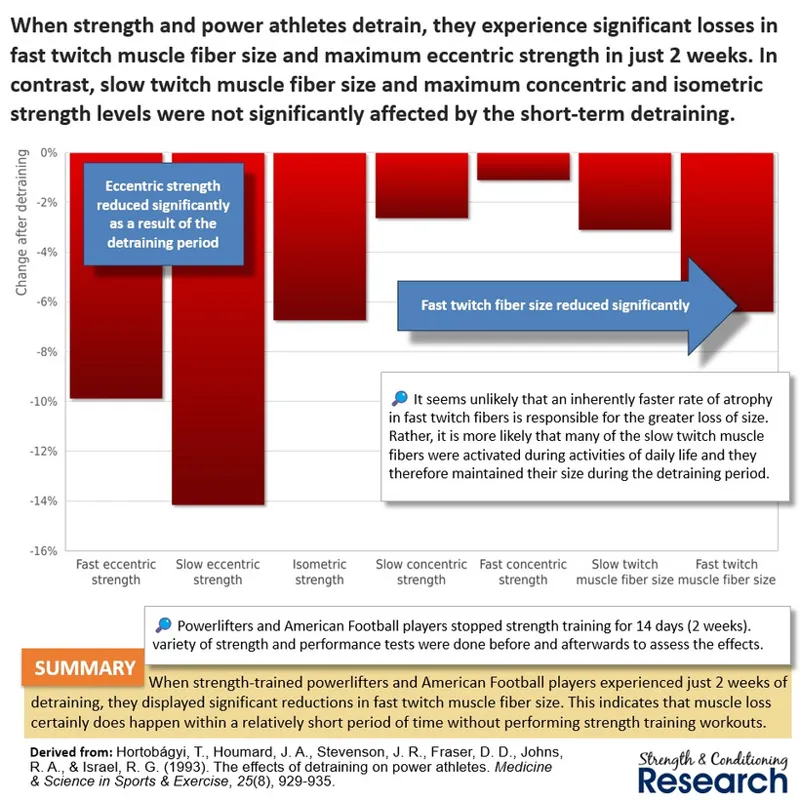
In this study, there was no negative effect of a 2-week period of detraining on concentric force production in strength and power athletes despite significant reductions in fast twitch muscle fiber size. Notably, the reduction in high-velocity concentric strength was smaller than any other measurement.
.
#3. Force-velocity profiles and fiber type shifts
In this study, strength training shifted the force-velocity profile towards a more force-dominant profile by increasing maximum strength without increasing maximum speed. Conversely, detraining produced a reduction in maximum strength and actually permitted maximum speed to increase rather than decrease. This appeared to be linked to the shifts in fiber type between type IIX and type IIA and back again during training and detraining.
.
Similar results have been reported in highly-trained sprint athletes, with clear reductions in maximum strength occurring without similar reductions in maximum speed.
.
#4. Neural adaptations
Speed can increase by means of five separate adaptations, of which four are neural in nature (improvements in coordination and antagonist coactivation, increases in the ability to recruit motor units, and increases in motor unit firing frequency). Only peripheral increases in muscle fiber shortening velocity involve changes outside of the central nervous system (read more).
.
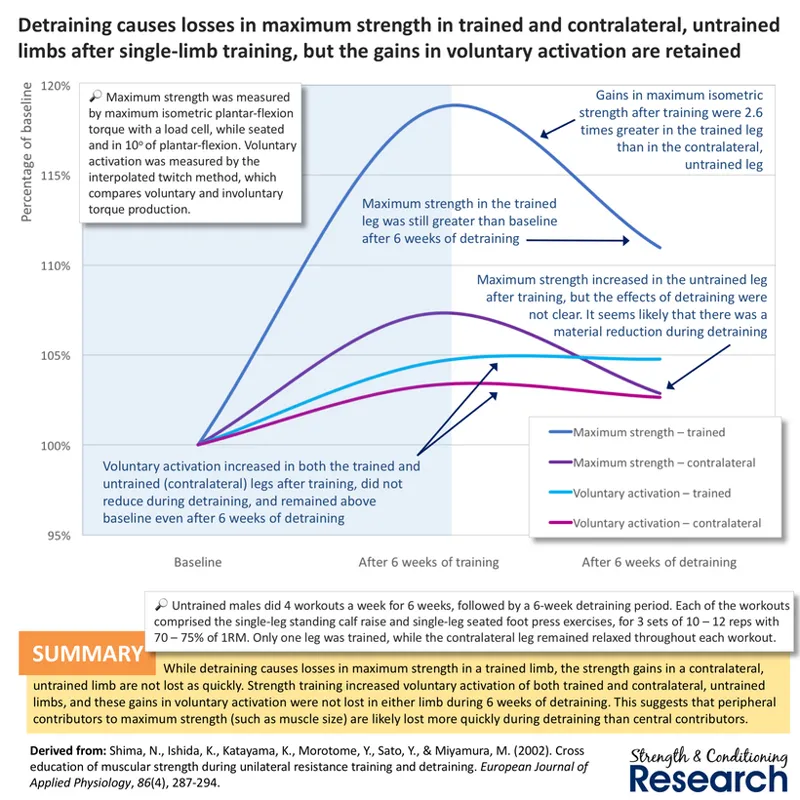
Neural adaptations are extremely resistant to change during detraining in comparison with changes in the muscle-tendon unit. Multiple studies have shown that there are minimal losses in voluntary activation during detraining.
.
Indeed, voluntary activation does not change for the worse even after multiple months spent without any training whatsoever. This suggests that detraining is primarily a peripheral effect.
.
Conclusions
Some strength and conditioning coaches have argued that speed is lost very rapidly during detraining in comparison to other physical qualities. However, the research literature does not support this view. Neither high-velocity force production nor throwing performances are seen to reduce during detraining periods, even though muscle size typically decreases quickly. Also, when force-velocity or load-velocity profiles are assessed before and after detraining, maximum speed either remains constant or increases. Speed behaves very differently from other physical qualities like strength and endurance during detraining owing to the unique physiological adaptations that contribute to increases in speed in the first place. Indeed, speed is increased primarily by neural adaptations but also benefits from a fast, glycolytic muscle fiber type proportion. During detraining, previously-obtained neural adaptations are extremely resilient and do not dissipate very quickly at all. Indeed, voluntary activation increases achieved by strength training do not dissipate at all during months of detraining. Also, muscle fiber type proportion tends to shift towards type IIX during detraining following a preceding block of fatiguing exercise, which increases the capacity for maximum speed at the muscular level.
Comments (3)
Thank you very much for this collection. In the Infographic «In highly-trained male and female sprint swimmers...», I think that the trend was clear for a shift towards speed-dominance (in the Infographic text it says «... towards force-dominance»). I apologize if I'm wrong.
High Chris, Joakim Dettner here. Long comment, my apologies for that. But this is a damn good scientific review. Very similar to what is experienced in the clinic with clients and entire teams. Especially interesting fact that neuro-central mechanisms are maintained for much longer than one might be led to believe. This ability to maintain neuromuscular recruitment level in combination with migration from type 2A to type 2X during detraining period is very interesting. If you combine this science with microperiodization of stimuli (exercises) for maximum strength, impulse and explosiveness (RFD), you would likely be able to both maintain mass (motors) and increase contraction speed and movement speed even during those periods on the pret when you cannot or should not train as much strength, e.g. the high season phase.
Thanks for your comment, sorry for the late reply. It is indeed strange that it is often assumed that neural adaptations dissipate quickly, when we all know that we never forget coordination adaptations (e.g. riding a bike). There is no incentive for the CNS to lose those adaptations because they don't cost anything to maintain (unlike peripheral adaptations).