



Age and peripheral adaptations
Younger and older people tend to display differences in respect of the rate at which certain peripheral adaptations occur in response to strength training programs. Researchers have assessed the effects of age on four peripheral adaptations: [1] muscle fiber hypertrophy, [2] sarcomerogenesis, [3] muscle fiber type shifts, and [4] increases in tendon stiffness.
.
#1. Hypertrophy
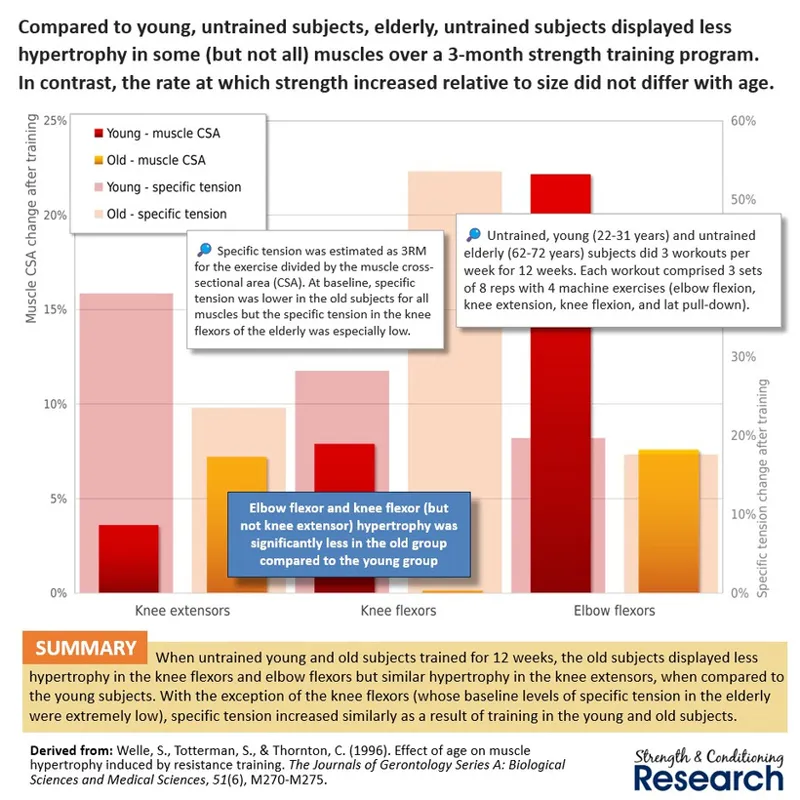
Famously, the rate of muscle growth caused by increases in muscle fiber diameter is slower in elderly people in comparison to young people. This can be observed in whole muscles (including those like the biceps brachii that do not display sarcomerogenesis).
.
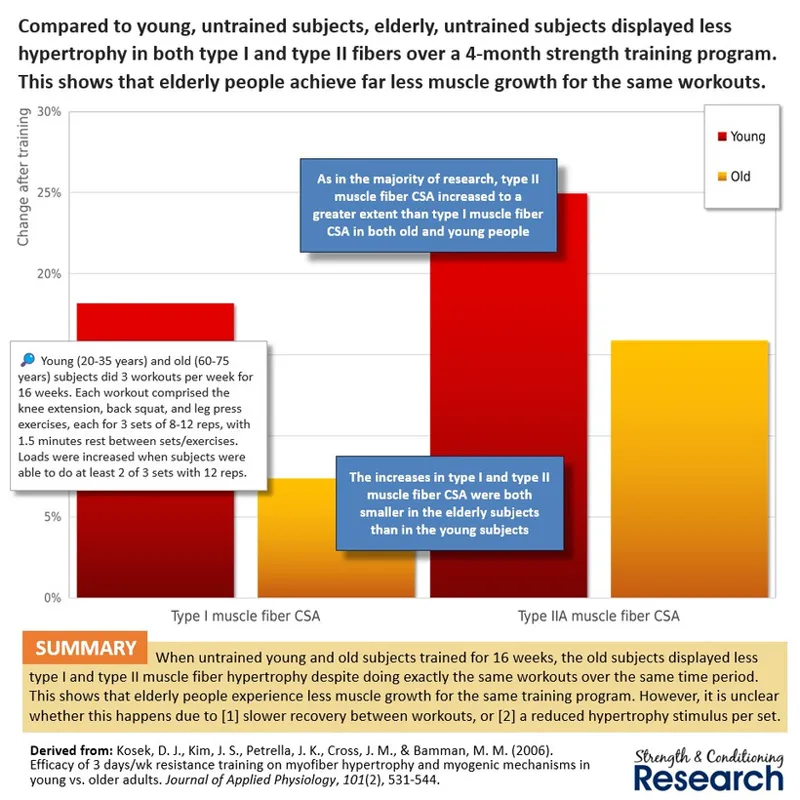
In addition, the same observation can be made in respect of muscle fiber cross-sectional area. Importantly, the same tendency for type II fibers to grow more than type I fibers can be observed in both young and old people.
.
Exactly why elderly people display slower muscle growth in response to a training program in comparison with young people is unclear. The most common hypothesis is that elderly lifters do not recover as quickly as younger lifters, which then impairs their ability to perform later workouts in the training program (read more).
.
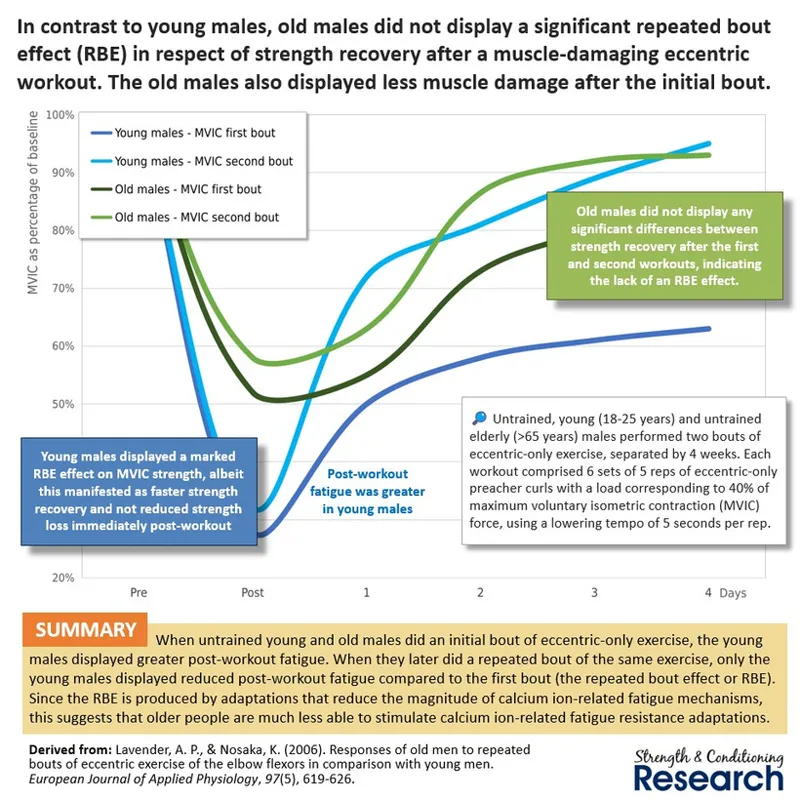
Indeed, it is interesting to note that older people display a much smaller repeated bout effect than younger people when performing the same muscle-damaging workout for the very first time. Logically, this would mean that they remain more susceptible to muscle damage for a longer duration of time and thereby accumulate more post-workout fatigue over the course of the training program.
.
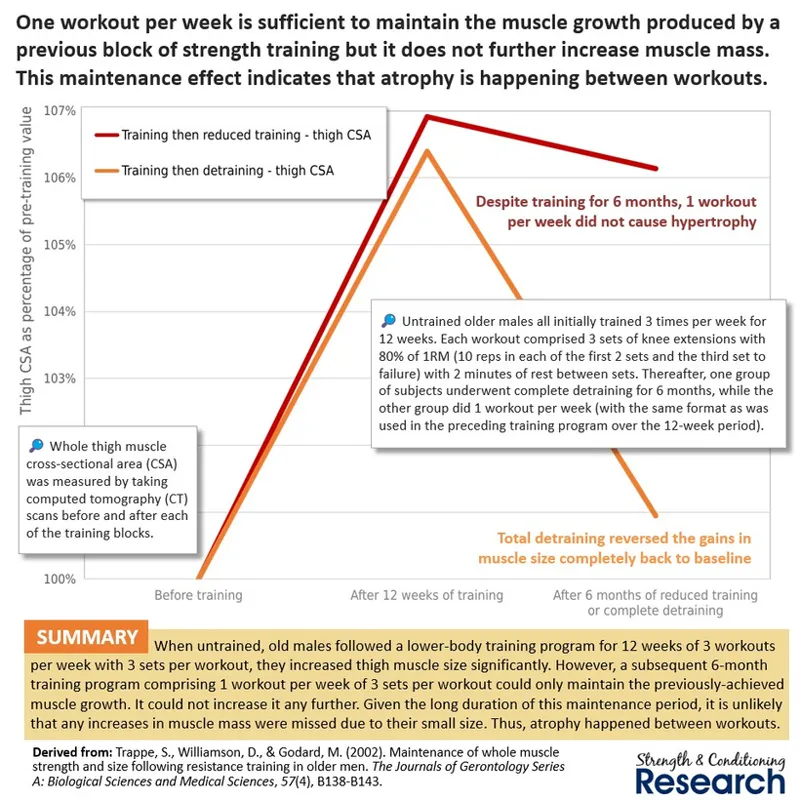
While the hypothesis that insufficient recovery is responsible for the reduced hypertrophy experienced by elderly people is probably the most popular, some researchers argue that elderly muscle fibers are simply less sensitive to the mechanical tension stimulus. However, we can rule out that possibility because maintenance studies in old subjects show that 3 sets done once per week is sufficient to maintain previously-gained muscle mass in the same way as it is in young people. If elderly muscle fibers were less sensitive to the mechanical tension stimulus, then this would not happen. They would need more sets in each weekly workout.
.
#2. Sarcomerogenesis
In human studies, the rate of increase in fascicle length during eccentric-only training is slower in old people in comparison to young people. This indicates that the rate of sarcomere addition is slower. Yet, over just 8 weeks of training, relative increases in fascicle length are not that different between younger and older lifters owing to the earlier plateau that occurs in the younger individuals. This suggests that the capacity for sarcomerogenesis is slowed down in old people but not removed.
.
Even so, rodent models indicate that the capacity for sarcomerogenesis as a result of eccentric-only training may be entirely lost or at least greatly reduced in old animals in comparison to in young animals. If sarcomerogenesis is similarly negatively affected by a reduced recovery capacity as hypertrophy, then this could be explained by the use of electrically-stimulated eccentric contractions in the animal models, which are known to cause much more muscle damage than voluntary contractions.
.
#3. Muscle fiber type shifts
While there are few studies available that have compared muscle fiber type shifts between young and old lifters over the course of a strength training program, the available data suggest that there is no meaningful effect of age on this adaptation. Yet, a time-course study would be necessary to be confident about this observation.
.
#4. Increases in tendon stiffness
While there are again few studies available that have compared increases in tendon stiffness between young and old lifters over the course of a strength training program, the available data suggest that there is no meaningful effect of age on this adaptation, with the proviso that increases in tendon stiffness occur for longer before reaching a plateau because they were much lower at baseline owing to the lower levels of physical activity in older people.
.
Moreover, it is noteworthy that elderly people display a similar dependence upon load for achieving increases in tendon stiffness, with only moderately-heavy (or heavy) loads being able to produce this adaptation.
.
Conclusions
Younger and older people tend to display differences in respect of the rate at which certain peripheral adaptations occur in response to strength training programs. Researchers have assessed the effects of age on four peripheral adaptations: [1] muscle fiber hypertrophy, [2] sarcomerogenesis, [3] muscle fiber type shifts, and [4] increases in tendon stiffness. The data indicate that older people display reduced muscle fiber hypertrophy and sarcomerogenesis in response to a given strength training program, possibly because of their reduced capacity to recover from a given amount of muscle damage. Indeed, research has demonstrated that elderly animals and humans take longer to recover from a given workout, even if they display the same amount of post-workout fatigue immediately after the exercise bout. Thus, they are likely to experience accumulated post-workout fatigue over the course of a training program, which then interferes with some of the adaptations that can be stimulated in the later weeks. Yet, in contrast to their reduced muscle fiber hypertrophy and sarcomerogenesis in response to strength training, elderly people do not appear to display slower or reduced shifts in fiber type nor do they display slower increases in tendon stiffness. This adds weight to the idea that incomplete recovery is the problem, since these adaptations would not be expected to suffer the same reductions in response to accumulated post-workout fatigue.

Comments (3)
In the last infographic, I don't understand the reference to "There were no changes in tendon stiffness after strength training, which is very different from what happens after aerobic exercise."
Is fiber type shift really detrimental for gains progression? How could we maintain the number of type IIx fibers
Please continue to report on this as new research comes out. Thanks for all your great work, Chris.