




Elevated MPS rates do not ALWAYS guarantee hypertrophy
Since the time hypertrophy researchers started focusing most of their efforts on muscle protein synthesis (MPS) and myofibrillar protein synthesis (MYOPS) rates, they have started to exaggerate what can be deduced from that data. One incorrect claim that they persist in making is that elevated MPS and/or MYOPS rates are always indicative of a hypertrophy stimulus. Yet, there are multiple datasets that completely disprove this claim.
.
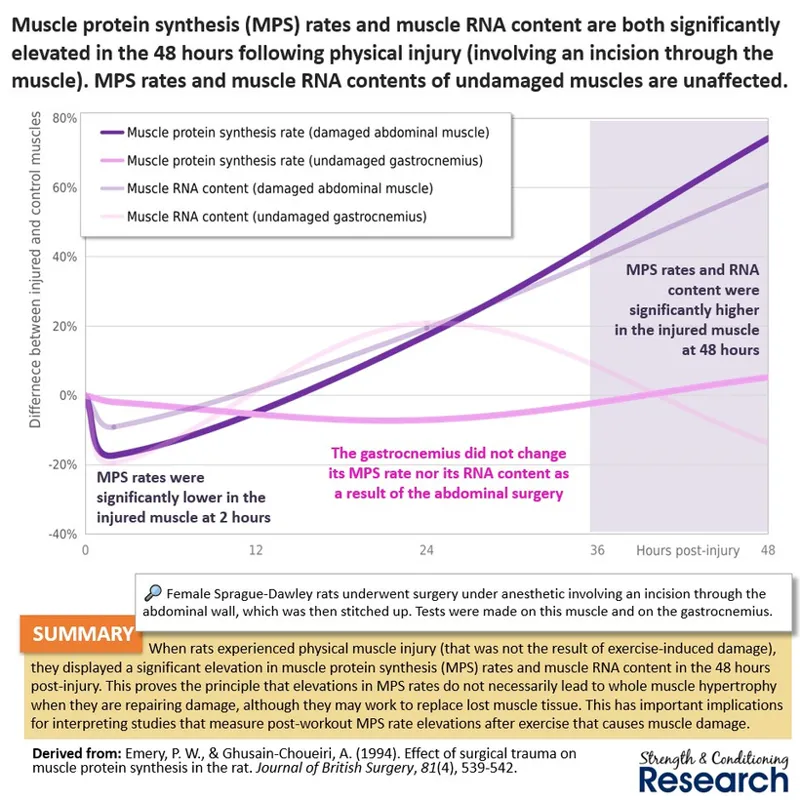
#1. Non-exercise muscle damage causes elevated MPS rates but still permits muscle atrophy to occur
When damage is produced by physical injury that does not involve muscle contractions (either by a cut, a bruise, or a burn), there is an increase in MPS rates in the days afterwards.
.
Nevertheless, this does not then cause muscle growth and in fact muscle atrophy often occurs, especially after burn injuries. After other injuries, there can be a minimal effect but there is certainly no increase in muscle size as would be predicted if MPS rate elevations always caused hypertrophy.
.
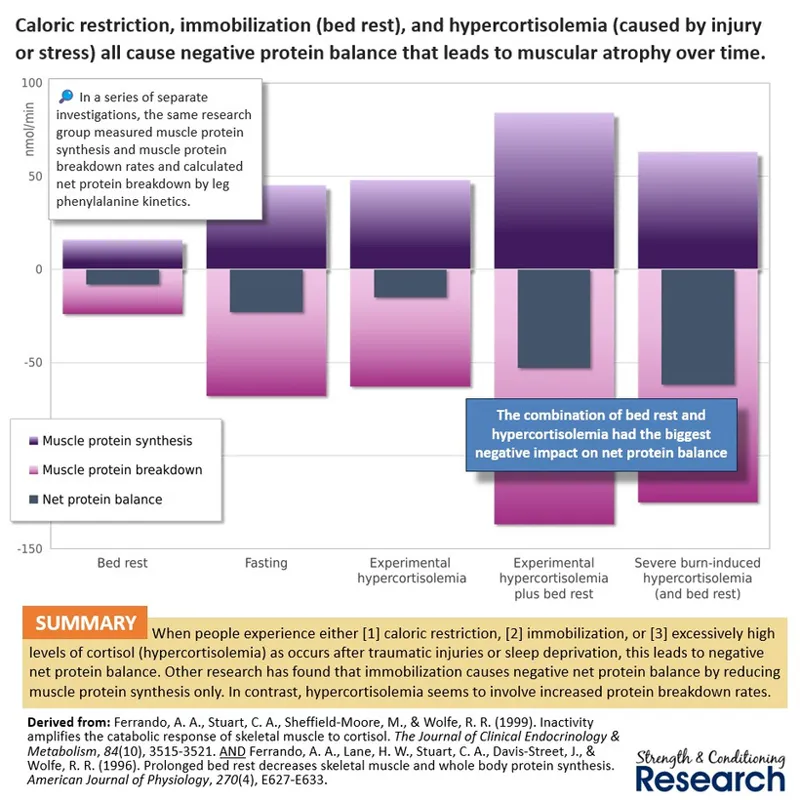
We can see very clearly how MPS rates are elevated when muscle damage occurs by reference to the burn literature. Bed rest alone involves greatly reduced MPS rates owing to inactivity, while bed rest in combination with a burn injury involves elevated MPS rates. The injury directly causes an increase in MPS rates that nevertheless do not cause hypertrophy. In fact, burn injuries are associated routinely with severe muscle atrophy because of a large increase in muscle protein breakdown (MPB) rates.
.
#2. Eating more protein causes elevated MPS rates but still permits muscle atrophy to occur
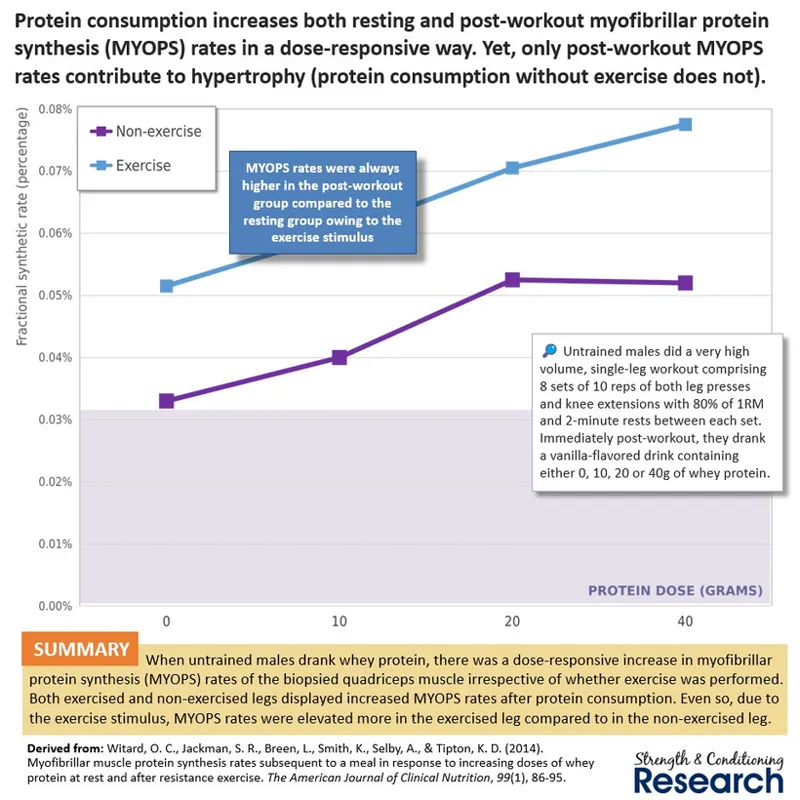
When we eat a meal containing protein, there is an elevation in MPS rates in the hours afterwards. This is frequently and incorrectly assumed to be protective against atrophy.
.
Nevertheless, eating more protein while a limb is immobilized or during bed rest does not protect a muscle against the lack of a hypertrophy stimulus. Therefore, again we can see that elevating MPS rates is not a guarantee that a hypertrophy stimulus has been experienced.
.
#3. Aerobic exercise elevates MPS rates but still permits muscle atrophy to occur
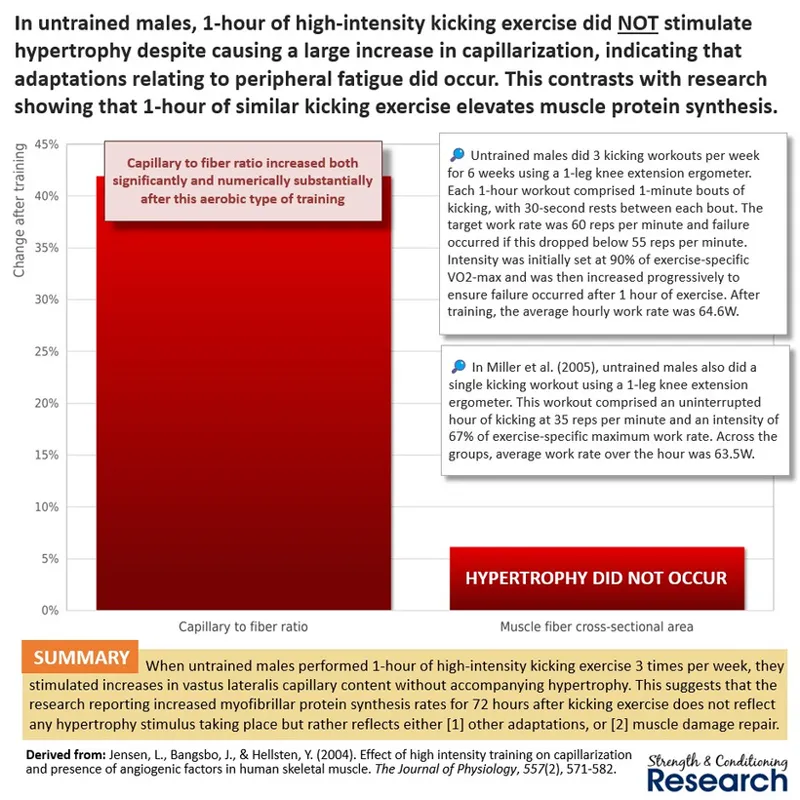
When we perform aerobic exercise, this can elevate MPS and/or MYOPS rates post-workout, although the majority of such studies have been performed in untrained people who are very susceptible to muscle damage from unaccustomed exercise.
.
Nevertheless, the same types of aerobic exercise that have been used to establish the elevation in MPS and/or MYOPS rates do not cause hypertrophy when they are used as a workout program for several weeks of training.
.
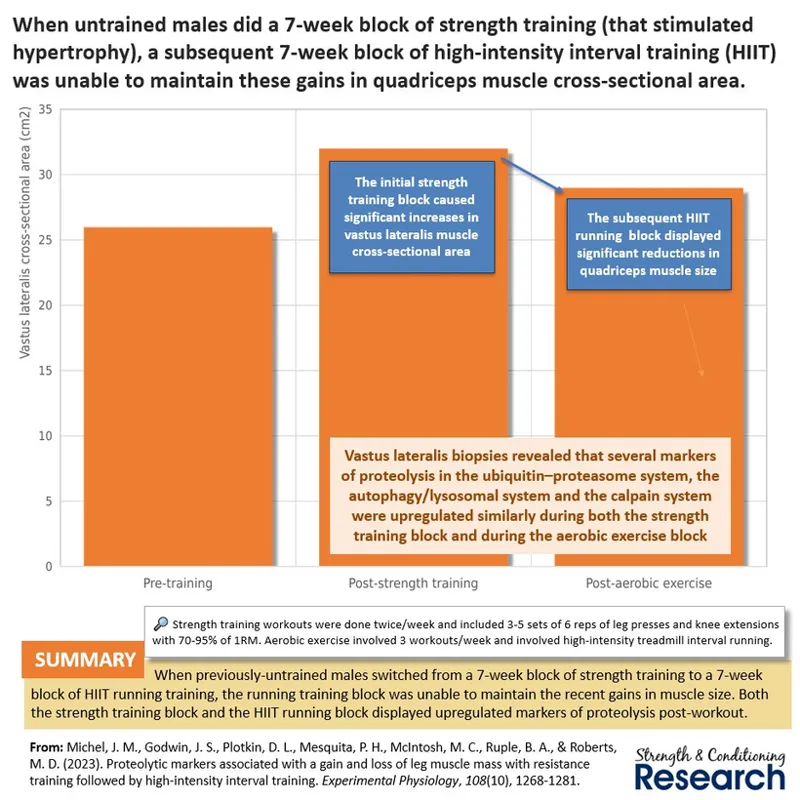
Also, when aerobic exercise training programs have been done in the detraining periods after strength training programs are concluded, this does not prevent atrophy from happening. This tells us that elevations in MPS and/or MYOPS rates after aerobic exercise workouts are not able to stop muscle atrophy from happening.
.
#4. Static stretching elevates MPS rates but still permits muscle atrophy to occur
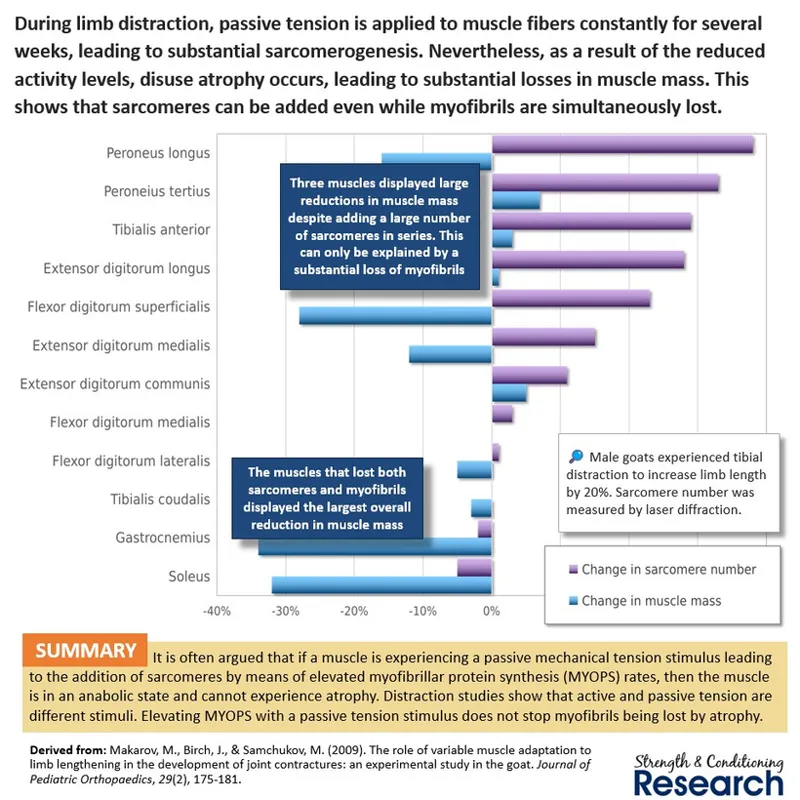
When static stretching is performed or muscles are immobilized in a stretched position, this immediately elevates MPS rates in animal models, as we would expect owing to the requirement for adding myofibrillar proteins into the new sarcomeres that are created.
.
Nevertheless, despite these new proteins being added in one part of the muscle fiber, there are simultaneous reductions in muscle fiber cross-sectional area due to the disuse atrophy associated with the immobilization. This shows that we can still experience muscle atrophy even when MPS rates are elevated due to a stretch stimulus.
.
Conclusions
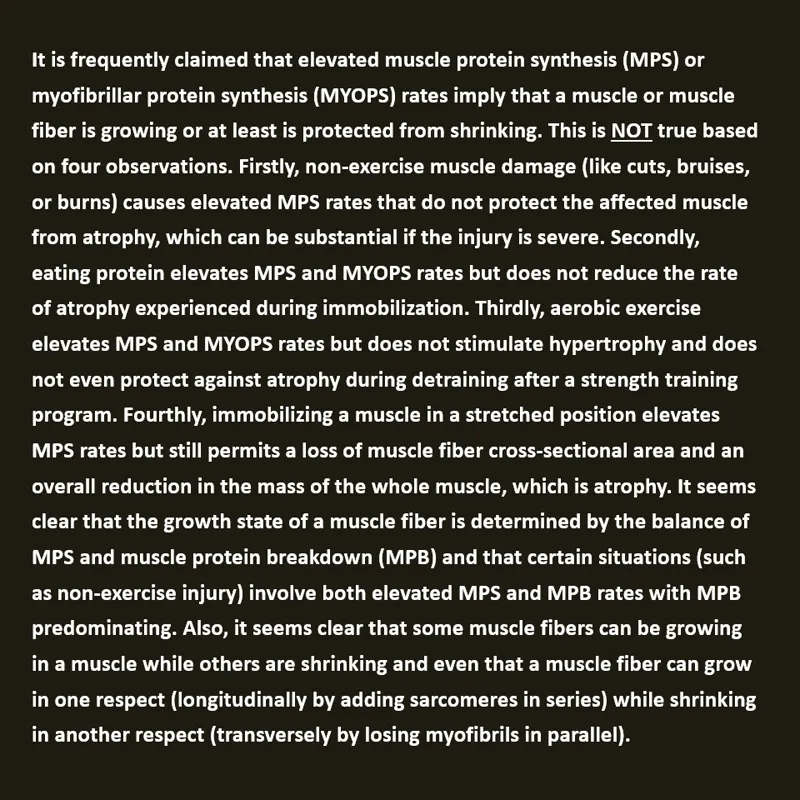
It is frequently claimed that elevated muscle protein synthesis (MPS) or myofibrillar protein synthesis (MYOPS) rates imply that a muscle or muscle fiber is growing or at least is protected from shrinking. We know that this is NOT true from four observations. Firstly, non-exercise muscle damage (like cuts, bruises, or burns) causes elevated MPS rates that do not protect the affected muscle from atrophy, which can be substantial if the injury is severe. Secondly, eating protein elevates MPS and MYOPS rates but does not reduce the rate of atrophy experienced during immobilization. Thirdly, aerobic exercise elevates MPS and MYOPS rates but does not stimulate hypertrophy and does not protect against atrophy during detraining after a strength training program. Fourthly, immobilizing a muscle in a stretched position elevates MPS rates but still permits a loss of muscle fiber cross-sectional area and an overall reduction in the mass of the whole muscle, which is atrophy. It seems clear that the growth state of a muscle fiber is determined by the balance of MPS and muscle protein breakdown (MPB) and that certain situations (such as non-exercise injury) involve both elevated MPS and MPB rates with MPB predominating. Also, it seems clear that some muscle fibers can be growing in a muscle while others are shrinking and even that a muscle fiber can grow in one respect (longitudinally by adding sarcomeres in series) while shrinking in another respect (transversely by losing myofibrils in parallel).