





Secondary muscle damage effect
Although most textbooks and educational materials show strength losses post-workout recovering in a relatively smooth line back to baseline, this is not actually what happens. Instead, there is a "secondary muscle damage effect" that involves a reduction in strength during the post-workout period.
.
#1. What causes post-workout fatigue?
Fatigue is a temporary and reversible reduction in exercise performance as a result of a previous bout of exercise. Post-workout fatigue refers to fatigue that lasts for a day or more after a workout. This type of fatigue comprises three main mechanisms (read more).
.
#2. What causes post-workout muscle damage?
Muscle damage is the main element of long-lasting post-workout fatigue. While hypertrophy researchers and the rest of the fitness industry still believe (incorrectly) that muscle damage is caused by tearing forces during exercise, the literature is extremely clear that the damage is instead caused by biochemical processes, including inflammation (read more).
.
#3. What is the secondary muscle damage effect? (animals)
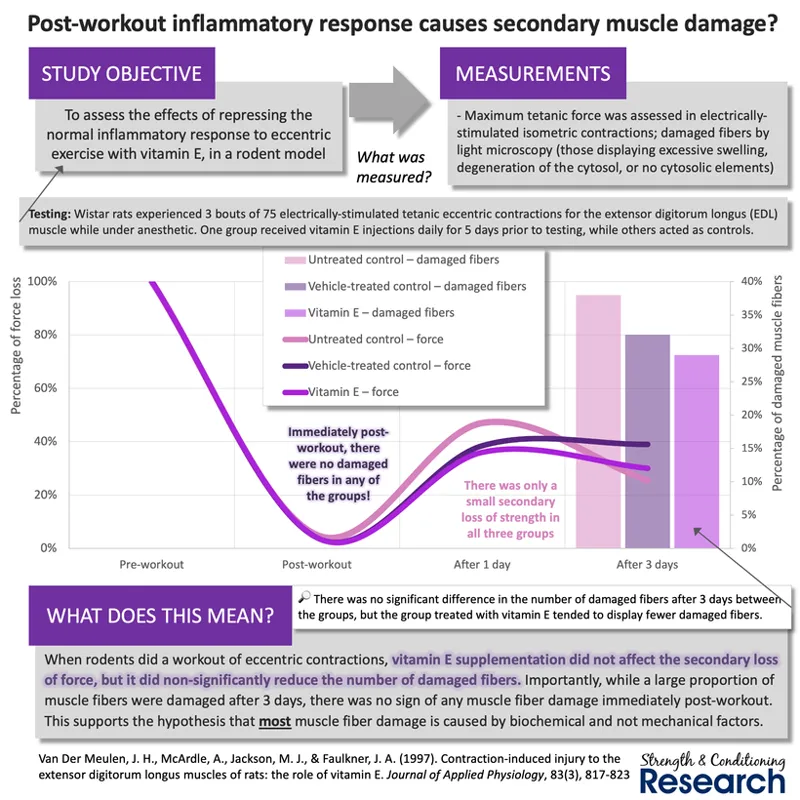
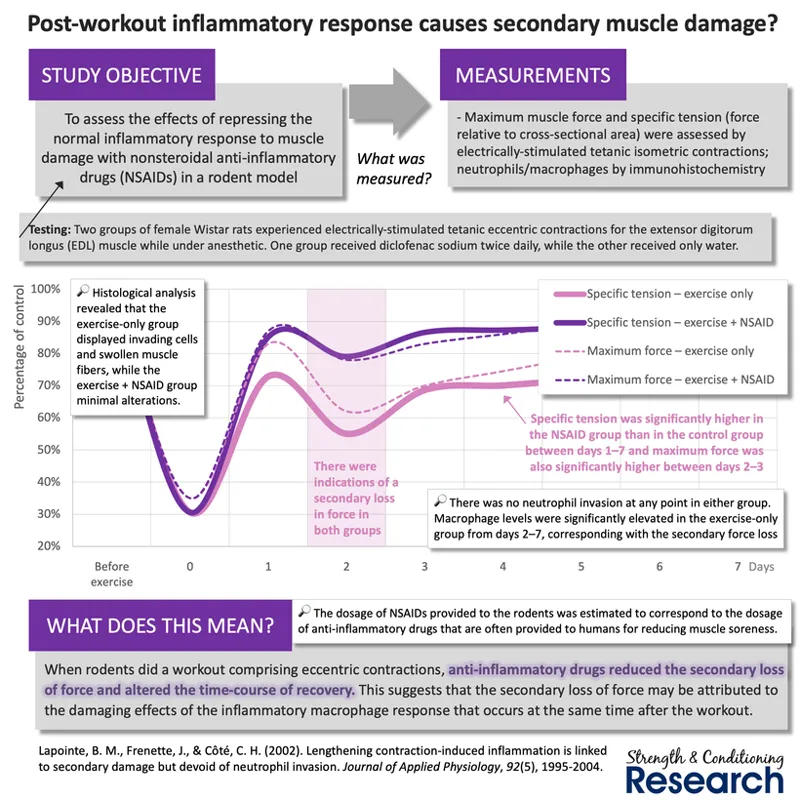
Multiple different scientific approaches to the question have revealed the presence of a secondary muscle damage effect that is linked to the post-workout inflammatory process. Sometimes, the effect appears to be relatively small.
.
In other cases, the magnitude of the secondary strength loss is much larger and impossible to overlook. Unfortunately, the paucity of measurements at different time-points makes it very difficult to pinpoint the exact time at which the secondary damage begins.
.
Even so, the general trend is for the effect to arise in the first couple of days post-workout.
.
#4. What is the secondary muscle damage effect? (humans)
Strength recovery follows exactly the same time-course in humans as in other animals, albeit it is very rarely measured sufficiently often in the post-workout recovery period to show this. This important study showed that the secondary strength loss occurs in the first 24 hours.
.
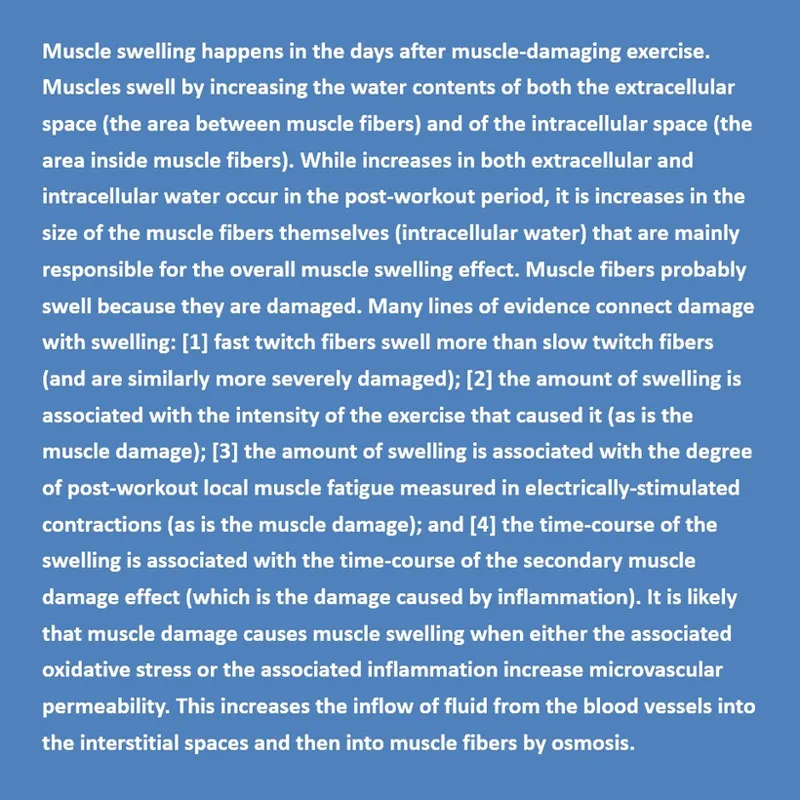
Other data have confirmed that it does occur in the first couple of days, in much the same way as in animals. Importantly, the secondary strength loss coincides with the arrival of the post-workout muscle swelling effect, which is linked to inflammation.
.
Indeed, this is why there is a secondary muscle swelling effect. Muscles swell in a workout due to the acidosis that they experience, which pulls water into the muscle fibers by osmosis. Then, in the post-workout period, they respond to the inflammatory process, swelling again.
.
This effect is described clearly in the literature and is summarized in this article (read more).
.
Conclusions
Although most educational materials show strength losses post-workout recovering in a smooth trajectory back to baseline, this is not what happens. Instead, strength initially recovers quickly immediately post-workout, before dropping back down again in the first day or so afterwards, before more slowly returning to baseline. This is the "secondary muscle damage effect" and has been observed in both animal models and humans. Multiple studies have shown that this second loss in strength coincides with and is produced by the post-workout inflammatory response. Inflammation removes any elements of the muscle fibers that were damaged by the calpains that were in turn generated in response to calcium ion accumulation during exercise. Thus, the inflammation can be viewed as a continuation of the biochemical processes that were originally stimulated to occur by calcium ion influx. Interestingly, the second loss in strength also corresponds to the rise ofpost-workout muscle swelling. Muscle swelling similarly displays a biphasic response to strength training workouts. Muscles swell during exercise in response to the accumulation of acidosis (which causes fibers to pull water inside themselves by osmosis). Evidently, this subsides quickly post-workout as metabolites disperse. Yet, muscles also swell in the post-workout period as the inflammation (or the associated oxidative stress) that causes the muscle damage also causes an increase in microvascular permeability.


