





Muscle swelling, damage, and inflammation
Muscle swelling occurs in the days after a muscle-damaging strength training workout. But what is this muscle swelling and what causes it to happen?
.
#1. Muscle swelling is mainly intracellular
While many researchers have focused on increases in the size of the spaces between muscle fibers within a muscle (extracellular water), the majority of the post-workout muscle swelling effect is actually attributable instead to increases in muscle fiber cross-sectional area (intracellular water).
While animal models (and some human studies) sometimes show relatively more extracellular water increases than intracellular water increases, this still does not matter because the absolute magnitude of the changes in intracellular water is still greater due to the larger amount of muscle fiber area compared to non-muscle fiber area.
This is why we should deduct both the increases in intracellular and extracellular water from increases in whole muscle size after high-volume training programs in order to establish the real hypertrophy that has happened (or has not happened, as the case may be).
#2. Muscle swelling is caused by muscle damage
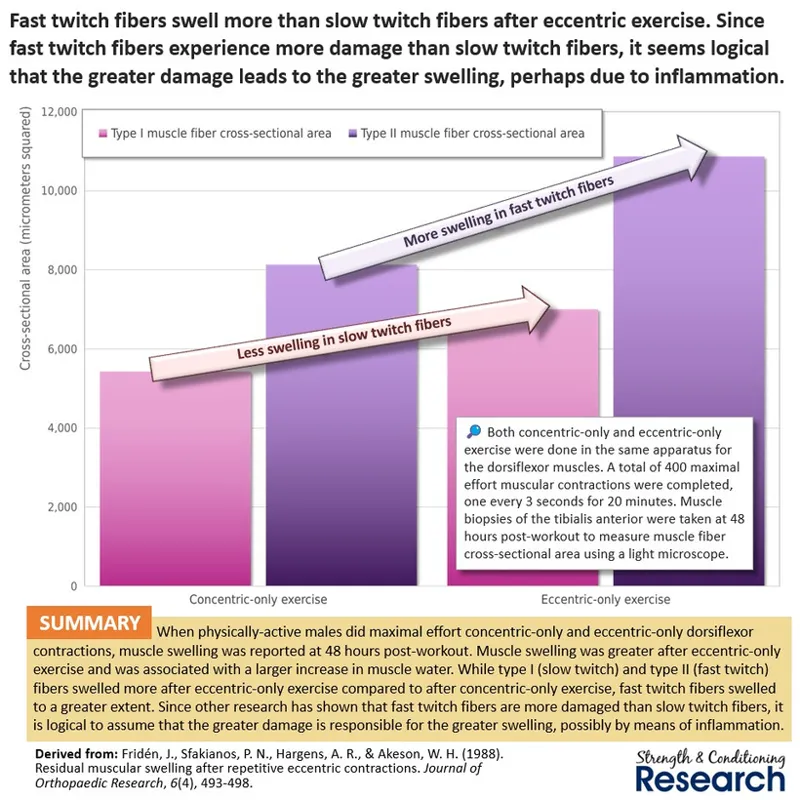
There are multiple lines of evidence showing that muscle fiber swelling in the post-workout period is caused by muscle damage. Firstly, the swelling is much greater in the fast twitch muscle fibers than in the slow twitch muscle fibers, and fast twitch muscle fibers are well-known to be more severely damaged by exercise.
Secondly, the magnitude of the post-exercise muscle swelling is correlated to the exercise intensity. Higher exercise intensities involve higher levels of muscle activation, which lead to greater levels of fast twitch muscle fiber usage and therefore damage.
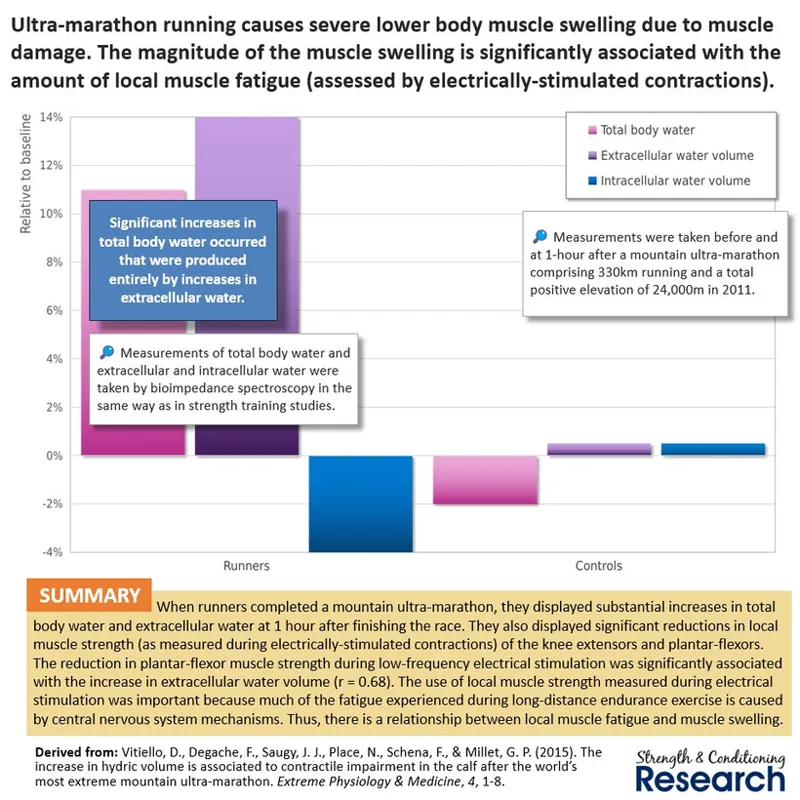
Thirdly, the magnitude of the post-exercise muscle swelling is correlated with the degree of local muscular fatigue (as measured during electrically-stimulated contractions). Local muscle fatigue is primarily calcium ion-related after endurance exercise and therefore extremely indicative of muscle damage.
Fourthly, post-workout muscle swelling follows the exact same time course as muscle damage development. Once the immediate effect of the exercise bout on muscle swelling has passed and the reactive hyperemia has dissipated, there is a secondary swelling effect that develops in tandem with the secondary muscle damage effect.
This secondary muscle swelling effect has been described multiple times and is therefore relatively well-established.
#3. Muscle damage causes muscle swelling through oxidative stress or inflammation
Studies have shown that when the oxidative stress that occurs in the post-workout period is reduced by pharmaceutical treatments, this reduces the amount of muscle swelling. This suggests that oxidative stress is likely responsible for the fluid inflow and muscle edema.
Yet, some studies have also shown that reducing the inflammatory response might also reduce the amount of muscle swelling in much the same way as reducing the oxidative stress.
Conclusions
Muscle swelling happens in the days after muscle-damaging exercise. Muscles swell by increasing the water contents of both the extracellular space (the area between muscle fibers) and of the intracellular space (the area inside muscle fibers). While increases in both extracellular and intracellular water occur in the post-workout period, it is increases in the size of the muscle fibers themselves (intracellular water) that are mainly responsible for the overall muscle swelling effect. Muscle fibers probably swell because they are damaged. Many lines of evidence connect damage with swelling: [1] fast twitch fibers swell more than slow twitch fibers (and are similarly more severely damaged); [2] the amount of swelling is associated with the intensity of the exercise that caused it (as is the muscle damage); [3] the amount of swelling is associated with the degree of post-workout local muscle fatigue measured in electrically-stimulated contractions (as is the muscle damage); and [4] the time-course of the swelling is associated with the time-course of the secondary muscle damage effect (which is the damage caused by inflammation). It is likely that muscle damage causes muscle swelling when either the associated oxidative stress or the associated inflammation increase microvascular permeability. This increases the inflow of fluid from the blood vessels into the interstitial spaces and then into muscle fibers by osmosis.