




Fatigue does NOT increase recruitment
One of the most annoying tendencies among hypertrophy researchers is their predisposition towards thinking that fatigue can do all kinds of magical things that it is physiologically unable to do. For example, it is very common for them to suggest that fatigue can increase motor unit recruitment. Fatigue does NOT increase motor unit recruitment.
.
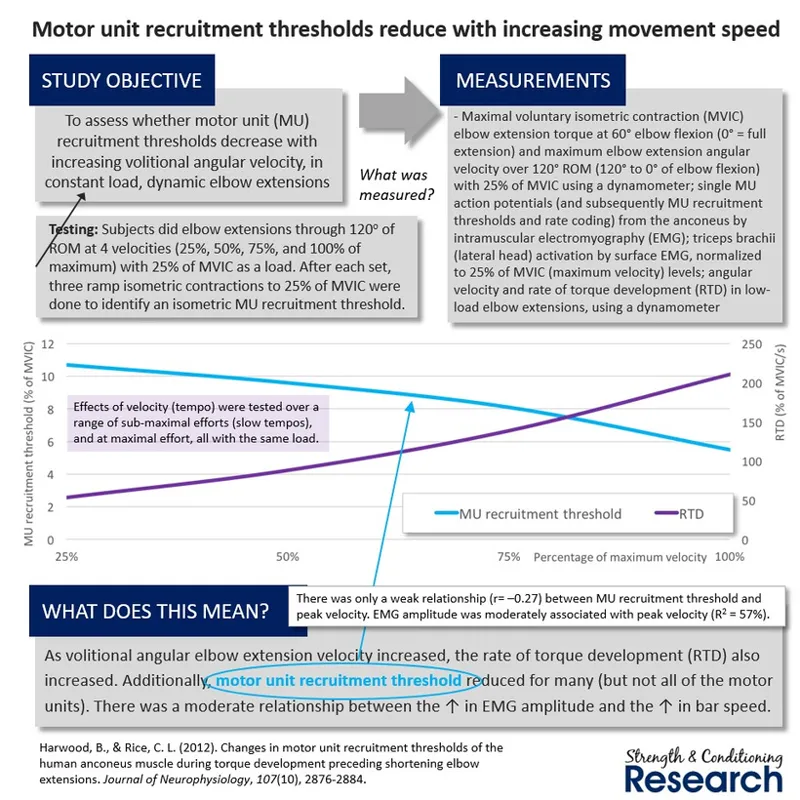
#1. Increases in motor unit recruitment with increasing velocity
When lifting a light load at a range of different velocities (tempos), the force threshold at which motor units are recruited decreases with increasing movement speed. This means that we voluntarily increase the number of motor units that are recruited when we want to move more quickly.
The same phenomenon has been observed repeatedly by many researchers.
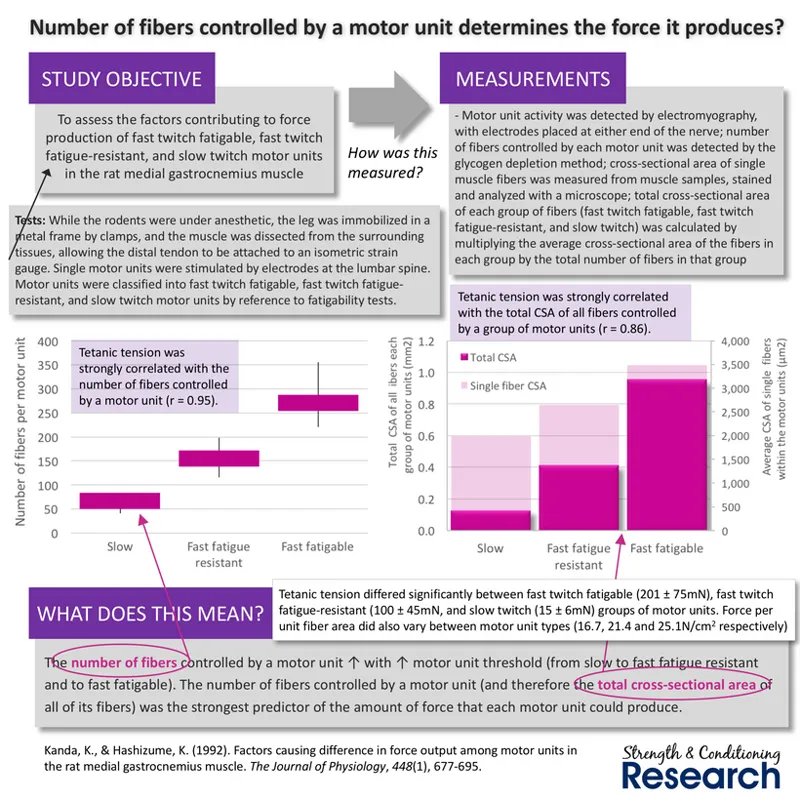
The number of recruited motor units (and therefore the number of activated muscle fibers) is a key determinant of whole muscle force. Therefore, when we want to move more quickly (which requires us to produce a greater force and thereby achieve a higher rate of acceleration), we must lower our recruitment thresholds and switch on more motor units.
#2. Increases in motor unit recruitment during fatiguing contractions
When producing a low force in varying states of fatigue, the force threshold at which motor units are recruited decreases with increasing fatigue. This has been interpreted to mean that fatigue increases motor unit recruitment level. Yet, as we observed in the previous section, we can achieve maximal levels of motor unit recruitment at any time, simply by trying to move more quickly. In reality, we voluntarily increase the number of motor units that are recruited when we want to continue performing a task despite the presence of fatigue.
Indeed, we know that we must increase our effort (and hence our central motor command) in order to overcome the fatigue that is present. The same increases in effort and central motor command occur when we increase load as when we increase fatigue. In every case, we must voluntarily choose to increase the level of effort in order to achieve the required outcome.
Conclusions
Hypertrophy researchers have a predisposition towards claiming that fatigue can do all kinds of magical things that it is physiologically unable to do. For example, they often suggest that fatigue can increase motor unit recruitment (MUR) over the course of a strength training set to failure. This is totally impossible because MUR is entirely under voluntary control. When we want to move more quickly, we voluntarily increase our effort levels, which increases our levels of central motor command (neural drive). This in turn increases the number of recruited motor units (and the number of activated muscle fibers), which allows us to produce more force and thereby achieve a higher rate of acceleration. The same thing happens whenever we want to lift a heavier load or whenever we wish to continue performing an exercise while we are in a fatigued state. At no point can the presence of fatigue override our voluntary control over MUR levels. Claiming that fatigue increases MUR levels is disingenuous because at any point during the strength training set, we could achieve maximal MUR levels just by exerting a maximal effort. What fatigue actually does is reduce the movement speeds that we can achieve while performing a maximal effort, which means that the muscle fibers of high-threshold motor units are exposed to slow shortening speeds (and hence high levels of single fiber mechanical tension due to the force-velocity relationship).
Comments (1)
All kinds of magical things 😂