


Intent to move quickly
For around two decades following the turn of the millennium, one of the most popular ideas in S&C was the belief that simply "intending" to move quickly was enough to maximize gains in speed and that actually moving quickly was unnecessary. But where did this idea come from and does it hold any water?
.
#1. What adaptations increase speed?
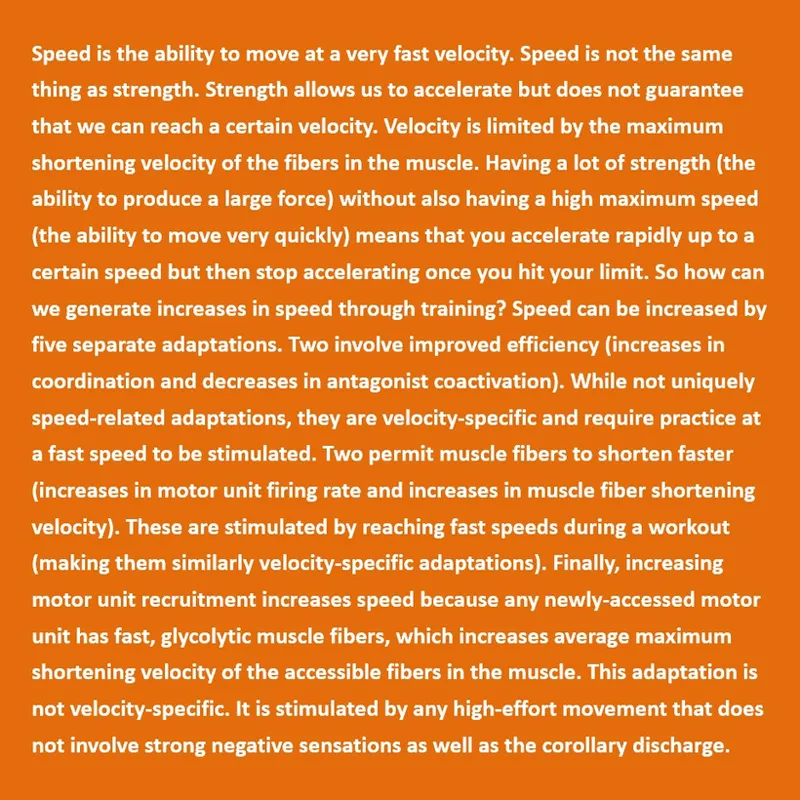
Five adaptations cause increases in speed after any type of exercise (read more). With the exception of increases in the ability to recruit high-threshold motor units, all of these adaptations are stimulated only by training involving fast movements. Thus, we would not expect that only "intending" to move quickly (but not actually moving quickly) would be able to stimulate increases in speed to the same extent as both intending to move quickly and also moving quickly.
.
The following chart summarizes the five adaptations that cause increases in speed and also shows the potentially negative effect of fiber type shifts that can occur after heavy strength training, especially close to failure.
.
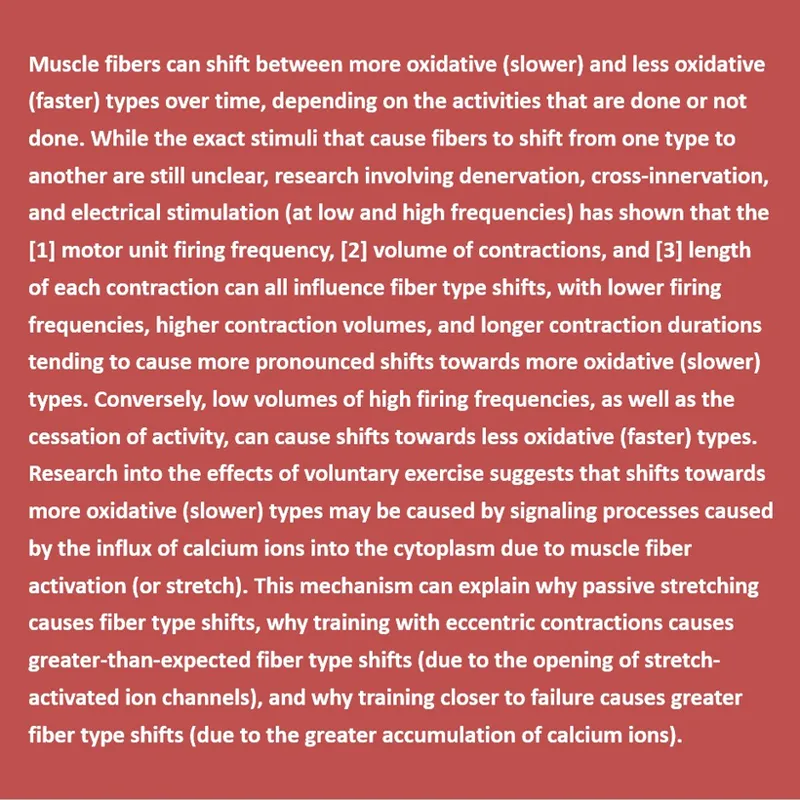
For more information about fiber type shifts, see this more detailed article (read more).
.
#2. Can "intent to move quickly" increase speed irrespective of movement velocity?
One very famous study in the mid-1990's was responsible for the idea that simply "intending" to move quickly was enough to maximize gains in speed and that actually moving quickly was unnecessary. That study used a within-subject design, however. Each subject did both of the training programs, one with each leg (a high-velocity exercise with one leg and a fast intent, isometric exercise with the other). In that original study, there were no differences in the gains in speed between legs. Yet, that could have just been the cross-education effect. Indeed, when the same research team did a follow-up with two parallel groups, the high-velocity exercise was far superior at increasing speed.
.
Conclusions
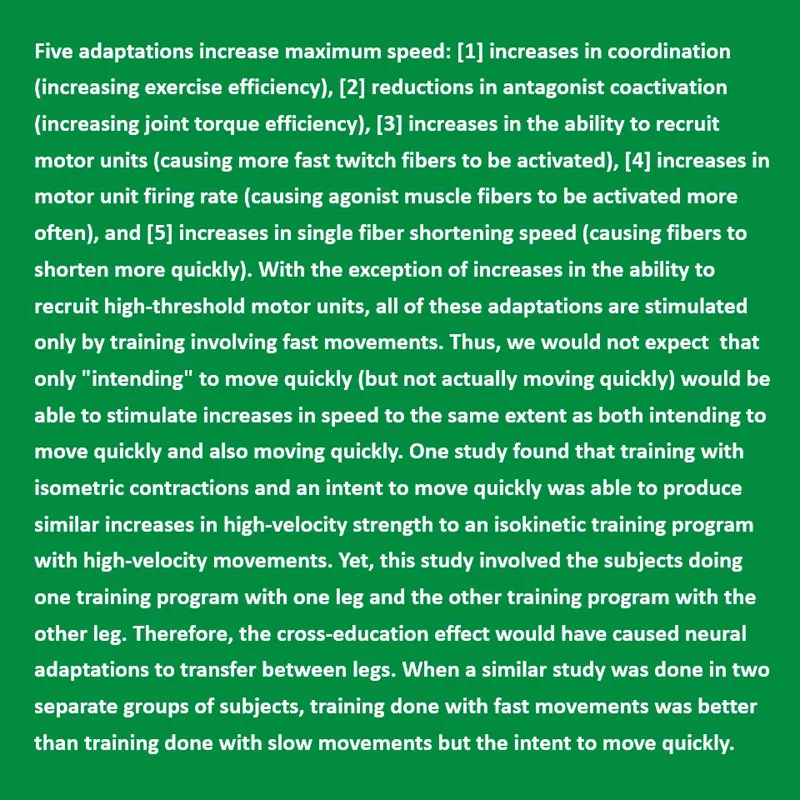
Five adaptations increase maximum speed: [1] increases in coordination (increasing exercise efficiency), [2] reductions in antagonist coactivation (increasing joint torque efficiency), [3] increases in the ability to recruit motor units (causing more fast twitch fibers to be activated), [4] increases in motor unit firing rate (causing agonist muscle fibers to be activated more often), and [5] increases in single fiber shortening speed (causing fibers to shorten more quickly). With the exception of increases in the ability to recruit high-threshold motor units, all of these adaptations are stimulated only by training involving fast movements. Thus, we would not expect that only "intending" to move quickly (but not actually moving quickly) would be able to stimulate increases in speed to the same extent as both intending to move quickly and also moving quickly. One study found that training with isometric contractions and an intent to move quickly was able to produce similar increases in high-velocity strength to an isokinetic training program with high-velocity movements. Yet, this study involved the subjects doing one training program with one leg and the other training program with the other leg. Therefore, the cross-education effect would have caused neural adaptations to transfer between legs. When a similar study was done in two separate groups of subjects, training done with fast movements was better than training done with slow movements but the intent to move quickly.

Comments (5)
If the cross-education effect might cause neural adaptations to transfer between legs, could this phenomenon compensate for neural cross-over fatigue in unilateral training?
Fantastic post Chris! How could we address the issue of fiber type shift in order to preserve fast twitch fibers? Might diminishing of calcium related fatigue, performing high speed training or neural priming with explosive set be good strategies ?
Complement with Chris Beardsley's video "5. Maximum speed - intent" (Patreon, Oct. 2025)
Great post Chris! Chris Would you consider this paper to be an example of where intent to move quickly did produce speed improvements? The group pushing as hard as possible against a fixed speed, motorized resistance, seemed to outperform more explosive forms of weight training in their sprint performance. Perhaps you have discussed this paper elsewhere and I missed it.
https://pubmed.ncbi.nlm.nih.gov/27820725/