



Sprinting muscles
How should we write strength training programs for sprinters? We can identify which muscles require hypertrophy by reference to [1] the biomechanics literature that shows which muscles contribute most to increases in running speed, and [2] the cross-sectional literature that has found associations between muscle sizes of track sprinters and sprinting performance.
.
#1. Biomechanics research
Biomechanics research has shown that the most important joint for determining running speed is the hip. Increases in running speed are produced by increases in hip flexion and hip extension work done.
.
When musculoskeletal modelling research has been done, it has found that increases in swing phase muscle forces by the hip flexors (psoas and rectus femoris) and hip extensors (gluteus maximus and hamstrings) are responsible for increases in running speed.
.
#2. Sprinting muscles
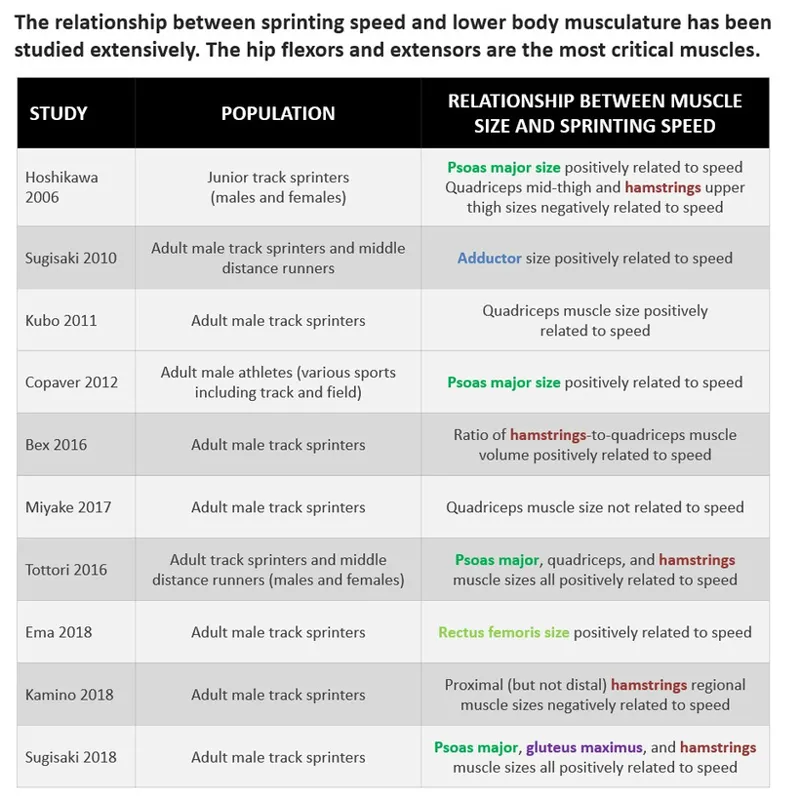
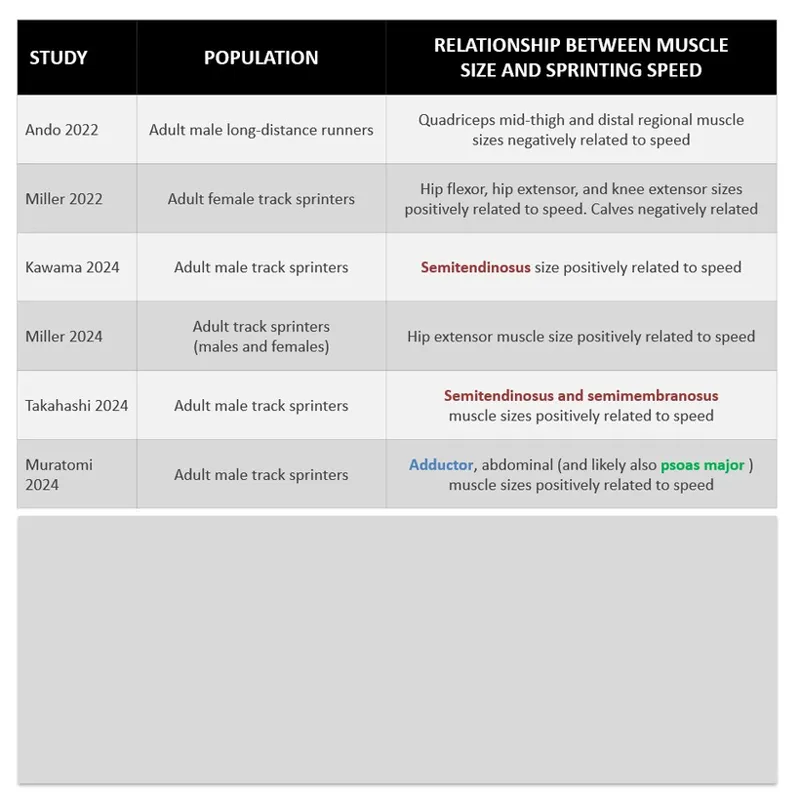
One very large group of studies has assessed the relationship between the muscle sizes of track sprinters and sprinting performance. There are clear relationships between the sizes of the hip flexors (psoas major and rectus femoris) and sprint speed, and between the sizes of the hip extensors (gluteus maximus and hamstrings) and sprint speed.
.
In contrast, larger quadriceps and calves are often a hindrance rather than a help. This can be explained partly by reference to the greater negative effects of more distal muscle mass on angular momentum and partly by reference to the proximal-to-distal sequence making more proximal muscles contribute more kinetic energy.
.
Other muscles, like the abdominals, may play a role in transmitting force between the upper and lower body, but they are not the primary muscles contributing to sprinting performance.
.
#3. Sprinting training muscles
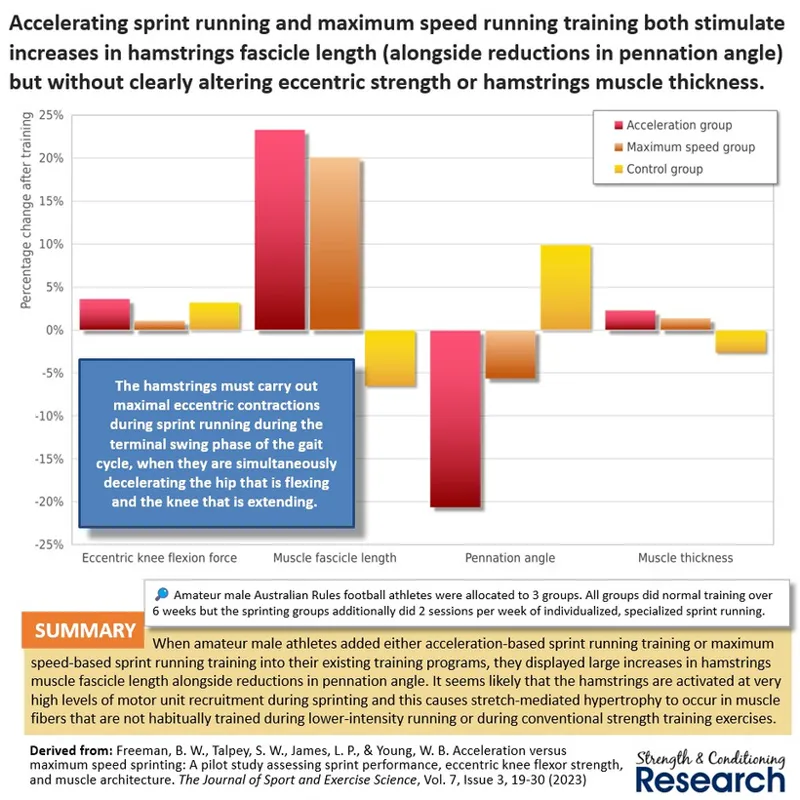
Importantly, sprinting itself will not provide the desired hypertrophy. The fast movements are too quick to cause high levels of single fiber mechanical tension, so we only see increases in muscle fascicle length due to sarcomerogenesis.
.
Conclusions
How should we write strength training programs for sprinters? We can identify which muscles require hypertrophy by reference to [1] the biomechanics literature showing which muscles contribute most to increases in running speed, and [2] the cross-sectional literature reporting associations between the muscle sizes of track sprinters and sprint speed. Biomechanics studies show that increases in running speed are produced by increases in hip flexion and hip extension work done. Musculoskeletal models show that increases in swing phase muscle forces by the hip flexors (psoas and rectus femoris) and hip extensors (gluteus maximus and hamstrings) are responsible for increases in running speed. Cross-sectional studies have found clear relationships between the sizes of the hip flexors (psoas and rectus femoris) and hip extensors (gluteus maximus and hamstrings) and sprint speed. In contrast, larger quadriceps and calves are often a hindrance rather than a help. This can be explained partly by reference to the greater effects of more distal muscle mass on the angular momentum of the legs, and partly by reference to the proximal-to-distal sequence of the running motion ensuring that more proximal muscles contribute much more kinetic energy to each stride than more distal muscles.
Comments (2)
Thank you bro 👍👍👍👍❤️❤️❤️❤️❤️
how to train for soccer performance on an athlete looking to get faster?