





CNS fatigue during exercise (training variables)
We now understand that there are two CNS fatigue mechanisms that occur during exercise, being [1] supraspinal (brain) CNS fatigue, and [2] spinal CNS fatigue. Clearly, if we want to achieve high levels of motor unit recruitment, we want to avoid these fatigue mechanisms. But what training variables can we modify in order to do that?
.
#1. Supraspinal CNS fatigue
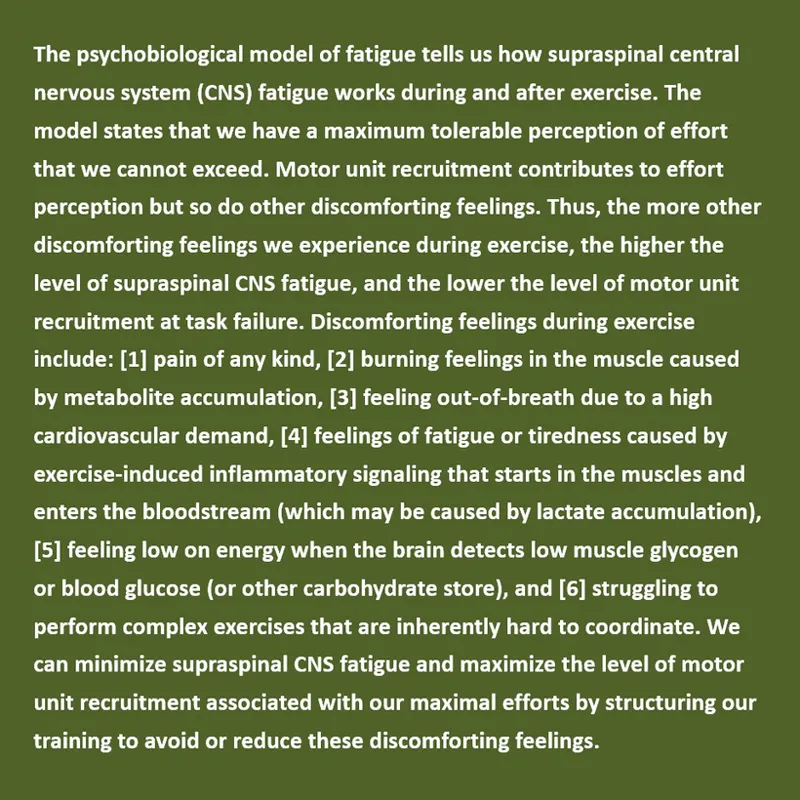
Supraspinal CNS fatigue causes a reduction in motor unit recruitment at the level of the motor cortex and thereby applies to all muscles in the body, even when the exercise only involves a single working muscle. It is created by the discomforting feelings experienced during exercise (read more).
.
#2. Spinal CNS fatigue
In contrast, to supraspinal CNS fatigue, spinal CNS fatigue occurs in the spinal cord. While supraspinal CNS fatigue reduces the magnitude of the central motor command that is generated in the motor cortex of the brain, spinal CNS fatigue reduces the amount of central motor command that reaches the muscle after being sent down the motor neurons of the spinal cord (read more).
.
#3. What training variables cause more CNS fatigue during exercise?
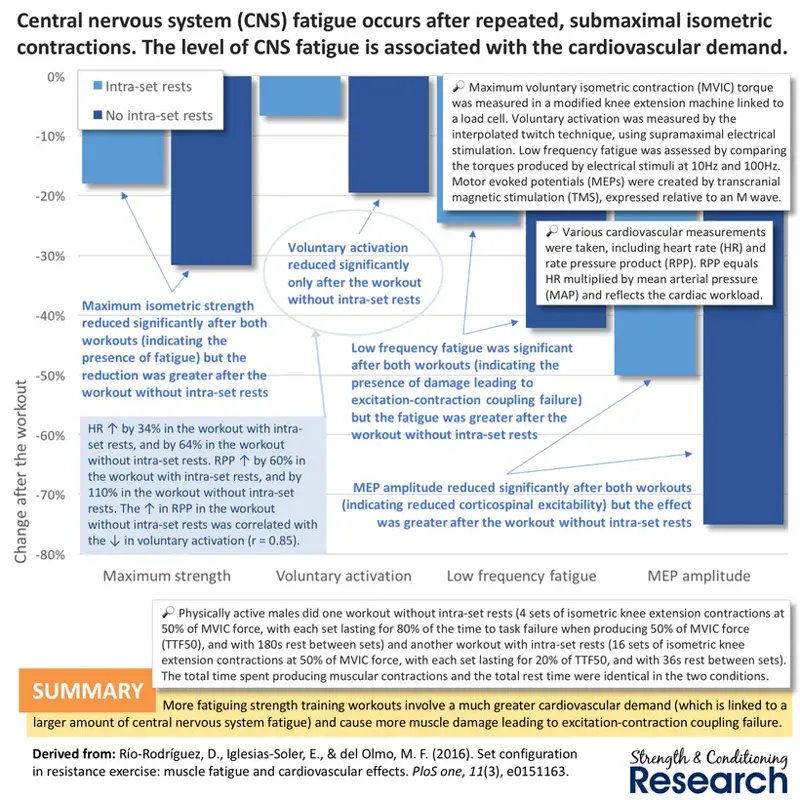
Supraspinal CNS fatigue is greater when a training variable causes more pain or discomfort during exercise. For example, we see much more CNS fatigue when cardiovascular demand is higher or when metabolite-related burning sensations are greater. Training variables associated with more discomfort include: [1] higher rep ranges, [2] shorter rest periods, [3] closer proximity to failure, [4] most advanced bodybuilding techniques (such as drop sets, pre-exhaustion, giant sets, etc.), [5] multi-joint exercises involving more muscle mass, and [6] exercises that are difficult to coordinate.
.
Spinal CNS fatigue is greater whenever a training variable involves causing motor units to be recruited for a longer duration of time, especially without breaks between contractions, as is the case with sustained isometrics. Training variables associated with more sustained muscle activation include: [1] higher rep ranges, [2] slow lifting phase tempos, [3] advanced bodybuilding techniques (such as drop sets, pre-exhaustion, giant sets, etc.), and [4] isometrics or any pauses between reps in which muscle activation is maintained.
.
#4. How does CNS fatigue accumulate over a workout?
CNS fatigue has been shown to accumulate over the course of a workout. When measuring the same muscle group, this accumulation is likely to reflect both supraspinal and spinal CNS fatigue mechanisms. Many studies have tested isometric contractions.
.
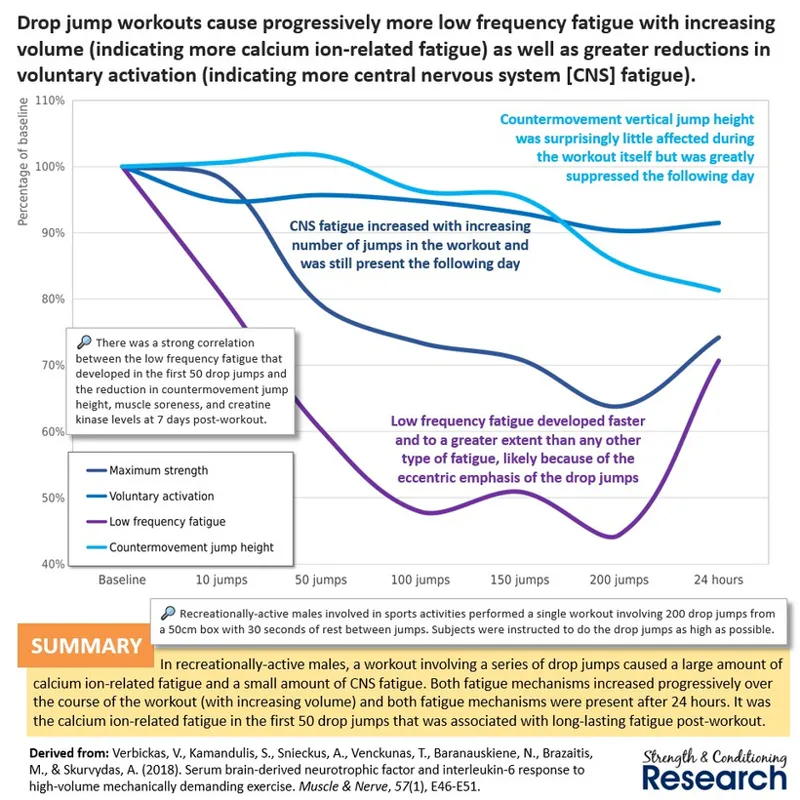
Even so, others have recorded CNS fatigue accumulating over a workout when the subjects perform dynamic contractions, such as plyometrics.
.
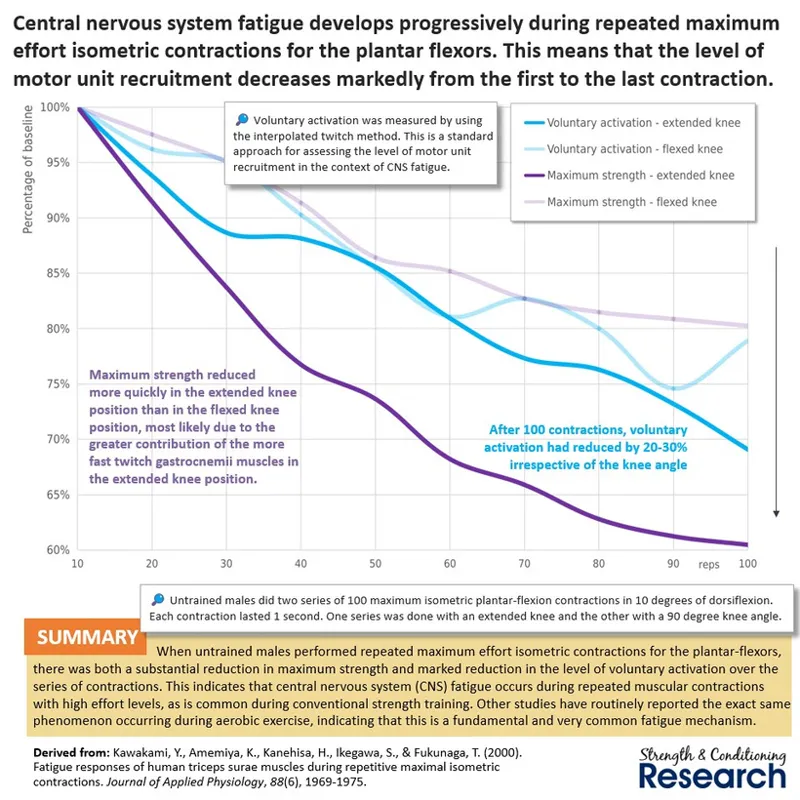
Many fitness influencers attempt to downplay the magnitude of CNS fatigue during a workout, claiming that it is not meaningful. Nevertheless, researchers have shown reductions in voluntary activation (the amount of recruited motor units) of 20-30% over the course of a series of muscular contractions, indicating that the changes are indeed very substantial.
.
This is not an isolated finding and multiple studies have confirmed similar large reductions in voluntary activation over the course of a sustained bout of high-effort muscular contractions. In this case, we can see evidence for the role of spinal CNS fatigue because the sustained contractions caused far more total CNS fatigue than the intermittent isometric contractions.
.
Conclusions
Two central nervous system (CNS) fatigue mechanisms occur during any bout of exercise: [1] supraspinal (brain) CNS fatigue, and [2] spinal CNS fatigue. If we want to achieve high levels of motor unit recruitment (either to maximize hypertrophy or to stimulate increases in our ability to recruit high-threshold motor units), we want to avoid these fatigue mechanisms. What training variables can we modify in order to do that? Supraspinal CNS fatigue is greater when a training variable causes more pain or discomfort during exercise. Training variables associated with more discomfort include: [1] higher rep ranges, [2] shorter rest periods, [3] closer proximity to failure, [4] advanced bodybuilding techniques (drop sets, pre-exhaustion, giant sets), [5] multi-joint exercises involving more muscle mass, and [6] exercises that are difficult to coordinate. Spinal CNS fatigue is greater whenever a training variable causes motor units to be recruited for a longer duration of time, especially without any breaks between contractions. Training variables associated with more sustained muscle activation include: [1] higher rep ranges, [2] slow lifting phase tempos, [3] advanced bodybuilding techniques, and [4] isometrics or any pauses between reps in which muscle activation is maintained. Finally, since both supraspinal and spinal CNS fatigue accumulate over time, their impact increases over the course of a workout.

Comments (2)
Is a PhyDS a saver of time (or efficient technique) but not a saver of fatigue? On the contrary, could 5RM clusters reduce the accumulation of CNS fatigue over time or get significant stimulus despite the already accumulated fatigue?
Chris makes several references to lactate accumulation associated with exercise-induced inflammatory signaling. Has this position been changed?