



Time under tension
For several decades, bodybuilding experts have maintained the idea that "time under tension" (TUT) is a key factor that contributes towards muscle growth. However, the physiology makes it clear that this is completely impossible.
.
#1. What causes muscle growth?
Muscle growth is the result of lots of individual muscle fibers growing. Each muscle fiber is stimulated to grow after it is [1] activated, and [2] experiences mechanical tension due to actin-myosin crossbridge formation. We know that each muscle fiber must experience its own unique stimulus because each muscle fiber has its own mechanoreceptors (read more).
.
#2. What training variables increase TUT?
TUT is calculated as the total time spent exercising during a strength training set. For this reason, light load strength training involves a longer TUT than heavier load strength training.
.
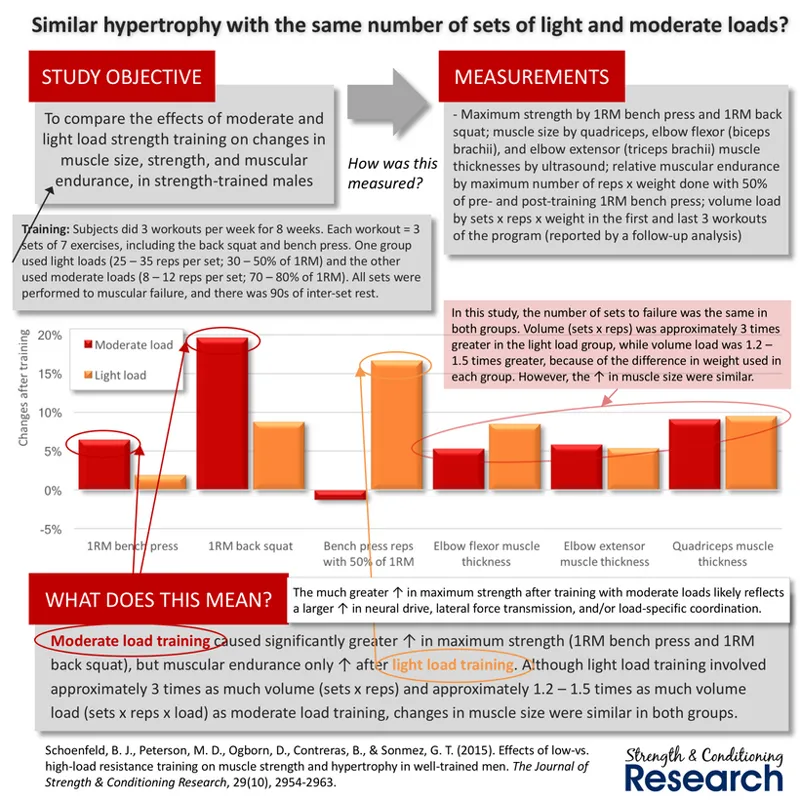
Even so, training with light loads to failure does not stimulate more hypertrophy than training with the same number of sets of heavier loads to failure, which suggests that increasing TUT in this way does nothing (read more). Indeed, the majority of the earlier reps in each set of light loads involve a low level of muscle activation. Therefore, not very many muscle fibers are exposed to any hypertrophy stimulus. Counting them towards the TUT is therefore incorrect.
.
Similarly, implementing a slow lifting (concentric phase) tempo also increases the total TUT during a strength training set with either light or moderate loads performed to failure.
.
Again, training with slow lifting (concentric phase) tempos during sets to failure does not stimulate more hypertrophy than training with a faster lifting tempo. This again tells us that increasing TUT in this way does nothing (read more). Indeed, those reps that are performed with a deliberately slow lifting (concentric phase) tempo again involve a low level of muscle activation. Therefore, not very many muscle fibers are exposed to any hypertrophy stimulus during these reps. Counting them towards the TUT is therefore incorrect. Only those reps that are performed with an involuntary slow speed involve a high level of muscle activation.
.
#3. When does TUT predict muscle growth?
TUT can predict muscle growth so long as every single rep or muscular contraction involves [1] a similarly high level of muscle activation, and [2] a slow movement speed such that single muscle fiber mechanical tension is high. In such situations, we are just counting the number of stimulating reps (read more).
.
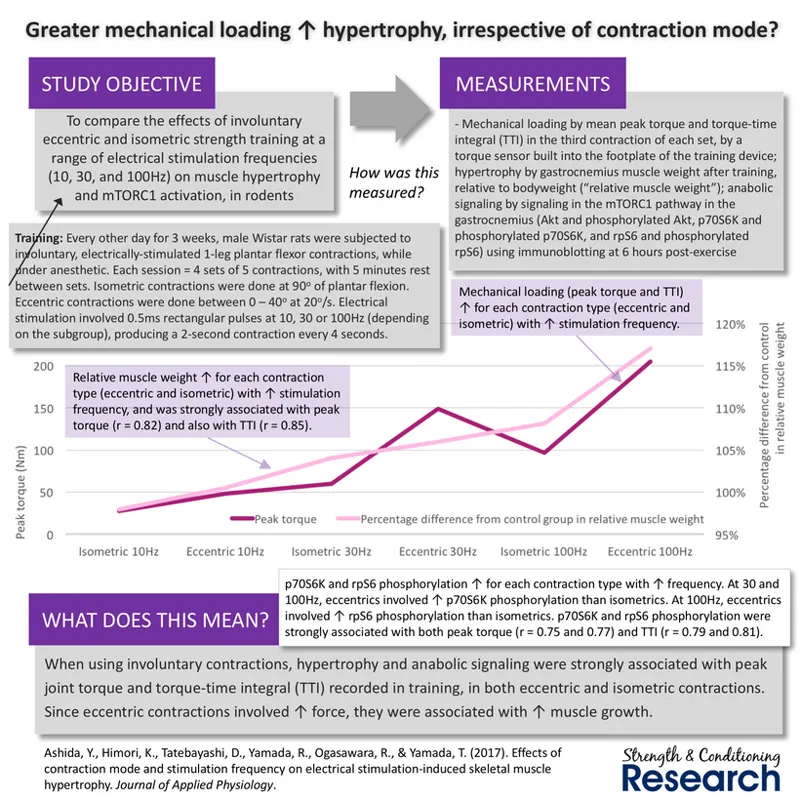
Animal studies involving electrically-stimulated, maximal contractions and either isometric contractions or slow eccentric contractions have reported that muscle growth is associated with TUT in these situations.
.
Conclusions
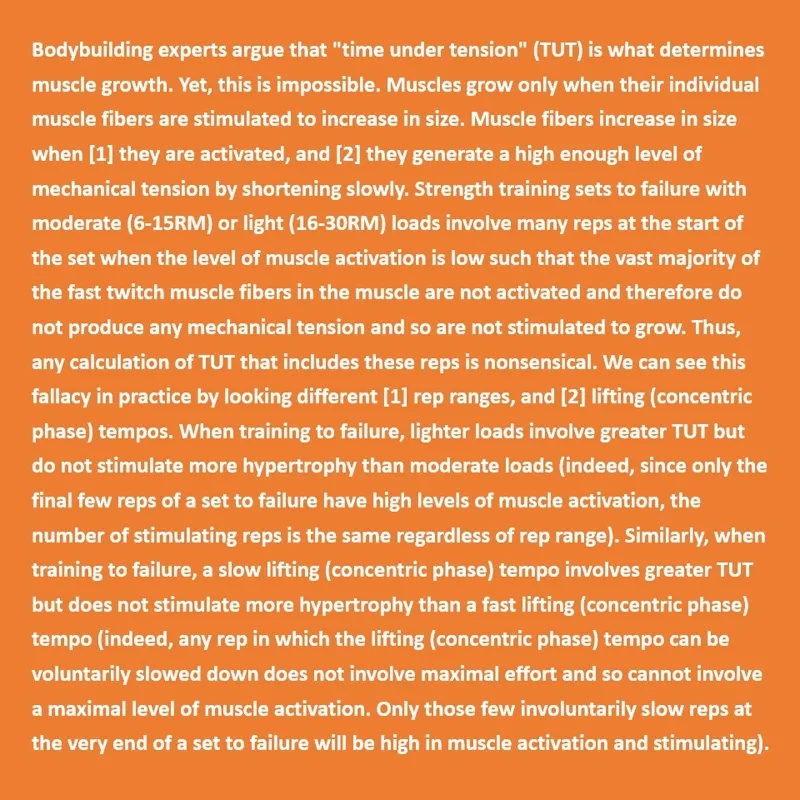
Bodybuilding experts argue that "time under tension" (TUT) is what determines muscle growth. Yet, this is impossible. Muscles grow only when their individual muscle fibers are stimulated to increase in size. Muscle fibers increase in size when [1] they are activated, and [2] they generate a high enough level of mechanical tension by shortening slowly. Strength training sets to failure with moderate (6-15RM) or light (16-30RM) loads involve many reps at the start of the set when the level of muscle activation is low such that the vast majority of the fast twitch muscle fibers in the muscle are not activated and therefore do not produce any mechanical tension and so are not stimulated to grow. Thus, any calculation of TUT that includes these reps is nonsensical. We can see this fallacy in practice by looking different [1] rep ranges, and [2] lifting (concentric phase) tempos. When training to failure, lighter loads involve greater TUT but do not stimulate more hypertrophy than moderate loads (indeed, since only the final few reps of a set to failure have high levels of muscle activation, the number of stimulating reps is the same regardless of rep range). Similarly, when training to failure, a slow lifting (concentric phase) tempo involves greater TUT but does not stimulate more hypertrophy than a fast lifting (concentric phase) tempo (indeed, any rep in which the lifting (concentric phase) tempo can be voluntarily slowed down does not involve maximal effort and so cannot involve a maximal level of muscle activation. Only those few involuntarily slow reps at the very end of a set to failure will be high in muscle activation and stimulating).


Comments (1)
Chris, in a set where maximum velocity is used from the start, say in the 10-15 range, is Hennemans size principle reversed? So, the fast, high threshold units drop out first?